Search
Abnova
PSMB8 Polyclonal Antibody, MaxPab™
{{$productOrderCtrl.translations['antibody.pdp.commerceCard.promotion.promotions']}}
{{$productOrderCtrl.translations['antibody.pdp.commerceCard.promotion.viewpromo']}}
{{$productOrderCtrl.translations['antibody.pdp.commerceCard.promotion.promocode']}}: {{promo.promoCode}} {{promo.promoTitle}} {{promo.promoDescription}}. {{$productOrderCtrl.translations['antibody.pdp.commerceCard.promotion.learnmore']}}
Additional Information:
{{banner.description}}
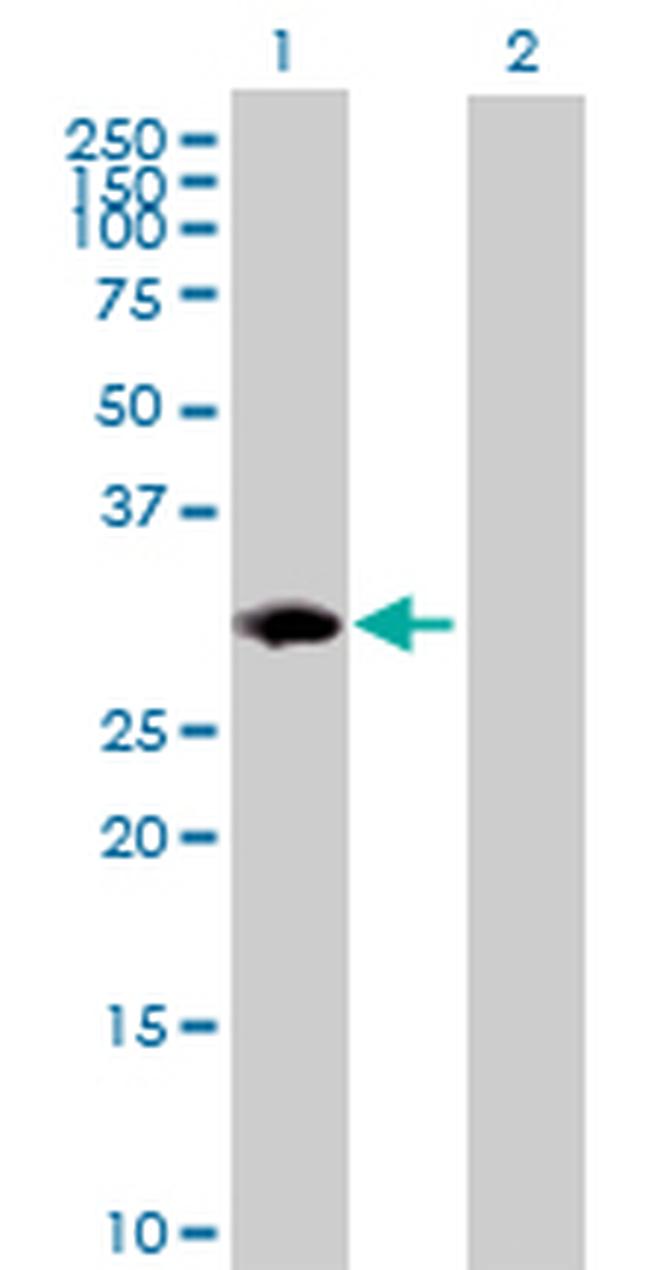
图: 1 / 3
PSMB8 Antibody (H00005696-D01P) in WB
Western Blot analysis of PSMB8 expression in transfected 293T cell line (H00005696-T01) by PSMB8 MaxPab polyclonal antibody.
Lane 1: PSMB8 transfected lysate(29.80 KDa).
Lane 2: Non-transfected lysate.
Lane 1: PSMB8 transfected lysate(29.80 KDa).
Lane 2: Non-transfected lysate.


产品信息
H00005696-D01P
产品规格
宿主/亚型
Rabbit
/ IgG
分类
Polyclonal
类型
Antibody
抗原
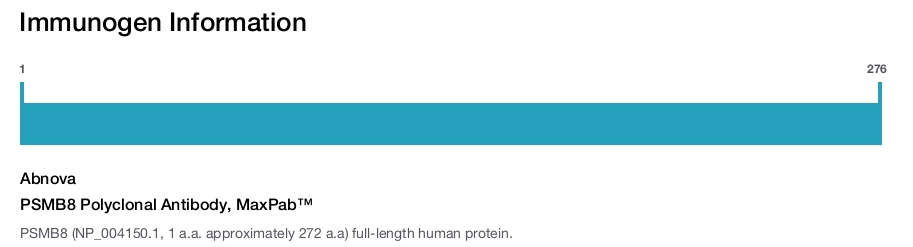
PSMB8 (NP_004150.1, 1 a.a. approximately 272 a.a) full-length human protein.
偶联物
形式
Liquid
浓度
See Label
规格
100 µg
保存条件
-20°C, Avoid Freeze/Thaw Cycles
运输条件
Ambient (domestic); Wet ice (international)
产品详细信息
Sequence of this protein is as follows: MLIGTPTPRD TTPSSWLTSS LLVEAAPLDD TTLPTPVSSG CPGLEPTEFF QSLGGDGERN VQIEMAHGTT TLAFKFQHGV IAAVDSRASA GSYISALRVN KVIEINPYLL GTMSGCAADC QYWERLLAKE CRLYYLRNGE RISVSAASKL LSNMMCQYRG MGLSMGSMIC GWDKKGPGLY YVDEHGTRLS GNMFSTGSGN TYAYGVMDSG YRPNLSPEEA YDLGRRAIAY ATHRDSYSGG VVNMYHMKED GWVKVESTDV SDLLHQYREA NQ
靶标信息
The proteasome is a multicatalytic proteinase complex with a highly ordered ring-shaped 20S core structure. The core structure is composed of 4 rings of 28 non-identical subunits; 2 rings are composed of 7 alpha subunits and 2 rings are composed of 7 beta subunits. Proteasomes are distributed throughout eukaryotic cells at a high concentration and cleave peptides in an ATP/ubiquitin-dependent process in a non-lysosomal pathway. An essential function of a modified proteasome, the immunoproteasome, is the processing of class I MHC peptides. This gene encodes a member of the proteasome B-type family, also known as the T1B family, that is a 20S core beta subunit. This gene is located in the class II region of the MHC (major histocompatibility complex). Expression of this gene is induced by gamma interferon and this gene product replaces catalytic subunit 3 (proteasome beta 5 subunit) in the immunoproteasome. Proteolytic processing is required to generate a mature subunit. Two alternative transcripts encoding two isoforms have been identified; both isoforms are processed to yield the same mature subunit.
仅用于科研。不用于诊断过程。未经明确授权不得转售。
篇参考文献 (0)
您是否在文献中引用过该产品?请点击下方按钮邮件告知我们。
Disclaimer

Clicking the images or links will redirect you to a website hosted by BenchSci that provides third-party scientific content. Neither the content nor the BenchSci technology and processes for selection have been evaluated by us; we are providing them as-is and without warranty of any kind, including for use or application of the Thermo Fisher Scientific products presented.

