Search
Proteintech
PSMD11 Polyclonal Antibody
{{$productOrderCtrl.translations['antibody.pdp.commerceCard.promotion.promotions']}}
{{$productOrderCtrl.translations['antibody.pdp.commerceCard.promotion.viewpromo']}}
{{$productOrderCtrl.translations['antibody.pdp.commerceCard.promotion.promocode']}}: {{promo.promoCode}} {{promo.promoTitle}} {{promo.promoDescription}}. {{$productOrderCtrl.translations['antibody.pdp.commerceCard.promotion.learnmore']}}
Additional Information:
{{banner.description}}
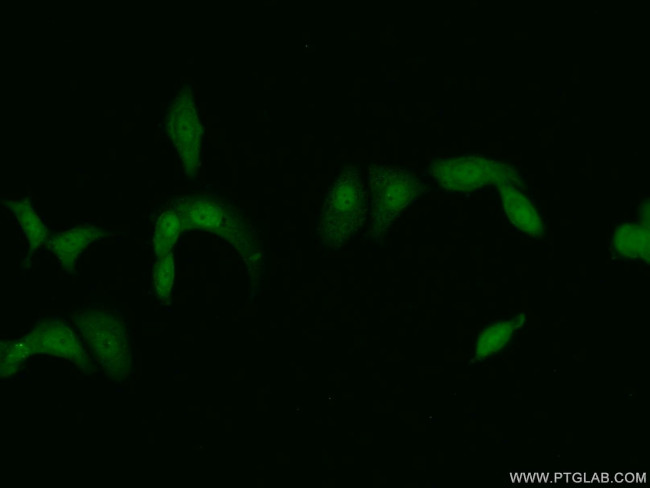

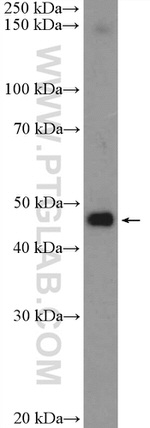
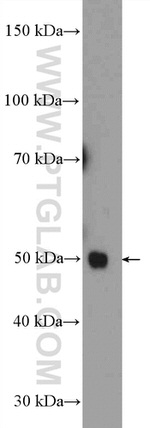
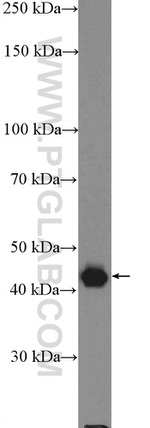
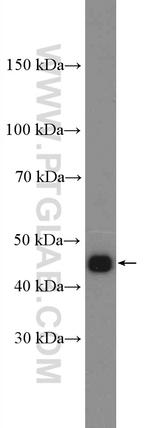
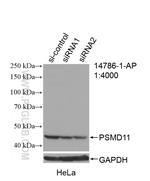
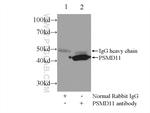


产品信息
14786-1-AP
应用
建议稀释比
已发表文章
产品规格
种属反应
Human,
Mouse,
Rat
已发表种属
Human
宿主/亚型
Rabbit
/ IgG
分类
Polyclonal
类型
Antibody
抗原
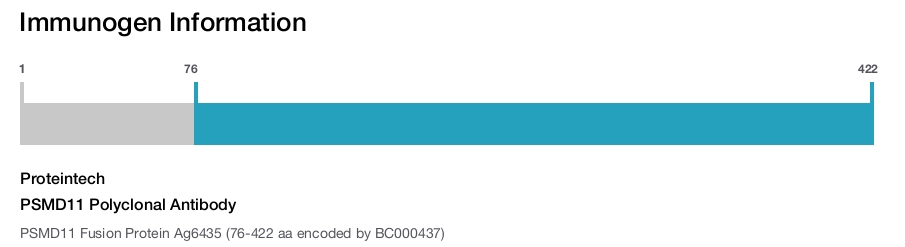
PSMD11 Fusion Protein Ag6435 (76-422 aa encoded by BC000437)
偶联物
形式
Liquid
浓度
0.23 mg/mL
规格
34.5 µg
纯化类型
Antigen affinity chromatography
保存液
PBS, pH 7.3, with 50% glycerol
内含物
0.02% sodium azide
保存条件
-20°C
运输条件
Wet ice (domestic); Dry ice (international)
产品详细信息
Immunogen sequence: FLNSISKAK AARLVRSLLD LFLDMEAATG QEVELCLECI EWAKSEKRTF LRQALEARLV SLYFDTKRYQ EALHLGSQLL RELKKMDDKA LLVEVQLLES KTYHALSNLP KARAALTSAR TTANAIYCPP KLQATLDMQS GIIHAAEEKD WKTAYSYFYE AFEGYDSIDS PKAITSLKYM LLCKIMLNTP EDVQALVSGK LALRYAGRQT EALKCVAQAS KNRSLADFEK ALTDYRAELR DDPIISTHLA KLYDNLLEQN LIRVIEPFSR VQIEHISSLI KLSKADVERK LSQMILDKKF HGILDQGEGV LIIFDEPPVD KTYEAALETI QNMSKVVDSL YNKAKKLT (76-422 aa encoded by BC000437 )
靶标信息
The 26S proteasome (PSMD11) is a multicatalytic proteinase complex with a highly ordered structure composed of 2 complexes, a 20S core and a 19S regulator. The 20S core is composed of 4 rings of 28 non-identical subunits; 2 rings are composed of 7 alpha subunits and 2 rings are composed of 7 beta subunits. The 19S regulator is composed of a base, which contains 6 ATPase subunits and 2 non-ATPase subunits, and a lid, which contains up to 10 non-ATPase subunits. Proteasomes are distributed throughout eukaryotic cells at a high concentration and cleave peptides in an ATP/ubiquitin-dependent process in a non-lysosomal pathway. An essential function of a modified proteasome, the immunoproteasome, is the processing of class I MHC peptides. The protein is a non-ATPase subunit of the 19S regulator.
仅用于科研。不用于诊断过程。未经明确授权不得转售。
生物信息学
蛋白别名: 26S proteasome non-ATPase regulatory subunit 11; 26S proteasome regulatory subunit 9; 26S proteasome regulatory subunit p44.5; 26S proteasome regulatory subunit RPN6; 26S proteasome regulatory subunit S9; proteasome (prosome, macropain) 26S subunit, non-ATPase, 11; unnamed protein product
基因别名: 1700089D09Rik; 1810019E17Rik; 2610024G20Rik; 2810055C24Rik; C78232; P44.5; PSMD11; Rpn6; S9
UniProt ID: (Human) O00231, (Rat) F1LMZ8, (Mouse) Q8BG32
Entrez Gene ID: (Human) 5717, (Rat) 303353, (Mouse) 69077
Disclaimer

Clicking the images or links will redirect you to a website hosted by BenchSci that provides third-party scientific content. Neither the content nor the BenchSci technology and processes for selection have been evaluated by us; we are providing them as-is and without warranty of any kind, including for use or application of the Thermo Fisher Scientific products presented.

