Search
Invitrogen
Pan Actin Recombinant Rabbit Monoclonal Antibody (F3C6)
{{$productOrderCtrl.translations['antibody.pdp.commerceCard.promotion.promotions']}}
{{$productOrderCtrl.translations['antibody.pdp.commerceCard.promotion.promocode']}}: {{promo.promoCode}} {{promo.promoTitle}} {{promo.promoDescription}}. {{$productOrderCtrl.translations['antibody.pdp.commerceCard.promotion.learnmore']}}
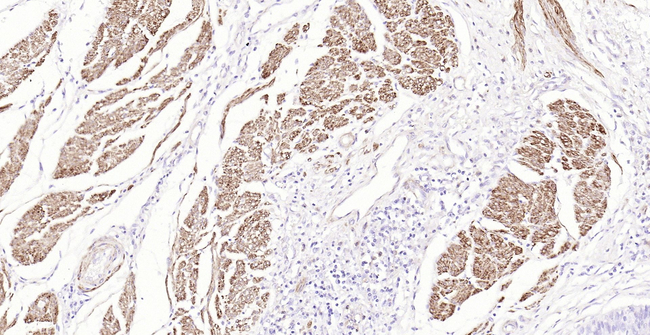
图: 1 / 6
Pan Actin Antibody (MA572137) in IHC (P)
Immunohistochemistry analysis of Pan Actin on paraffin-embedded Human Colon Cancer tissue. Antigen retrieval by boiling in sodium citrate buffer (pH 6.0) for 15 min. Block endogenous peroxidase by 3% hydrogen peroxide for 20 min. Blocking buffer (normal goat serum) at 37°C for 30 min. Samples were incubated with Pan Actin Recombinant Monoclonal (Product # MA572137) using a dilution at 1:200 overnight at 4°C... View More
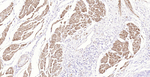
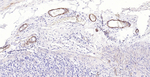
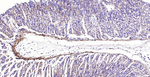
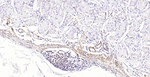
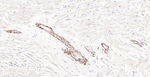
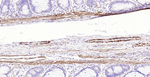
Please note: We are reviewing Western blot images included in the antibody testing data in our catalog, including those provided by third parties. Unless expressly labeled or annotated as “raw-unedited”, Western blot images included in the antibody testing data in our catalog may have been edited, optimized or otherwise adjusted for presentation.


产品信息
MA572137
应用
建议稀释比
已发表文章
产品规格
种属反应
Human,
Mouse,
Rat
宿主/亚型
Rabbit
/ IgG
Expression System
HEK293 cells
分类
Recombinant Monoclonal
类型
Antibody
克隆号
F3C6
抗原
Synthetic Peptide.
偶联物
Unconjugated
Unconjugated
Unconjugated
形式
Liquid
浓度
1 mg/mL
规格
100 µg
纯化类型
Protein A
保存液
TBS, pH 7.4, with 50% glycerol, 1% BSA
内含物
0.02% ProClin 300
保存条件
-20°C, Avoid Freeze/Thaw Cycles
运输条件
Ambient (domestic); Wet ice (international)
靶标信息
Actin is a highly conserved cytoskeletal protein essential for maintaining cell shape, enabling motility, supporting intracellular transport, and driving cell division. It exists in two forms: globular actin (G-actin), a monomer that polymerizes, and filamentous actin (F-actin), the polymerized form that assembles into dynamic microfilaments providing structural support and mechanical force. Actin isoforms are encoded by multiple genes and show slight sequence variations that support tissue-specific functions. In humans, major isoforms include actin-actin in muscle cells, where it enables contraction; beta-actin, which is ubiquitously expressed and critical for general cellular structure and movement; and gamma-actin, found mainly in non-muscle cells and involved in cytoskeletal organization. Pan actin antibodies recognize conserved epitopes shared across all major isoforms, allowing broad detection across tissues and species. They are widely used in Western blotting as loading controls to verify equal protein loading, in immunofluorescence to visualize actin organization, and in ELISA to quantify actin levels. Because actin remodeling regulates cell migration, adhesion, and signaling, pan actin detection is essential for studying cytoskeletal dynamics and diseases such as cancer, cardiovascular disorders, and neurodegeneration.
仅用于科研。不用于诊断过程。未经明确授权不得转售。
篇参考文献 (0)
您是否在文献中引用过该产品?请点击下方按钮邮件告知我们。
Disclaimer

Clicking the images or links will redirect you to a website hosted by BenchSci that provides third-party scientific content. Neither the content nor the BenchSci technology and processes for selection have been evaluated by us; we are providing them as-is and without warranty of any kind, including for use or application of the Thermo Fisher Scientific products presented.

