Search
Invitrogen
Phospho-AANAT (Ser206) Polyclonal Antibody
{{$productOrderCtrl.translations['antibody.pdp.commerceCard.promotion.promotions']}}
{{$productOrderCtrl.translations['antibody.pdp.commerceCard.promotion.promocode']}}: {{promo.promoCode}} {{promo.promoTitle}} {{promo.promoDescription}}. {{$productOrderCtrl.translations['antibody.pdp.commerceCard.promotion.learnmore']}}
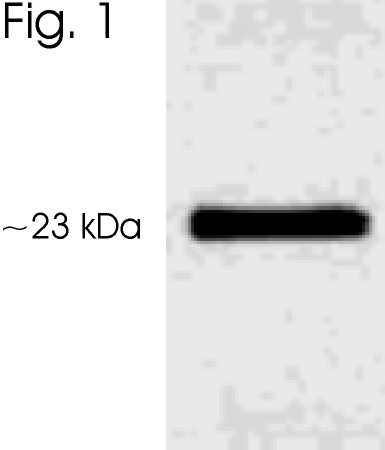
Please note: We are reviewing Western blot images included in the antibody testing data in our catalog, including those provided by third parties. Unless expressly labeled or annotated as “raw-unedited”, Western blot images included in the antibody testing data in our catalog may have been edited, optimized or otherwise adjusted for presentation.

产品信息
PA1-763
产品规格
宿主/亚型
Rabbit
/ IgG
分类
Polyclonal
类型
Antibody
抗原
Synthetic peptide: C(195) H T F L R R N S(p) G C(205)
偶联物
Unconjugated
Unconjugated
Unconjugated
形式
Liquid
浓度
1 mg/mL
规格
50 µg
保存条件
-20°C, Avoid Freeze/Thaw Cycles
运输条件
Wet ice
RRID
产品详细信息
PA1-763 detects phospho serotonin N-acetyltransferase (AA-NAT) from rat tissues.
PA1-763 has been successfully used in Western blot procedures. By Western blot, this antibody detects an ~23 kDa protein representing phosphorylated AA-NAT from rat pineal gland whole protein extract.
PA1-763 immunizing phosphopeptide (Cat. # PEP-066) corresponds to carboxy-terminal amino acid residues 198-208 of rat AA-NAT. Total anti-carboxy-terminal AA-NAT-specific IgG (Cat. # PA1-762) was affinity purified on resin-coupled non-phosphopeptide (Cat. # PEP-065). Phospho-specific carboxy-terminal IgG (Cat. # PA1-763) was subsequently isolated on resin-coupled phosphopeptide (Cat. # PEP-066). This sequence is completely conserved between rat and mouse AA-NAT protein.
靶标信息
Arylalkylamine N-Acetyltransferase (AANAT) is the penultimate enzyme is melatonin synthesis. Hormonal melatonin has been implicated in sleep and circadian clock function. Large changes in the abundance of AANAT are believed to be responsible for the large day/night rhythms in melatonin synthesis in the pineal gland and retina. Most research shows that AANAT activity is regulated by controlling the steady-state levels of the protein. Recent research, however, suggests that another mechanism may also play a role in controlling melatonin production without altering AANAT protein and activity. This mechanism may explain the sudden physiological increase in circulating melatonin observed at the onset of the dark period in humans.
仅用于科研。不用于诊断过程。未经明确授权不得转售。
篇参考文献 (0)
您是否在文献中引用过该产品?请点击下方按钮邮件告知我们。
Disclaimer

Clicking the images or links will redirect you to a website hosted by BenchSci that provides third-party scientific content. Neither the content nor the BenchSci technology and processes for selection have been evaluated by us; we are providing them as-is and without warranty of any kind, including for use or application of the Thermo Fisher Scientific products presented.

