Search
Invitrogen
Phospho-CREB (Ser133) Polyclonal Antibody
{{$productOrderCtrl.translations['antibody.pdp.commerceCard.promotion.promotions']}}
{{$productOrderCtrl.translations['antibody.pdp.commerceCard.promotion.viewpromo']}}
{{$productOrderCtrl.translations['antibody.pdp.commerceCard.promotion.promocode']}}: {{promo.promoCode}} {{promo.promoTitle}} {{promo.promoDescription}}. {{$productOrderCtrl.translations['antibody.pdp.commerceCard.promotion.learnmore']}}
Additional Information:
{{banner.description}}
产品信息
PA1-851B
应用
建议稀释比
已发表文章
产品规格
已发表种属
Rat
宿主/亚型
Rabbit
/ IgG
分类
Polyclonal
类型
Antibody
抗原
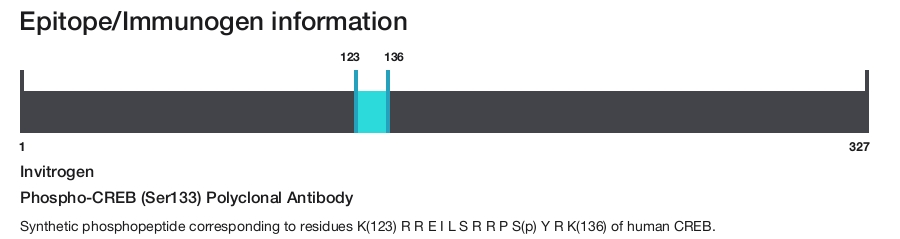
Synthetic phosphopeptide corresponding to residues K(123) R R E I L S R R P S(p) Y R K(136) of human CREB.
偶联物
Unconjugated
Unconjugated
Unconjugated
形式
Liquid
浓度
0.25 mg/mL
规格
25 µg
保存条件
-20°C, Avoid Freeze/Thaw Cycles
运输条件
Wet ice
RRID
产品详细信息
PA1-851B detects the phosphorylated form of cyclic-AMP response element binding protein (CREB) from rat and human cells. This antibody does not detect the unphosphorylated form of CREB.
PA1-851B has been successfully used in Western blot procedures. By Western blot, this antibody detects an ~43 kDa protein representing phospho-CREB from forskolin treated PC12 cell lysate.
The PA1-851B immunogen is a synthetic phospeptide corresponding to residues K(123) R R E I L S R R P S(p) Y R K(136) of human CREB. This sequence is completely conserved between human, bovine, canine, mouse, pig, sheep, and rat CREB protein. The PA1-851B immunizing peptide (Cat. # PEP-143) is available for use in neutralization and control experiments.
靶标信息
CREB (Cyclic AMP response element binding protein) is a 43 kDa basic/leucine zipper transcription factor that binds the cyclic AMP response element (CRE) and activates transcription in response to a variety of extracellular signals including neurotransmitters, hormones, membrane depolarization, and growth and neurotrophic factors. Activation of CREB is dependent upon the phosphorylation of serine 133. Phosphorylation of CREB occurs via p44/42 MAP kinase and p90RSK, and via p38 MAP kinase and MSK1. Although CREB will bind DNA independent of its phosphorylation state, only the phosphorylated form is competent as a transcription factor. CREB binding protein (CBP), a transcriptional coactivator that directly interacts with CREB, binds to CREB in the region of serine 133. CREB is involved in different cellular processes including the synchronization of circadian rhythmicity, differentiation of adipose cells, and learning and memory. In humans, the gene is located on the q arm of chromosome 2. Diseases associated with CREB dysfunction include Alzheimer's Disease, histiocytoma and soft tissue melanoma.
仅用于科研。不用于诊断过程。未经明确授权不得转售。
Disclaimer

Clicking the images or links will redirect you to a website hosted by BenchSci that provides third-party scientific content. Neither the content nor the BenchSci technology and processes for selection have been evaluated by us; we are providing them as-is and without warranty of any kind, including for use or application of the Thermo Fisher Scientific products presented.

