Search
Invitrogen
Phospho-LIMK1/LIMK2 (Ser323, Ser314) Polyclonal Antibody
{{$productOrderCtrl.translations['antibody.pdp.commerceCard.promotion.promotions']}}
{{$productOrderCtrl.translations['antibody.pdp.commerceCard.promotion.promocode']}}: {{promo.promoCode}} {{promo.promoTitle}} {{promo.promoDescription}}. {{$productOrderCtrl.translations['antibody.pdp.commerceCard.promotion.learnmore']}}
{{$ctrl.translations['antibody.pdp.skuNotes.additionalInformation']}}:
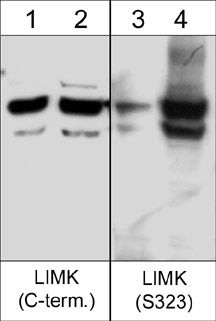
图: 1 / 1
Phospho-LIMK1/LIMK2 (Ser323, Ser314) Antibody (PA5-143714) in WB
Western blot of Phospho-LIMK1/LIMK2 (Ser323, Ser314) in human A431 cells untreated (lanes 1 & 3) or treated (lanes 2 & 4)with calyculin A (100 nM for 30 minutes). The blots were probed with anti-LIMK1 (C-terminus) (lanes 1 & 2) or Phospho-LIMK1/LIMK2 (Ser323, Ser314) polyclonal antibody (Product # PA5-143714) (lanes 3 & 4).
Please note: We are reviewing Western blot images included in the antibody testing data in our catalog, including those provided by third parties. Unless expressly labeled or annotated as “raw-unedited”, Western blot images included in the antibody testing data in our catalog may have been edited, optimized or otherwise adjusted for presentation.

产品信息
PA5-143714
产品规格
种属反应
Human,
Mouse,
Rat
宿主/亚型
Rabbit
/ IgG
分类
Polyclonal
类型
Antibody
抗原
LIMK1 (Ser-323) synthetic peptide (coupled to carrier protein) corresponding to amino acids surrounding serine 323 in human LIMK1. This sequence is conserved in rat and mouse LIMK1, and has high homology to Ser-314 in human LIMK2.
偶联物
Unconjugated
Unconjugated
Unconjugated
形式
Liquid
浓度
1 mg/mL
规格
100 µg
纯化类型
Antigen affinity chromatography
保存液
PBS with 1mg/mL BSA, 50% glycerol
内含物
0.05% sodium azide
保存条件
-20°C, Avoid Freeze/Thaw Cycles
运输条件
Ambient (domestic); Wet ice (international)
RRID
产品详细信息
This antibody was cross-adsorbed to unphosphorylated LIMK1 (Ser-323) peptide then affinity purified using LIMK1 (Ser-323) peptide (without carrier). The antibody detects a protein with the same mobility as anti-LIMK1 (C-terminus, LP1831) in human A431 cells treated with calyculin A. This band is weak in control cells and is not detected after lambda phosphatase treatment.
靶标信息
Proteins containing LIM motifs are typically involved in cell fate determination and growth control. A family of proteins designated LIM kinases, including LIMK-1 and LIMK-2, has been identified. LIMK-1 has been shown to regulate the stabilization of F-Actin structures and cofilin activity, indicating that LIMK-1 plays a role in a signaling pathway involved in the regulation of cell motility and morphogenesis. LIMK-1 inhibits neuronal differentiation of PC12 cells, and is thought to act by interfering with events downstream of MAPK activation. Expression patterns of LIMK-1 and LIMK-2 suggest that these proteins may have different functions during development. A truncated form of LIMK-2 has been identified in adult testis that is thought to arise from an alternative initiation exon.
仅用于科研。不用于诊断过程。未经明确授权不得转售。
篇参考文献 (0)
您是否在文献中引用过该产品?请点击下方按钮邮件告知我们。
生物信息学
蛋白别名: lim kinase 1; LIM kinase 2; LIM motif-containing protein kinase; LIM motif-containing protein kinase 1; LIM motif-containing protein kinase 2; LIM-domain containing, protein kinase; LIM-domain containing, protein kinase 1; LIMK 2; LIMK-1; LIMK-2; LIMK2; LIMK2b; unnamed protein product
基因别名: KIZ-1; LIMK; LIMK-1; Limk-2; Limk2b; Link2; whe
UniProt ID: (Human) P53667, (Human) P53671, (Mouse) P53668, (Mouse) O54785, (Rat) P53670
Entrez Gene ID: (Human) 3984, (Human) 3985, (Mouse) 16885, (Rat) 65172, (Mouse) 16886, (Rat) 29524
protein phosphorylation
actin cytoskeleton organization
positive regulation of actin filament bundle assembly
positive regulation of axon extension
positive regulation of stress fiber assembly
regulation of modification of postsynaptic actin cytoskeleton
spermatogenesis
astral microtubule organization
establishment of vesicle localization
head development
cornea development in camera-type eye
positive regulation of protein localization to nucleus
negative regulation of cilium assembly
signal transduction
Rho protein signal transduction
nervous system development
Fc-gamma receptor signaling pathway involved in phagocytosis
spermatid development
Disclaimer

Clicking the images or links will redirect you to a website hosted by BenchSci that provides third-party scientific content. Neither the content nor the BenchSci technology and processes for selection have been evaluated by us; we are providing them as-is and without warranty of any kind, including for use or application of the Thermo Fisher Scientific products presented.

