Search
Disclaimer

Clicking the images or links will redirect you to a website hosted by BenchSci that provides third-party scientific content. Neither the content nor the BenchSci technology and processes for selection have been evaluated by us; we are providing them as-is and without warranty of any kind, including for use or application of the Thermo Fisher Scientific products presented.
Invitrogen
Phospho-beta Arrestin 1 (Ser412) Polyclonal Antibody
{{$productOrderCtrl.translations['antibody.pdp.commerceCard.promotion.promotions']}}
{{$productOrderCtrl.translations['antibody.pdp.commerceCard.promotion.viewpromo']}}
{{$productOrderCtrl.translations['antibody.pdp.commerceCard.promotion.promocode']}}: {{promo.promoCode}} {{promo.promoTitle}} {{promo.promoDescription}}. {{$productOrderCtrl.translations['antibody.pdp.commerceCard.promotion.learnmore']}}
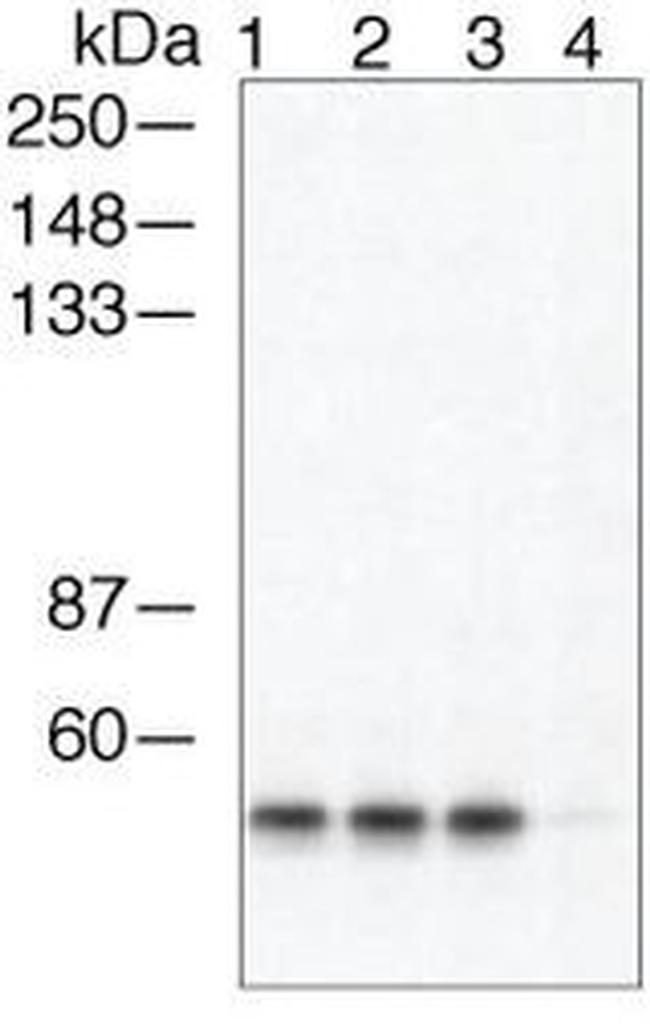
图: 1 / 1
Phospho-beta Arrestin 1 (Ser412) Antibody (PA1-26637) in WB
Western blot analysis of Phospho-beta-1 Arrestin pSer412 in PC12 cell extracts, untreated (1, 3) or treated (2, 4) with PP2A phosphatase. Samples were probed with a Phospho-beta-1 Arrestin pSer412 polyclonal antibody (Product # PA1-26637) (lanes 3, 4) and a pan non-phospho antibody (lanes 1, 2).

产品信息
PA1-26637
产品规格
宿主/亚型
Rabbit
/ IgG
分类
Polyclonal
类型
Antibody
抗原
Synthetic phosphopeptide corresponding to a portion of rat beta Arrestin 1 containing serine 412.
偶联物
形式
Liquid
浓度
0.75 mg/mL
保存条件
-80°C, Avoid Freeze/Thaw Cycles
运输条件
Wet ice
RRID
产品详细信息
PA1-26637 detects beta 1 Arrestin (phospho S412) from mouse and rat samples. PA1-26637 is expected to cross react with bovine (77% conserved) and human (77% conserved) due to sequence homology.
PA1-26637 has been successfully used in Western blot procedures.
The PA1-26637 immunogen is a synthetic phosphopeptide corresponding to a portion of rat beta Arrestin 1 containing serine 412.
靶标信息
Beta Arrestin 1 is a member of a family of proteins widely expressed but especially abundant in the central nervous system. Serving as an adaptor or scaffold molecule, beta Arrestin 1 is essential for mitogenic signaling and mediates agonist-dependent desensitization and internalization of Gprotein-coupled receptors (GPCRs, e.g., beta 2-adrenergic receptor). After binding to their ligand and interacting with heterotrimeric G proteins, GPCRs are phosphorylated by G-protein receptor kinases (GRKs) on serine residues. Beta Arrestin 1 in the cytosol is phosphorylated by ERK1 and 2 on serine412 in a negative feedback mechanism and binds to the phosphorylated receptors at the plasma membrane. Serine 412 is then dephosphorylated and the GPCRs are internalized, leading to activation of the Ras, Raf, ERK1 and 2 signaling pathway.
仅用于科研。不用于诊断过程。未经明确授权不得转售。
篇参考文献 (0)
您是否在文献中引用过该产品?请点击下方按钮邮件告知我们。

