Search
Invitrogen
Phospho-beta Catenin/gamma Catenin (Tyr333, Tyr324) Polyclonal Antibody
{{$productOrderCtrl.translations['antibody.pdp.commerceCard.promotion.promotions']}}
{{$productOrderCtrl.translations['antibody.pdp.commerceCard.promotion.promocode']}}: {{promo.promoCode}} {{promo.promoTitle}} {{promo.promoDescription}}. {{$productOrderCtrl.translations['antibody.pdp.commerceCard.promotion.learnmore']}}
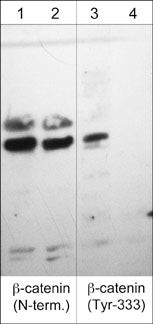
图: 1 / 1
Phospho-beta Catenin/gamma Catenin (Tyr333, Tyr324) Antibody (PA5-143665) in WB
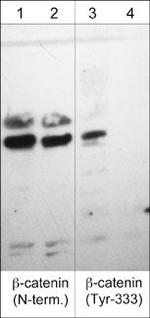
Western blot of Phospho-beta Catenin/gamma Catenin (Tyr333, Tyr324) in A431 cells stimulated with pervanadate (1 mM) for 30 minutes (lanes 1 & 3) then treated with alkaline phosphatase (lanes 2 & 4). The blot was probed with anti-beta-Catenin (lanes 1 & 2) and Phospho-beta Catenin/gamma Catenin (Tyr333, Tyr324) polyclonal antibody (Product # PA5-143665) (lanes 3 & 4).
Please note: We are reviewing Western blot images included in the antibody testing data in our catalog, including those provided by third parties. Unless expressly labeled or annotated as “raw-unedited”, Western blot images included in the antibody testing data in our catalog may have been edited, optimized or otherwise adjusted for presentation.

产品信息
PA5-143665
产品规格
种属反应
Human,
Mouse,
Rat
宿主/亚型
Rabbit
/ IgG
分类
Polyclonal
类型
Antibody
抗原
Phospho-beta-Catenin (Tyr-333) synthetic peptide (coupled to KLH) that includes amino acid residues around tyrosine 333 of human beta-Catenin. This peptide sequence is highly conserved in rat and mouse beta-Catenin, and has high homology to the conserved site in gamma-Catenin (Tyr-324).
偶联物
Unconjugated
Unconjugated
Unconjugated
形式
Liquid
浓度
1 mg/mL
规格
100 µg
纯化类型
Antigen affinity chromatography
保存液
PBS with 1mg/mL BSA, 50% glycerol
内含物
0.05% sodium azide
保存条件
-20°C, Avoid Freeze/Thaw Cycles
运输条件
Ambient (domestic); Wet ice (international)
RRID
产品详细信息
The antibody detects a 92kDa* protein corresponding to the molecular mass of beta-Catenin on SDS-PAGE immunoblots of human A431 cells treated with pervanadate, but not in control cells. In addition, the pervanadate induced reactivity is not observed after alkaline phosphatase treatment.
靶标信息
beta-Catenin is a 92 kDa protein that binds to the cytoplasmic tail of E-Cadherin. The cadherins, transmembrane adhesion molecules, are found with catenins at adherens junctions. Deletions in the cytoplasmic domain of E-Cadherin eliminate catenin binding and result in a loss of cell adhesion. Tyrosine phosphorylation of beta-Catenin can regulate its interaction with critical components of adherens junctions. Both Fer and Fyn kinases phosphorylate tyrosine 142 in vitro. Overexpression of these kinases in epithelial cells disrupts interactions between alpha- and beta-Catenins. The phosphorylation of tyrosine 142 may act as a switch from the transcriptional to the adhesive role of beta-Catenin. Src family kinases can also phosphorylate tyrosine 86 and 654 in beta-Catenin. The Tyr-654 phosphorylation regulates beta-Catenin binding to E-cadherin. Thus, site-specific tyrosine phosphorylation of beta-Catenin may regulate protein-protein interactions leading to changes in cell adhesion.
仅用于科研。不用于诊断过程。未经明确授权不得转售。
篇参考文献 (0)
您是否在文献中引用过该产品?请点击下方按钮邮件告知我们。
生物信息学
蛋白别名: beta-catenin; cadherin associated protein beta 1; catenin (cadherin associated protein), beta 1; catenin (cadherin associated protein), beta 1, 88kDa; catenin (cadherin-associated protein), beta 1, 88kDa; Catenin beta1; CTNNB1; unnamed protein product
基因别名: armadillo; Bfc; Catnb; CTNNB; EVR7; Mesc; MRD19; NEDSDV
UniProt ID: (Human) P35222, (Rat) Q9WU82, (Mouse) Q02248
Entrez Gene ID: (Human) 1499, (Rat) 84353, (Mouse) 12387
transcription cofactor binding
transcription corepressor binding
chromatin binding
transcription coactivator activity
receptor binding
protein binding
ligand-dependent nuclear receptor binding
enzyme binding
kinase binding
protein kinase binding
phosphatase binding
protein phosphatase binding
estrogen receptor binding
ubiquitin protein ligase binding
ion channel binding
alpha-catenin binding
cadherin binding
SMAD binding
RNA polymerase II sequence-specific DNA binding transcription factor binding
I-SMAD binding
disordered domain specific binding
DNA-binding transcription factor binding
histone methyltransferase binding
nucleic acid binding
ionotropic glutamate receptor binding
macromolecular complex binding
nitric-oxide synthase binding
delta-catenin binding
molecular function activator activity
negative regulation of transcription from RNA polymerase II promoter
protein polyubiquitination
embryonic axis specification
cell morphogenesis
skeletal system development
angiogenesis
patterning of blood vessels
vasculogenesis
osteoblast differentiation
branching involved in ureteric bud morphogenesis
in utero embryonic development
gastrulation with mouth forming second
endoderm formation
cell fate specification
cell fate determination
endodermal cell fate commitment
neuron migration
kidney development
neural plate development
liver development
tissue homeostasis
vasculature development
positive regulation of neuroblast proliferation
positive regulation of mesenchymal cell proliferation
lens morphogenesis in camera-type eye
outflow tract morphogenesis
regulation of secondary heart field cardioblast proliferation
metanephros morphogenesis
negative regulation of mesenchymal to epithelial transition involved in metanephros morphogenesis
regulation of transcription from RNA polymerase II promoter
cell adhesion
cell-matrix adhesion
epidermal growth factor receptor signaling pathway
chemical synaptic transmission
ectoderm development
glial cell fate determination
midgut development
heart development
protein localization
cell proliferation
positive regulation of cell proliferation
negative regulation of cell proliferation
response to xenobiotic stimulus
response to hormone
anterior/posterior axis specification
dorsal/ventral axis specification
dorsal/ventral pattern formation
proximal/distal pattern formation
gene expression
regulation of gene expression
positive regulation of gene expression
negative regulation of gene expression
regulation of epithelial to mesenchymal transition
positive regulation of epithelial to mesenchymal transition
positive regulation of heparan sulfate proteoglycan biosynthetic process
Schwann cell proliferation
response to activity
morphogenesis of embryonic epithelium
dendrite development
negative regulation of angiogenesis
layer formation in cerebral cortex
hypothalamus development
central nervous system vasculogenesis
hair cycle process
hemopoiesis
cell differentiation
neuron differentiation
T cell differentiation
osteoclast differentiation
lung development
male genitalia development
regulation of epithelial cell differentiation
positive regulation of epithelial cell differentiation
forebrain development
midbrain development
hindbrain development
regulation of centriole-centriole cohesion
pancreas development
hair follicle morphogenesis
regulation of protein ubiquitination
regulation of myelination
positive regulation of telomere maintenance via telomerase
negative regulation of chondrocyte differentiation
response to estradiol
positive regulation of transcription elongation from RNA polymerase II promoter
T cell differentiation in thymus
negative regulation of protein sumoylation
response to cytokine
positive regulation of homotypic cell-cell adhesion
cellular response to zinc ion starvation
adherens junction organization
adherens junction assembly
protein localization to cell surface
embryonic heart tube development
genitalia morphogenesis
embryonic forelimb morphogenesis
embryonic hindlimb morphogenesis
embryonic skeletal limb joint morphogenesis
astrocyte-dopaminergic neuron signaling
regulation of cell proliferation
regulation of T cell proliferation
odontogenesis of dentin-containing tooth
embryonic digit morphogenesis
regulation of apoptotic process
positive regulation of apoptotic process
negative regulation of apoptotic process
proteasome-mediated ubiquitin-dependent protein catabolic process
positive regulation of MAPK cascade
negative regulation of neuron apoptotic process
positive regulation of neuron apoptotic process
skin development
response to estrogen
cell-cell adhesion mediated by cadherin
cellular response to fibroblast growth factor stimulus
myoblast differentiation
bone resorption
regulation of cell differentiation
negative regulation of cell differentiation
positive regulation of endothelial cell differentiation
regulation of osteoblast differentiation
positive regulation of osteoblast differentiation
regulation of osteoclast differentiation
negative regulation of osteoclast differentiation
positive regulation of fibroblast growth factor receptor signaling pathway
negative regulation of transcription, DNA-templated
positive regulation of transcription, DNA-templated
positive regulation of transcription from RNA polymerase II promoter
negative regulation of mitotic cell cycle, embryonic
response to cadmium ion
bone remodeling
cell maturation
synaptic vesicle transport
animal organ development
thymus development
embryonic organ development
oocyte development
embryonic foregut morphogenesis
positive regulation of skeletal muscle tissue development
regulation of smooth muscle cell proliferation
negative regulation of oligodendrocyte differentiation
negative regulation of neurogenesis
synapse organization
smooth muscle cell differentiation
regulation of timing of anagen
regulation of synapse assembly
oviduct development
canonical Wnt signaling pathway
limb development
mesenchymal to epithelial transition
trachea morphogenesis
trachea formation
epithelial tube branching involved in lung morphogenesis
lung cell differentiation
lung-associated mesenchyme development
lung induction
epithelial cell differentiation involved in prostate gland development
positive regulation of epithelial cell proliferation involved in prostate gland development
hair follicle placode formation
establishment of blood-brain barrier
mesenchymal cell proliferation involved in lung development
positive regulation of branching involved in lung morphogenesis
endothelial tube morphogenesis
fungiform papilla formation
sympathetic ganglion development
cranial ganglion development
regulation of centromeric sister chromatid cohesion
bicellular tight junction assembly
cellular response to mechanical stimulus
cellular response to lithium ion
cellular response to growth factor stimulus
cellular response to indole-3-methanol
renal vesicle formation
renal inner medulla development
renal outer medulla development
nephron tubule formation
regulation of nephron tubule epithelial cell differentiation
mesenchymal stem cell differentiation
negative regulation of canonical Wnt signaling pathway
regulation of calcium ion import
synaptic vesicle clustering
cell-cell adhesion
positive regulation of odontoblast differentiation
negative regulation of oxidative stress-induced neuron intrinsic apoptotic signaling pathway
cranial skeletal system development
midbrain dopaminergic neuron differentiation
positive regulation of blood vessel branching
epididymis development
neuron projection extension
cellular response to insulin-like growth factor stimulus
embryonic brain development
dorsal root ganglion development
establishment of blood-retinal barrier
regulation of protein localization to cell surface
positive regulation of determination of dorsal identity
positive regulation of neural precursor cell proliferation
negative regulation of apoptotic signaling pathway
epithelial to mesenchymal transition
stem cell population maintenance
hair cell differentiation
detection of muscle stretch
positive regulation of cell differentiation
regulation of angiogenesis
positive regulation of angiogenesis
regulation of fibroblast proliferation
regulation of neurogenesis
detection of mechanical stimulus
long term synaptic depression
ventricular compact myocardium morphogenesis
cell-cell junction organization
cardiac muscle cell proliferation
mesenchyme development
cardiac vascular smooth muscle cell differentiation
coronary artery morphogenesis
epicardium-derived cardiac vascular smooth muscle cell differentiation
mesenchyme morphogenesis
Disclaimer

Clicking the images or links will redirect you to a website hosted by BenchSci that provides third-party scientific content. Neither the content nor the BenchSci technology and processes for selection have been evaluated by us; we are providing them as-is and without warranty of any kind, including for use or application of the Thermo Fisher Scientific products presented.

