Search
Invitrogen
Placental Alkaline Phosphatase Monoclonal Antibody (SP15)
{{$productOrderCtrl.translations['antibody.pdp.commerceCard.promotion.promotions']}}
{{$productOrderCtrl.translations['antibody.pdp.commerceCard.promotion.viewpromo']}}
{{$productOrderCtrl.translations['antibody.pdp.commerceCard.promotion.promocode']}}: {{promo.promoCode}} {{promo.promoTitle}} {{promo.promoDescription}}. {{$productOrderCtrl.translations['antibody.pdp.commerceCard.promotion.learnmore']}}
Additional Information:
{{banner.description}}

产品信息
MA5-14544
产品规格
已发表种属
Human
宿主/亚型
Rabbit
/ IgG
分类
Monoclonal
类型
Antibody
克隆号
SP15
抗原
Recombinant protein encoding human Placental Alkaline Phosphatase (PLAP)
偶联物
Unconjugated
Unconjugated
Unconjugated
形式
Liquid
浓度
Conc. Not Determined
保存条件
4°C
运输条件
Wet ice
RRID
产品详细信息
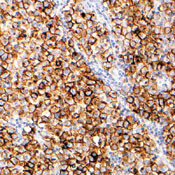
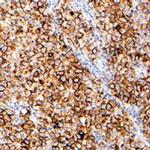
MA5-14544 targets Placental Alk Phosphatase in IHC (P) applications and shows reactivity with Human samples.
The MA5-14544 immunogen is recombinant protein encoding human Placental Alkaline Phosphatase (PLAP).
靶标信息
Placental Alkaline Phosphatase plays an important role in the regulation of specific inflammatory disease processes. There are at least four distinct but related alkaline phosphatases: intestinal, placental, placental-like, and liver/bone/kidney for this form of alkaline phosphatase have been well characterized. Placental Alkaline Phosphatase reacts with a membrane-bound isoenzyme (Regan and Nagao type) of Placental Alkaline Phosphatase (PLAP) occurring in the placenta during the 3rd trimester of gestation. Placental Alkaline Phosphatase is useful in the identification of testicular germ cell tumors. Unlike germ cell tumors, PLAP-positive somatic cell tumors uniformly express epithelial membrane antigen (EMA). A proposed function of Placental Alkaline Phosphatase is matrix mineralization; however, mice that lack a functional form of this enzyme show normal skeletal development. Placental Alkaline Phosphatase has been linked directly to hypophosphatasia, a disorder that is characterized by hypercalcemia and includes skeletal defects. The character of hypophosphatasia can vary, however, depending on the specific mutation since this determines age of onset and severity of symptoms.
仅用于科研。不用于诊断过程。未经明确授权不得转售。
Disclaimer

Clicking the images or links will redirect you to a website hosted by BenchSci that provides third-party scientific content. Neither the content nor the BenchSci technology and processes for selection have been evaluated by us; we are providing them as-is and without warranty of any kind, including for use or application of the Thermo Fisher Scientific products presented.

