Search
GenScript
Presenilin 1 Polyclonal Antibody
{{$productOrderCtrl.translations['antibody.pdp.commerceCard.promotion.promotions']}}
{{$productOrderCtrl.translations['antibody.pdp.commerceCard.promotion.viewpromo']}}
{{$productOrderCtrl.translations['antibody.pdp.commerceCard.promotion.promocode']}}: {{promo.promoCode}} {{promo.promoTitle}} {{promo.promoDescription}}. {{$productOrderCtrl.translations['antibody.pdp.commerceCard.promotion.learnmore']}}
Additional Information:
{{banner.description}}
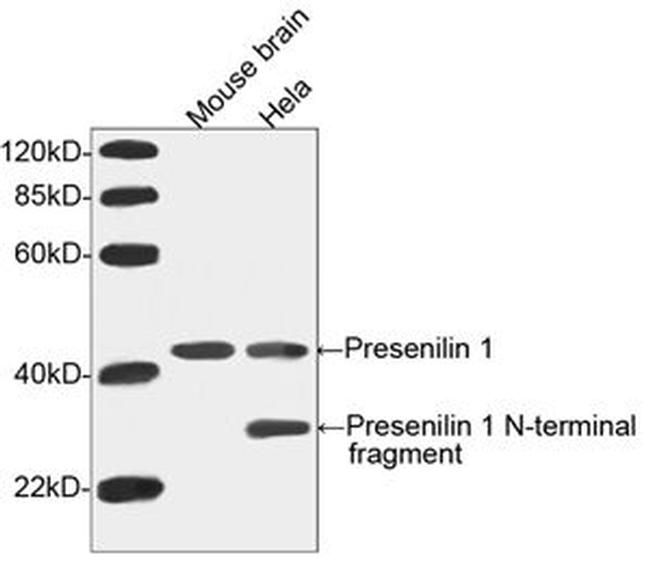
图: 1 / 1
Presenilin 1 Antibody (A00881-40) in WB
Western blot analysis of cell and tissue lysates using Presenilin 1 Antibody, pAb, Rabbit (GenScript, A00881, 2 µg/mL). The signal was developed with Goat Anti-Rabbit IgG (H&L) [HRP] Polyclonal Antibody (GenScript, A00098, 1:5,000) and LumiSensor TM HRP Substrate Kit (GenScript, L00221). Predicted Size: 45 kD. Observed Size: 45 kD, 32 kD.

产品信息
A00881-40
产品规格
宿主/亚型
Rabbit
/ IgG
分类
Polyclonal
类型
Antibody
抗原
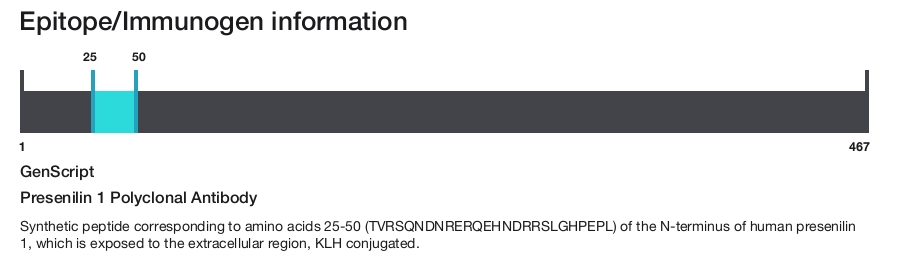
Synthetic peptide corresponding to amino acids 25-50 (TVRSQNDNRERQEHNDRRSLGHPEPL) of the N-terminus of human presenilin 1, which is exposed to the extracellular region, KLH conjugated.
偶联物
Unconjugated
Unconjugated
Unconjugated
形式
Liquid
浓度
0.5 mg/mL
规格
40 µg
保存条件
-20°C or -80°C if preferred
运输条件
Wet ice
产品详细信息
Presenilin 1 (PS1) and presenilin 2 (PS2) are catalytic subunits of the gamma-secretase complex, an endoprotease complex that catalyzes the intramembrane cleavage of integral membrane proteins such as Notch receptors and APP (beta-amyloid precursor protein). The other members of the gamma-secretase complex are required to have protease activity. PS1 and PS2 may play a role in intracellular signaling and gene expression or in linking chromatin to the nuclear membrane. It regulates epithelial-cadherin function. Three causative genes have been identified that when mutated lead to presenile Alzheimer's disease: APP (amyloid precursor protein gene), PSEN1, and PSEN2. The presenilin 1 gene has recently been discovered on chromosome 14 and is responsible for an early onset form of Alzheimer's disease that accounts for 70-80% of the inherited forms of Alzheimer's. It is a membrane protein that has a region where at least seven mutations have been identified in family members with Alzheimer's disease. Endogenous presenilin mainly exists in a heterodimeric complex formed from the endoproteolytically processed amino-terminal (28 kD) and carboxy-terminal (&(8)776;17 kD) fragments.GenScript Rabbit Anti-Presenilin 1 Polyclonal Antibody is developed in rabbit hosts using a synthetic peptide, TVRSQNDNRERQEHNDRRSLGHPEPL, corresponding to amino acids 25-50 of the N-terminus of human presenilin 1.Rabbit Anti-Presenilin 1 Polyclonal Antibody is highly purified from rabbit antiserum by immunoaffinity chromatography and is supplied as a 40 μg aliquot at a concentration of 0.5 mg/ml.
靶标信息
Presenilin1 was initially identified a marker of susceptibility to early-onset Alzheimer's disease. In addition to PEN2, nicastrin and APH-1, Presenilin1 forms the -gamma-secretase protein complex, a membrane-bound aspartyl protease that can cleave certain proteins at peptide bonds buried within the hydrophobic environment of the lipid bilayer. This cleavage is responsible for a key step in signaling from several cell-surface receptors and is thought to be required for the generation of the neurotoxic amyloid peptides that are central to the pathogenesis of Alzheimer's disease. Like the tumor necrosis factor-alpha-converting enzyme (TACE) and the beta-site cleavage enzyme (BACE) protease families, -gamma-secretase will cleave the amyloid precursor protein (APP), but within the intramembrane region of APP, resulting in either the non-toxic p3 (from the alpha and -gamma cleavage site) or the toxic Abeta amyloid peptide (from the beta and -gamma cleavage site). It is thought that accumulation of the Abeta peptide is the precursor to Alzheimer's disease. Multiple isoforms of presenilin1 are known to exist.
仅用于科研。不用于诊断过程。未经明确授权不得转售。
篇参考文献 (0)
您是否在文献中引用过该产品?请点击下方按钮邮件告知我们。
Disclaimer

Clicking the images or links will redirect you to a website hosted by BenchSci that provides third-party scientific content. Neither the content nor the BenchSci technology and processes for selection have been evaluated by us; we are providing them as-is and without warranty of any kind, including for use or application of the Thermo Fisher Scientific products presented.

