Search
Invitrogen
RIT1 Polyclonal Antibody
{{$productOrderCtrl.translations['antibody.pdp.commerceCard.promotion.promotions']}}
{{$productOrderCtrl.translations['antibody.pdp.commerceCard.promotion.promocode']}}: {{promo.promoCode}} {{promo.promoTitle}} {{promo.promoDescription}}. {{$productOrderCtrl.translations['antibody.pdp.commerceCard.promotion.learnmore']}}
{{$ctrl.translations['antibody.pdp.skuNotes.additionalInformation']}}:
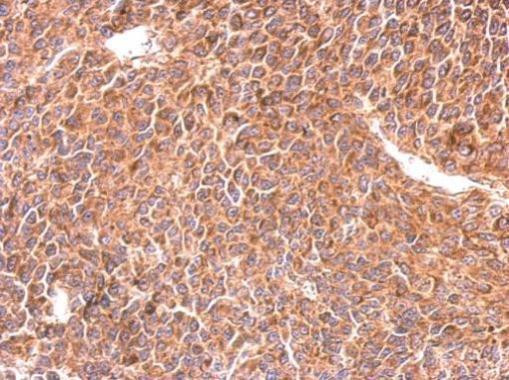
图: 1 / 3
RIT1 Antibody (PA5-30919) in IHC (P)
RIT1 Polyclonal Antibody detects RIT1 protein at cytosol on BT483 xenograft by immunohistochemical analysis. Sample: Paraffin-embedded BT4838 xenograft. RIT1 Polyclonal Antibody (Product # PA5-30919) dilution: 1:500. Antigen Retrieval: EDTA based buffer, pH 8.0, 15 min.
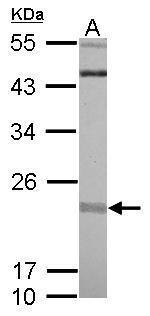
Please note: We are reviewing Western blot images included in the antibody testing data in our catalog, including those provided by third parties. Unless expressly labeled or annotated as “raw-unedited”, Western blot images included in the antibody testing data in our catalog may have been edited, optimized or otherwise adjusted for presentation.


产品信息
PA5-30919
产品规格
种属反应
Human
已发表种属
Human
宿主/亚型
Rabbit
/ IgG
分类
Polyclonal
类型
Antibody
抗原
Recombinant protein encompassing a sequence within the center region of human RIT1. The exact sequence is proprietary.
偶联物
Unconjugated
Unconjugated
Unconjugated
形式
Liquid
浓度
0.75 mg/mL
规格
75 µg
纯化类型
Antigen affinity chromatography
保存液
0.1M tris glycine, pH 7, with 20% glycerol
内含物
0.01% thimerosal
保存条件
Store at 4°C short term. For long term storage, store at -20°C, avoiding freeze/thaw cycles.
运输条件
Ambient (domestic); Wet ice (international)
RRID
产品详细信息
Recommended positive controls: A431.
Predicted reactivity: Mouse (97%), Zebrafish (87%), Xenopus laevis (87%), Pig (97%), Chicken (96%), Sheep (99%), Rhesus Monkey (100%), Bovine (98%).
Store product as a concentrated solution. Centrifuge briefly prior to opening the vial.
靶标信息
Rit and its neuron-specific homologue, Rin, define a recently discovered subfamily of Ras-related GTPases. Rit and Rin are membrane-associated in spite of the fact that they lack a CAAX box or similar C-terminal lipidation motif. Rit and Rin display 64% amino acid sequence identity and share a unique nine amino acid effector domain (DPTIEDAYK) that is 100% conserved between the murine and human proteins. Although the effector domain sequences of Rit and Rin are very similar to that of Ras, Rit and Rin have been shown to interact with the known Ras-binding proteins RalGDS, Rlf and AF-6, but not the Raf kinases, RIN1 or the p110 subunit of PI3 kinase. For this reason, it has been suggested that Rit and Rin may play important roles in the regulation of signaling pathways distinct from those controlled by Ras.
⚠WARNING: This product can expose you to chemicals including mercury, which is known to the State of California to cause birth defects or other reproductive harm. For more information go to www.P65Warnings.ca.gov.
仅用于科研。不用于诊断过程。未经明确授权不得转售。
生物信息学
蛋白别名: GTP-binding protein Roc1; MGC125864; MGC125865; Ras-like GTPase; ras-like protein expressed in many tissues; ras-like without CAAX protein 1; Ric-like, expressed in many tissues; RIT (Ric-related gene expressed in many tissues); RIT1; small GTP binding protein; unnamed protein product
基因别名: NS8; RIBB; RIT; ROC1
UniProt ID: (Human) Q92963
Entrez Gene ID: (Human) 6016
Disclaimer

Clicking the images or links will redirect you to a website hosted by BenchSci that provides third-party scientific content. Neither the content nor the BenchSci technology and processes for selection have been evaluated by us; we are providing them as-is and without warranty of any kind, including for use or application of the Thermo Fisher Scientific products presented.

