Search
Abnova
RNF168 Monoclonal Antibody (3E1)
{{$productOrderCtrl.translations['antibody.pdp.commerceCard.promotion.promotions']}}
{{$productOrderCtrl.translations['antibody.pdp.commerceCard.promotion.promocode']}}: {{promo.promoCode}} {{promo.promoTitle}} {{promo.promoDescription}}. {{$productOrderCtrl.translations['antibody.pdp.commerceCard.promotion.learnmore']}}
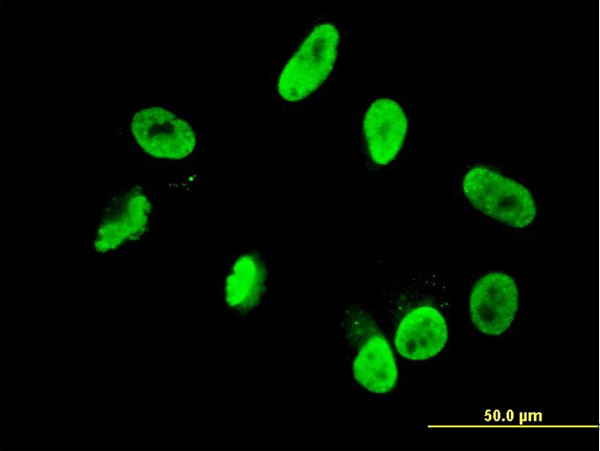
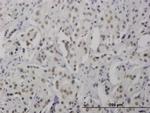
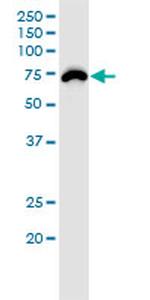
Please note: We are reviewing Western blot images included in the antibody testing data in our catalog, including those provided by third parties. Unless expressly labeled or annotated as “raw-unedited”, Western blot images included in the antibody testing data in our catalog may have been edited, optimized or otherwise adjusted for presentation.


产品信息
H00165918-M01
应用
建议稀释比
已发表文章
产品规格
种属反应
Human
宿主/亚型
Mouse
/ IgG2b, kappa
分类
Monoclonal
类型
Antibody
克隆号
3E1
抗原
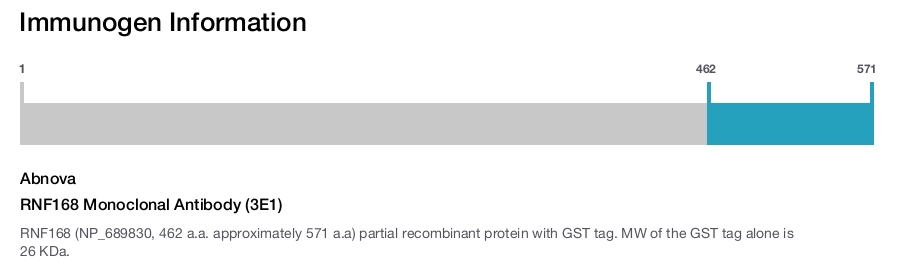
RNF168 (NP_689830, 462 a.a. approximately 571 a.a) partial recombinant protein with GST tag. MW of the GST tag alone is 26 KDa.
偶联物
Unconjugated
Unconjugated
Unconjugated
形式
Liquid
浓度
See Label
规格
100 µg
纯化类型
Affinity chromatography
保存液
PBS, pH 7.4
内含物
no preservative
保存条件
-20°C, Avoid Freeze/Thaw Cycles
运输条件
Ambient (domestic); Wet ice (international)
产品详细信息
Sequence of this protein is as follows: MVPNRQKGSP DEYHLRATSS PPDKVLNGQR KNPKDGNFKR QTHTKHPTPE RGSRDKNRQV SLKMQLKQSV NRRKMPNSTR DHCKVSKSAH SLQPSISQKS VFQMFQRCTK
靶标信息
RNF168 was identified as a chromatin-associated RING finger protein that acts as a ubiquitin ligase both in vitro and in vivo. RNF168 targets histones H2A and H2AX, but not H2B, forming K63 polyubiquitin chains. Upon formation of DNA double strand breaks, RNF168 is recruited to the site of DNA damage where it co-localizes with -gammaH2AX and 53BP1 in an RNF8-dependent manner. This localization of RNF168 increases the local concentration of ubiquinated proteins to the threshold required for retention of the proteins 53BP1 and BRCA1, facilitating the downstream signaling cascade. Thus, RNF168 defines a new pathway demonstrating a functional cooperation between E3 ligases in genome maintenance. At least three isoforms of RNF168 are known to exist.
仅用于科研。不用于诊断过程。未经明确授权不得转售。
篇参考文献 (0)
您是否在文献中引用过该产品?请点击下方按钮邮件告知我们。
生物信息学
蛋白别名: FLJ35794; ring finger protein 168, E3 ubiquitin protein ligase; RING-type E3 ubiquitin transferase RNF168; unnamed protein product
基因别名: hRNF168; RIDL
UniProt ID: (Human) Q8IYW5
Entrez Gene ID: (Human) 165918
DNA metabolic process
double-strand break repair
double-strand break repair via nonhomologous end joining
ubiquitin-dependent protein catabolic process
cellular response to DNA damage stimulus
response to radiation
response to ionizing radiation
protein ubiquitination
negative regulation of transcription elongation from RNA polymerase II promoter
interstrand cross-link repair
regulation of gene expression, epigenetic
isotype switching
positive regulation of DNA repair
protein K63-linked ubiquitination
double-strand break repair via classical nonhomologous end joining
DNA repair-dependent chromatin remodeling
Disclaimer

Clicking the images or links will redirect you to a website hosted by BenchSci that provides third-party scientific content. Neither the content nor the BenchSci technology and processes for selection have been evaluated by us; we are providing them as-is and without warranty of any kind, including for use or application of the Thermo Fisher Scientific products presented.

