Search
Invitrogen
Rifampicin Recombinant Mouse Monoclonal Antibody (6A4)
{{$productOrderCtrl.translations['antibody.pdp.commerceCard.promotion.promotions']}}
{{$productOrderCtrl.translations['antibody.pdp.commerceCard.promotion.promocode']}}: {{promo.promoCode}} {{promo.promoTitle}} {{promo.promoDescription}}. {{$productOrderCtrl.translations['antibody.pdp.commerceCard.promotion.learnmore']}}
{{$ctrl.translations['antibody.pdp.skuNotes.additionalInformation']}}:
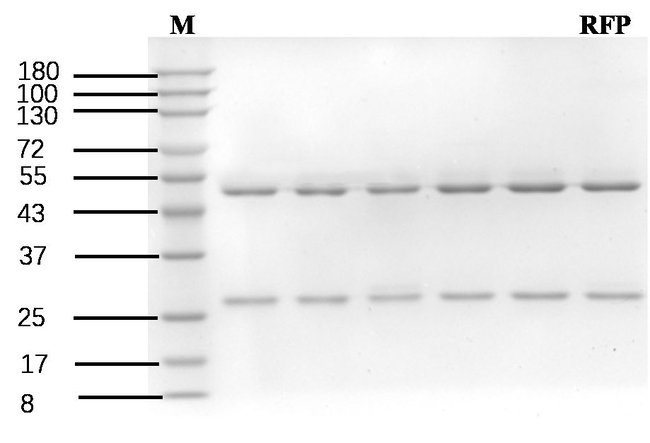
图: 1 / 1
Rifampicin Antibody (MA566333) in SDS-PAGE
SDS-PAGE characterization of Rifampicin under reducing conditions. Lane M: Protein marker (kDa); Lane RFP: Purified Rifampicin Recombinant Monoclonal (Product # MA566333). Rifampicin showing heavy chain (~50 kDa) and light chain (~25 kDa). Gels were stained with Coomassie Brilliant Blue R-432.
Please note: We are reviewing Western blot images included in the antibody testing data in our catalog, including those provided by third parties. Unless expressly labeled or annotated as “raw-unedited”, Western blot images included in the antibody testing data in our catalog may have been edited, optimized or otherwise adjusted for presentation.

产品信息
MA566333
产品规格
种属反应
Chemical
宿主/亚型
Mouse
/ IgG
Expression System
CHO cells
分类
Recombinant Monoclonal
类型
Antibody
克隆号
6A4
抗原
Conjugate of RFP hapten and KLH.
偶联物
Unconjugated
Unconjugated
Unconjugated
形式
Liquid
浓度
6.2 mg/mL
规格
200 µg
纯化类型
Protein G
保存液
PBS
内含物
0.09% sodium azide
保存条件
-20°C
运输条件
Ambient (domestic); Wet ice (international)
RRID
靶标信息
Rifampicin, a potent antibiotic, primarily targets the bacterial RNA polymerase by binding to the beta subunit encoded by the rpoB gene, which is located on the bacterial chromosome. The structure of rifampicin includes an ansa bridge that facilitates its binding to the RNA polymerase, effectively inhibiting the transcription process. This binding is crucial for its antibacterial activity, particularly against Mycobacterium tuberculosis. Rifampicin's interaction with biological targets has been studied using molecular docking and density functional theory, revealing its electronic properties and stability. Additionally, rifampicin is a ligand for the pregnane X receptor (PXR), influencing the regulation of cytochrome P450 3A4, which is involved in drug metabolism. The presence of heterocyclic and basic substituents at specific positions in its structure contributes to its high antibacterial efficacy. Mutations in the rpoB gene can confer resistance to rifampicin, highlighting the importance of understanding its gene location and structural interactions for developing effective treatments.
仅用于科研。不用于诊断过程。未经明确授权不得转售。
篇参考文献 (0)
您是否在文献中引用过该产品?请点击下方按钮邮件告知我们。
Disclaimer

Clicking the images or links will redirect you to a website hosted by BenchSci that provides third-party scientific content. Neither the content nor the BenchSci technology and processes for selection have been evaluated by us; we are providing them as-is and without warranty of any kind, including for use or application of the Thermo Fisher Scientific products presented.

