Search
Disclaimer

Clicking the images or links will redirect you to a website hosted by BenchSci that provides third-party scientific content. Neither the content nor the BenchSci technology and processes for selection have been evaluated by us; we are providing them as-is and without warranty of any kind, including for use or application of the Thermo Fisher Scientific products presented.
GenScript
SARS-CoV-2 Spike S1 Chimeric Recombinant Human Monoclonal Antibody (HC2001)
{{$productOrderCtrl.translations['antibody.pdp.commerceCard.promotion.promotions']}}
{{$productOrderCtrl.translations['antibody.pdp.commerceCard.promotion.viewpromo']}}
{{$productOrderCtrl.translations['antibody.pdp.commerceCard.promotion.promocode']}}: {{promo.promoCode}} {{promo.promoTitle}} {{promo.promoDescription}}. {{$productOrderCtrl.translations['antibody.pdp.commerceCard.promotion.learnmore']}}


产品信息
A02038-100
产品规格
种属反应
Virus
宿主/亚型
Human
/ IgG1
Expression System
proprietary
分类
Recombinant Monoclonal
类型
Antibody
克隆号
HC2001
抗原
Recombinant SARS-CoV-2 RBD Protein
偶联物
形式
Liquid
浓度
1 mg/mL
纯化类型
Protein A
保存液
PBS, pH 7.2
内含物
0.02% sodium azide
保存条件
-20°C, Avoid Freeze/Thaw Cycles
运输条件
Ambient (domestic); Wet ice (international)
产品详细信息
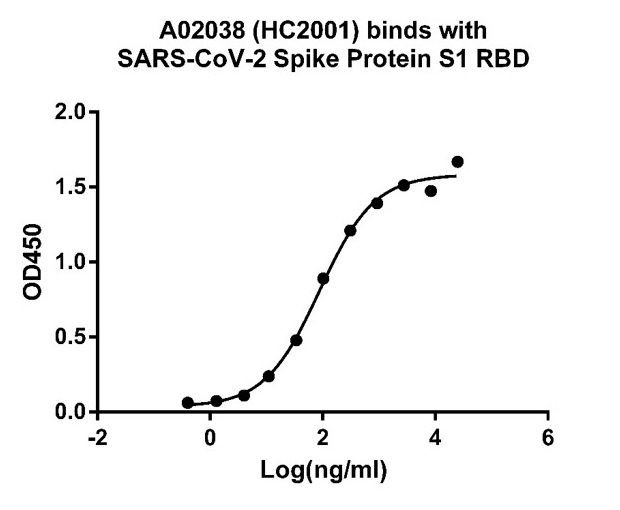
SARS-CoV-2 (Severe acute respiratory syndrome coronavirus 2), also known as 2019-nCoV, is a positive-sense single-stranded RNA virus. It caused coronavirus disease 2019 (COVID-19). SARS-CoV-2 contains glycosylated spike (S) protein, which is composed of S1 subunit and S2 subunit. The S1 contains a receptor-binding domain (RBD) that can bind to ACE2 receptor on target cells.SARS-CoV-2 Spike S1 Antibody (HC2001), Human Chimeric is produced from cell culture in vitro under conditions free from animal-derived components.
靶标信息
SARS-CoV-2 (Severe Acute Respiratory Syndrome Coronavirus 2) also known as 2019-nCoV (2019 Novel Coronavirus) is a virus that causes illnesses ranging from the common cold symptoms to severe effects including death and respiratory distress. SARS-CoV-2 Spike Protein is composed of S1 domain and S2 domain (Spike Protein). The Spike protein is the main surface antigen of the coronavirus. The glycosylated Spike protein (as well as the nucleocapsid protein) can be detected in infected cell culture supernatants with antisera from SARS patients. S1 contains a receptor-binding domain (RBD) that can specifically bind to angiotensin-converting enzyme 2 (ACE2), the receptor on target cells. CoV diversity is reflected in the variable Spike proteins (S proteins), which have evolved into forms differing in their receptor interactions and their response to various environmental triggers of virus-cell membrane fusion.
仅用于科研。不用于诊断过程。未经明确授权不得转售。
篇参考文献 (0)
您是否在文献中引用过该产品?请点击下方按钮邮件告知我们。

