Search
Disclaimer

Clicking the images or links will redirect you to a website hosted by BenchSci that provides third-party scientific content. Neither the content nor the BenchSci technology and processes for selection have been evaluated by us; we are providing them as-is and without warranty of any kind, including for use or application of the Thermo Fisher Scientific products presented.
Proteintech
SCPEP1 Recombinant Rabbit Monoclonal Antibody (240886B6)
{{$productOrderCtrl.translations['antibody.pdp.commerceCard.promotion.promotions']}}
{{$productOrderCtrl.translations['antibody.pdp.commerceCard.promotion.viewpromo']}}
{{$productOrderCtrl.translations['antibody.pdp.commerceCard.promotion.promocode']}}: {{promo.promoCode}} {{promo.promoTitle}} {{promo.promoDescription}}. {{$productOrderCtrl.translations['antibody.pdp.commerceCard.promotion.learnmore']}}
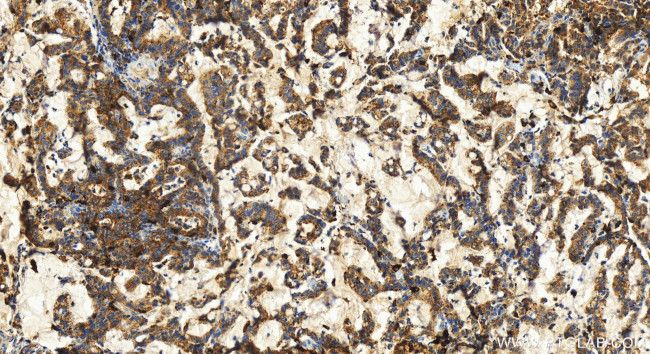
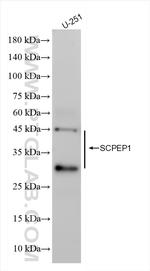
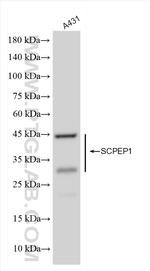


产品信息
83786-4-RR
应用
建议稀释比
已发表文章
产品规格
种属反应
Human
宿主/亚型
Rabbit
/ IgG
Expression System
HEK293F
分类
Recombinant Monoclonal
类型
Antibody
克隆号
240886B6
抗原
SCPEP1 fusion protein Ag31381
偶联物
形式
Liquid
浓度
1 mg/mL
纯化类型
Protein A
保存液
PBS, pH 7.3, with 50% glycerol
内含物
0.02% sodium azide
保存条件
-20°C
运输条件
Wet ice
产品详细信息
Immunogen sequence: LLEDKGLAE VSKVAEQVLN AVNKGLYREA TELWGKAEMI IEQNTDGVNF YNILTKSTPT STMESSLEFT QSHLVCLCQR HVRHLQRDAL SQLMNGPIRK KLKIIPEDQS WGGQATNVFV NMEEDFMKPV ISIVDELLEA GINVTVYNGQ LDLIVDTMGQ EAWVRKLKWP ELPKFSQLKW KALYSDPKSL ETSAFVKSYK NLAFYWILKA GHMVPSDQGD MALKMMRLVT QQE
靶标信息
The RNA-induced silencing complex (RISC) is a key player in the regulation of gene expression through RNA interference (RNAi) mechanisms. It operates by utilizing small RNA molecules-such as microRNAs (miRNAs), small interfering RNAs (siRNAs), and PIWI-interacting RNAs (piRNAs)-which are processed from double-stranded RNA precursors by enzymes like Drosha and Dicer in animals, and DICER-LIKE in plants. RISC is a versatile molecular complex consisting of Argonaute proteins as its core component, which guides the complex to the target RNA by complementary base pairing. Once assembled, RISC can recruit other proteins that mediate gene silencing by degrading or inhibiting the translation of the target RNA. This post-transcriptional regulation system is integral to numerous biological processes, allowing cells to control gene expression finely and respond to endogenous and exogenous signals. The functionality of RISC in gene silencing highlights its significance in the broader context of genetic regulation and has implications in therapies that target gene expression through RNAi.
仅用于科研。不用于诊断过程。未经明确授权不得转售。
篇参考文献 (0)
您是否在文献中引用过该产品?请点击下方按钮邮件告知我们。
生物信息学
蛋白别名: retinoid inducible serine carboxypeptidase; Retinoid-inducible serine carboxypeptidase; Serine carboxypeptidase 1; serine carboxypeptidase 1 precursor protein
基因别名: HSCP1; MSTP034; RISC; SCP1; SCPEP1; UNQ265/PRO302
UniProt ID: (Human) Q9HB40
Entrez Gene ID: (Human) 59342

