Search
Proteintech
SEPT12 Polyclonal Antibody
{{$productOrderCtrl.translations['antibody.pdp.commerceCard.promotion.promotions']}}
{{$productOrderCtrl.translations['antibody.pdp.commerceCard.promotion.viewpromo']}}
{{$productOrderCtrl.translations['antibody.pdp.commerceCard.promotion.promocode']}}: {{promo.promoCode}} {{promo.promoTitle}} {{promo.promoDescription}}. {{$productOrderCtrl.translations['antibody.pdp.commerceCard.promotion.learnmore']}}
Additional Information:
{{banner.description}}
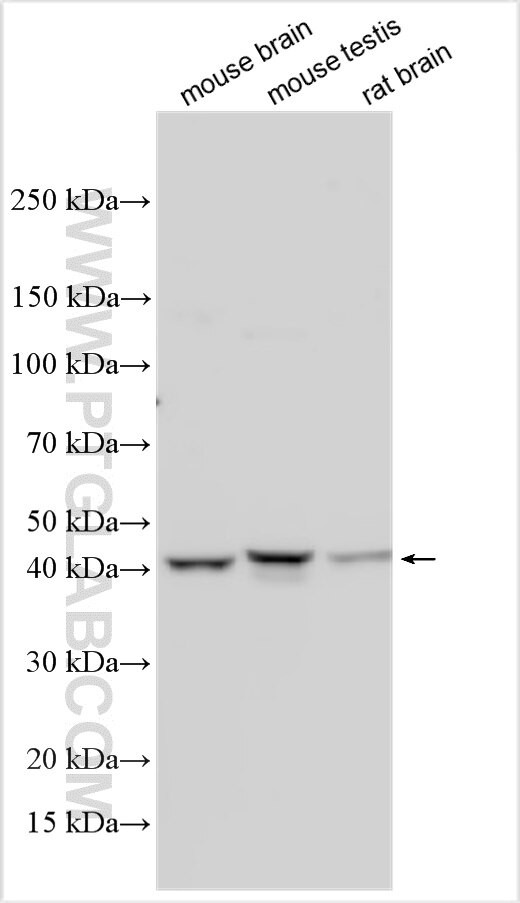

产品信息
13707-1-AP
产品规格
种属反应
Human,
Mouse,
Rat
宿主/亚型
Rabbit
/ IgG
分类
Polyclonal
类型
Antibody
抗原
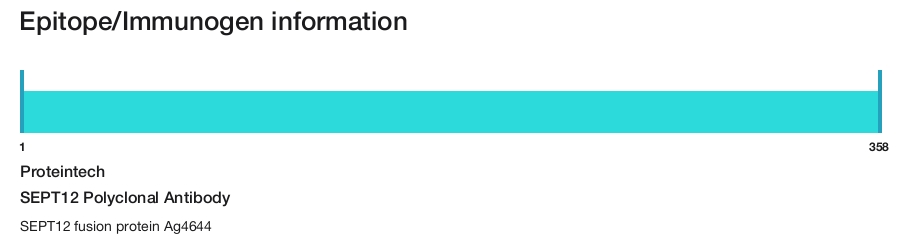
SEPT12 fusion protein Ag4644
偶联物
Unconjugated
Unconjugated
Unconjugated
形式
Liquid
浓度
350 µg/mL
规格
52.5 µg
纯化类型
Affinity chromatography
保存液
PBS, pH 7.3, with 50% glycerol
内含物
0.02% sodium azide
保存条件
-20°C
运输条件
Wet ice
产品详细信息
Sequence of this protein is as follows: MDPLRRSPSP CLSSQPSSPS TPPCEMLGPV GIEAVLDQLK IKAMKMGFEF NIMVVGQSGL GKSTMVNTLF KSKVWKSNPP GLGVPTPQTL QLHSLTHVIE EKGVKLKLTV TDTPGFGDQI NNDNCWDPIL GYINEQYEQY LQEEILITRQ RHIPDTRVHC CVYFVPPTGH CLRPLDIEFL QRLCRTVNVV PVIARADSLT MEEREAFRRR IQQNLRTHCI DVYPQMCFDE DINDKILNSK LRDRIPFAVV GADQEHLVNG RCVLGRKTKW GIIEVENMAH CEFPLLRDLL IRSHLQDLKD ITHNIHYENY RVIRLNESHL LPRGPGWVNL APASPGQLTT PRTFKVCRGA HDDSDDEF
靶标信息
Septins, such as SEPT12, are conserved GTP-binding proteins that function as dynamic, regulatable scaffolds for the recruitment of other proteins. They are involved in membrane dynamics, vesicle trafficking, apoptosis, and cytoskeleton remodeling, as well as infection, neurodegeneration, and neoplasia (Hall et al., 2005 [PubMed 15915442]).
仅用于科研。不用于诊断过程。未经明确授权不得转售。
篇参考文献 (0)
您是否在文献中引用过该产品?请点击下方按钮邮件告知我们。
生物信息学
蛋白别名: sept12_v1; Septin-12; testicular tissue protein Li 168; unnamed protein product
基因别名: 1700028G04Rik; 4933413B09Rik; SEPT12; SEPTIN12; SPGF10
UniProt ID: (Human) Q8IYM1, (Rat) Q4V8G5
Entrez Gene ID: (Human) 124404, (Rat) 363542, (Mouse) 71089
Disclaimer

Clicking the images or links will redirect you to a website hosted by BenchSci that provides third-party scientific content. Neither the content nor the BenchSci technology and processes for selection have been evaluated by us; we are providing them as-is and without warranty of any kind, including for use or application of the Thermo Fisher Scientific products presented.

