Search
Invitrogen
SIAH1 Polyclonal Antibody
{{$productOrderCtrl.translations['antibody.pdp.commerceCard.promotion.promotions']}}
{{$productOrderCtrl.translations['antibody.pdp.commerceCard.promotion.promocode']}}: {{promo.promoCode}} {{promo.promoTitle}} {{promo.promoDescription}}. {{$productOrderCtrl.translations['antibody.pdp.commerceCard.promotion.learnmore']}}
{{$ctrl.translations['antibody.pdp.skuNotes.additionalInformation']}}:
产品信息
PA5-85202
产品规格
种属反应
Human,
Mouse
宿主/亚型
Rabbit
/ IgG
分类
Polyclonal
类型
Antibody
抗原
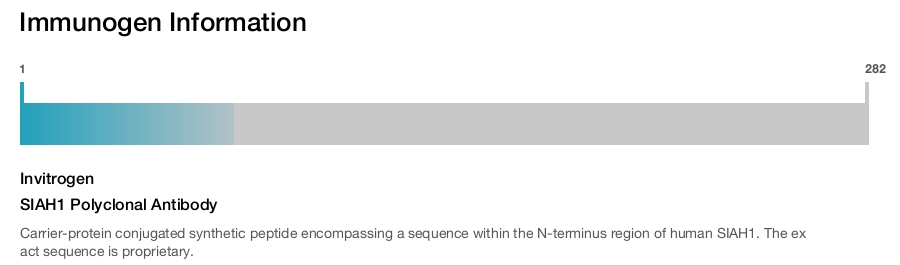
Carrier-protein conjugated synthetic peptide encompassing a sequence within the N-terminus region of human SIAH1. The exact sequence is proprietary.
偶联物
Unconjugated
Unconjugated
Unconjugated
形式
Liquid
浓度
1 mg/mL
规格
100 µg
纯化类型
Antigen affinity chromatography
保存液
PBS, pH 7, with 40% glycerol
内含物
0.01% thimerosal
保存条件
Store at 4°C short term. For long term storage, store at -20°C, avoiding freeze/thaw cycles.
运输条件
Ambient (domestic); Wet ice (international)
RRID
产品详细信息
Keep as concentrated solution.
Predicted reactivity: Rat (100%), Zebrafish (100%), Rhesus Monkey (100%), Chimpanzee (100%), Bovine (100%).
Positive Control: Synthetic peptide: 1:8,000.
Store product as a concentrated solution. Centrifuge briefly prior to opening the vial.
靶标信息
This gene encodes a protein that is a member of the seven in absentia homolog family. The protein is an E3 ligase and is involved in ubiquitination and proteasome-mediated degradation of specific proteins. The activity of this ubiquitin ligase has been implicated in the development of certain forms of Parkinson's disease, the regulation of the cellular response to hypoxia and induction of apoptosis. Alternative splicing results in several additional transcript variants, some encoding different isoforms and others that have not been fully characterized.
⚠WARNING: This product can expose you to chemicals including mercury, which is known to the State of California to cause birth defects or other reproductive harm. For more information go to www.P65Warnings.ca.gov.
仅用于科研。不用于诊断过程。未经明确授权不得转售。
篇参考文献 (0)
您是否在文献中引用过该产品?请点击下方按钮邮件告知我们。
生物信息学
蛋白别名: drosophila seven-in-absentia gene product homolog; FLJ08065; h HUMSIAH; hSIAH1; mSiah-1a; RING-type E3 ubiquitin transferase SIAH1; RING-type E3 ubiquitin transferase SIAH1A; RING-type E3 ubiquitin transferase SIAH1B; seven in absentia 1A; seven in absentia 1B; seven in absentia homolog 1; seven in absentia homolog 1a; seven in absentia homolog 1b; siah-1a; unnamed protein product
基因别名: BURHAS; siah-1b; SIAH1A; Sinh1a; Sinh1b
UniProt ID: (Human) Q8IUQ4, (Mouse) P61092, (Mouse) Q06985
Entrez Gene ID: (Human) 6477, (Mouse) 20437, (Mouse) 20438
ubiquitin-dependent protein catabolic process
protein ubiquitination
protein catabolic process
protein destabilization
positive regulation of apoptotic process
proteasome-mediated ubiquitin-dependent protein catabolic process
neuron apoptotic process
canonical Wnt signaling pathway
positive regulation of intrinsic apoptotic signaling pathway
male meiosis I
spermatogenesis
post-embryonic development
regulation of multicellular organism growth
apoptotic process
nervous system development
axon guidance
anatomical structure morphogenesis
amyloid fibril formation
regulation of apoptotic signaling pathway
Disclaimer

Clicking the images or links will redirect you to a website hosted by BenchSci that provides third-party scientific content. Neither the content nor the BenchSci technology and processes for selection have been evaluated by us; we are providing them as-is and without warranty of any kind, including for use or application of the Thermo Fisher Scientific products presented.

