Search
Invitrogen
SIGLEC15 Biosimilar Recombinant Human Monoclonal Antibody
{{$productOrderCtrl.translations['antibody.pdp.commerceCard.promotion.promotions']}}
{{$productOrderCtrl.translations['antibody.pdp.commerceCard.promotion.viewpromo']}}
{{$productOrderCtrl.translations['antibody.pdp.commerceCard.promotion.promocode']}}: {{promo.promoCode}} {{promo.promoTitle}} {{promo.promoDescription}}. {{$productOrderCtrl.translations['antibody.pdp.commerceCard.promotion.learnmore']}}
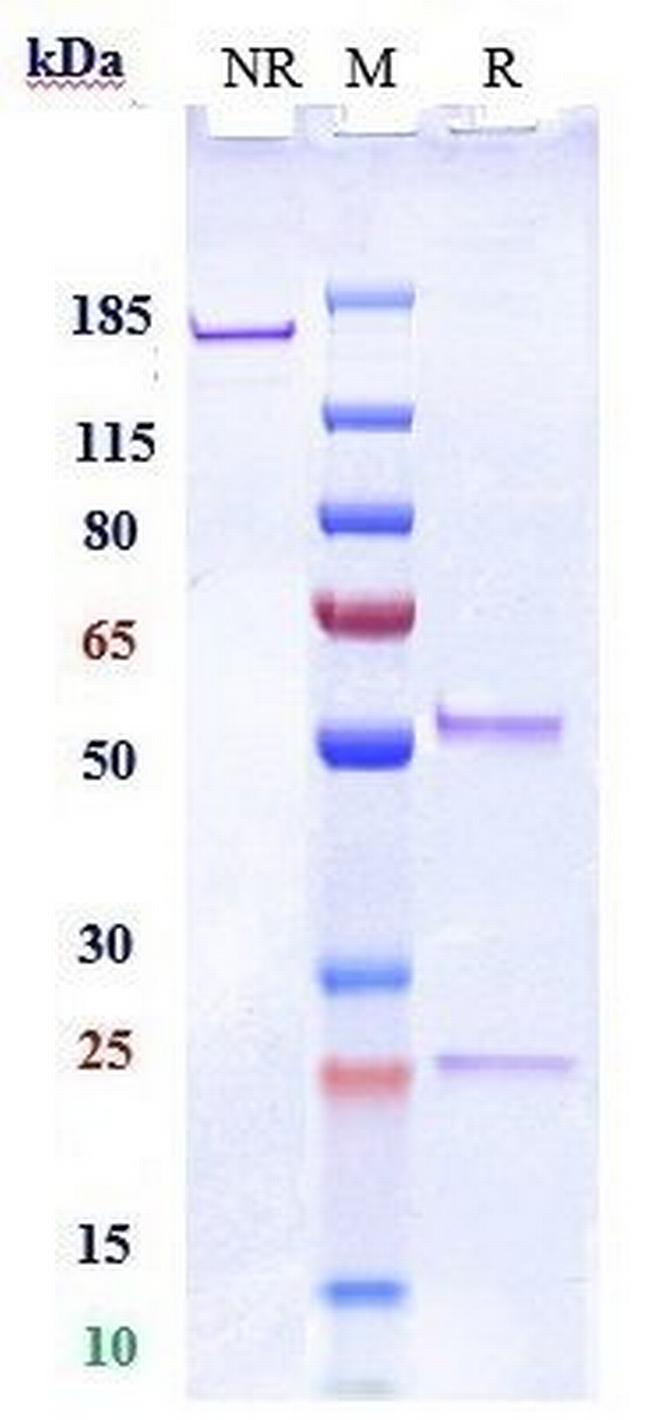
Please note: We are reviewing Western blot images included in the antibody testing data in our catalog, including those provided by third parties. Unless expressly labeled or annotated as “raw-unedited”, Western blot images included in the antibody testing data in our catalog may have been edited, optimized or otherwise adjusted for presentation.

产品信息
MA5-59774
应用
建议稀释比
已发表文章
产品规格
宿主/亚型
Human
/ IgG1
Expression System
CHO cells
分类
Recombinant Monoclonal
类型
Antibody
偶联物
Unconjugated
Unconjugated
Unconjugated
形式
Lyophilized
浓度
1 mg/mL
规格
1 mg
保存条件
-20°C, Avoid Freeze/Thaw Cycles
运输条件
Ambient (domestic); Dry ice (international)
RRID
产品详细信息
For reconstitution, add sterile, distilled water to achieve a final antibody concentration of 1 mg/mL. Gently shake to solubilize the protein completely. Do not vortex. Reconstituted products should be stored at -80 °.
This antibody can also be cross referenced by the term Medimmune patent anti-Siglec-15.
靶标信息
SIGLEC15 (Sialic acid-binding immunoglobulin-like lectin 15) is a member of the Siglec family, which is primarily involved in immune cell signaling and modulation. It is located on chromosome 18q12.2 and is highly expressed in myeloid cells, including macrophages and dendritic cells. Structurally, Siglec-15 contains a V-set and a C2-set immunoglobulin-like domain, a transmembrane domain, and a cytoplasmic domain containing immunoreceptor tyrosine-based inhibition motifs (ITIMs). Functionally, Siglec-15 plays a crucial role in osteoclast differentiation and bone resorption, as well as in modulating immune responses. It enhances tumor immune escape by suppressing T cell activation and has been identified as a potential target for cancer immunotherapy. Overexpression of Siglec-15 is associated with various cancers, infectious diseases, and bone metabolic disorders.
仅用于科研。不用于诊断过程。未经明确授权不得转售。
篇参考文献 (0)
您是否在文献中引用过该产品?请点击下方按钮邮件告知我们。
Disclaimer

Clicking the images or links will redirect you to a website hosted by BenchSci that provides third-party scientific content. Neither the content nor the BenchSci technology and processes for selection have been evaluated by us; we are providing them as-is and without warranty of any kind, including for use or application of the Thermo Fisher Scientific products presented.

