Search
Proteintech
SPAG6 Polyclonal Antibody
{{$productOrderCtrl.translations['antibody.pdp.commerceCard.promotion.promotions']}}
{{$productOrderCtrl.translations['antibody.pdp.commerceCard.promotion.viewpromo']}}
{{$productOrderCtrl.translations['antibody.pdp.commerceCard.promotion.promocode']}}: {{promo.promoCode}} {{promo.promoTitle}} {{promo.promoDescription}}. {{$productOrderCtrl.translations['antibody.pdp.commerceCard.promotion.learnmore']}}
Additional Information:
{{banner.description}}
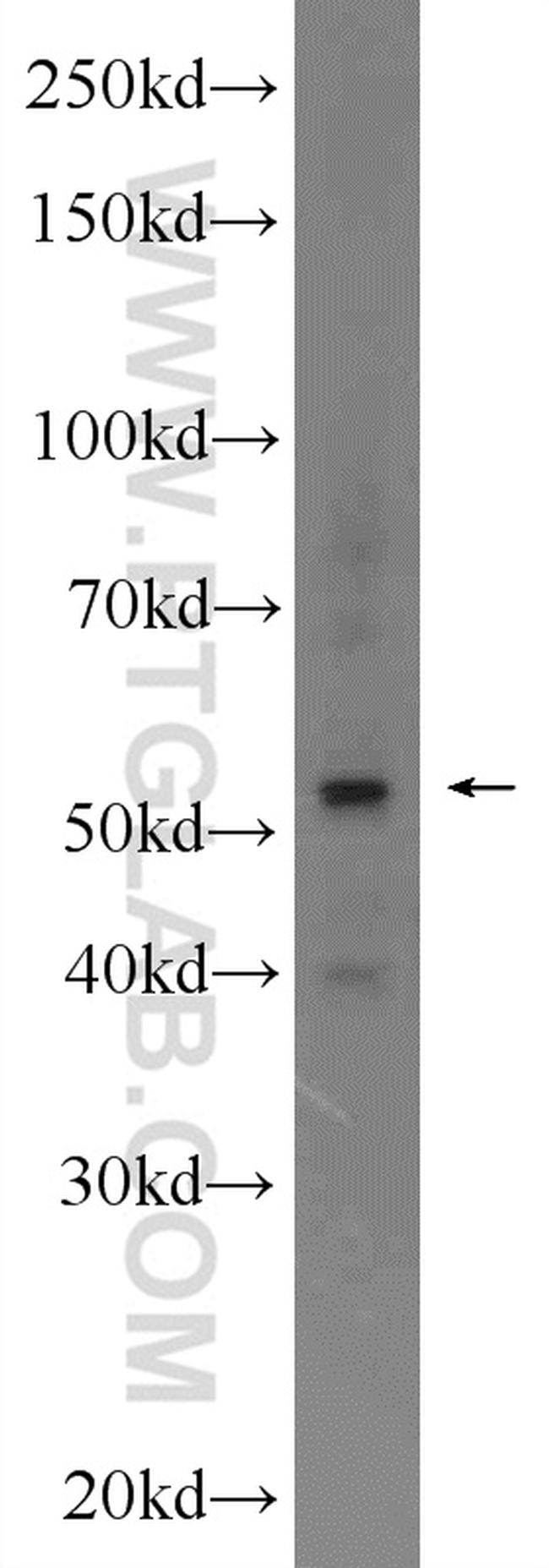
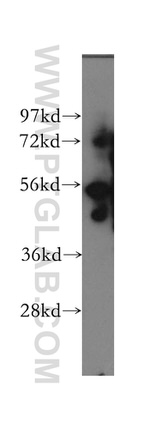
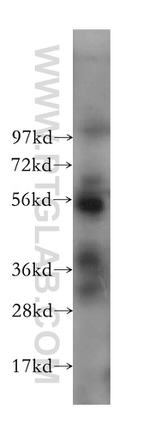
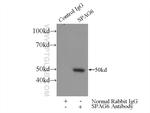


产品信息
12462-1-AP
应用
建议稀释比
已发表文章
产品规格
种属反应
Human,
Mouse,
Rat
已发表种属
Mouse
宿主/亚型
Rabbit
/ IgG
分类
Polyclonal
类型
Antibody
抗原
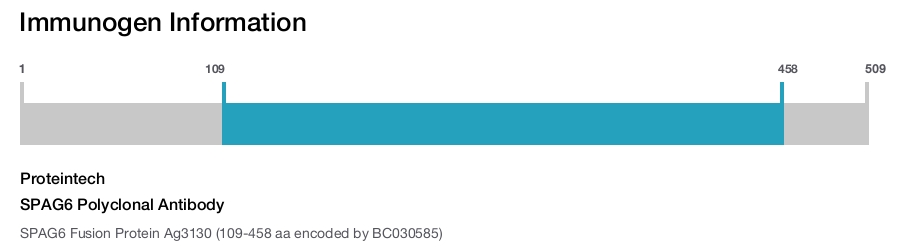
SPAG6 Fusion Protein Ag3130 (109-458 aa encoded by BC030585)
偶联物
形式
Liquid
浓度
0.13 mg/mL
规格
19.5 µg
纯化类型
Antigen affinity chromatography
保存液
PBS, pH 7.3, with 50% glycerol
内含物
0.02% sodium azide
保存条件
-20°C
运输条件
Wet ice (domestic); Dry ice (international)
产品详细信息
Immunogen sequence: AVGKHSPQL AQAIVDCGAL DTLVICLEDF DPGVKEAAAW ALRYIARHNA ELSQAVVDAG AVPLLVLCIQ EPEIALKGIA ASALSDIVKH SPELAQTVVD AGAVAHLAQM ILNPDAKLKH QILSALSQVS KHSVDLAEMV VEAEIFPVVL TCLKDKDEYV KKNASTLIRE IAKHTPELSQ LVVNAGGVAA VIDCIGSCKG NTRLPGIMML GYVAAHSENL AMAVIISKGV PQLSVCLSEE PEDHIKAAAA WALGQIGRHT PEHARAVAVT NTLPVLLSLY MSTESSEDLQ VKSKKAIKNI LQKCTYLPAL EPFLYDAPPN ILKHVVGQFS KVLFPWIFRY TSAEGGQLST T (109-458 aa encoded by BC030585)
靶标信息
The correlation of anti-sperm antibodies with cases of unexplained infertility implicates a role for these antibodies in blocking fertilization. Improved diagnosis and treatment of immunologic infertility, as well as identification of proteins for targeted contraception, are dependent on the identification and characterization of relevant sperm antigens. The protein expressed by this gene is recognized by anti-sperm antibodies from an infertile man. This protein localizes to the tail of permeabilized human sperm and contains eight contiguous armadillo repeats, a motif known to mediate protein-protein interactions. Studies in mice suggest that this protein is involved in sperm flagellar motility and maintenance of the structural integrity of mature sperm. Alternatively spliced variants that encode different protein isoforms have been described but the full-length sequences of only two have been determined.
仅用于科研。不用于诊断过程。未经明确授权不得转售。
生物信息学
蛋白别名: axoneme central apparatus protein; Protein PF16 homolog; Repro-SA-1; SPAG6; Sperm flagellar protein; Sperm-associated antigen 6; testicular tissue protein Li 176; unnamed protein product
基因别名: CFAP194; CT141; FAP194; PF16; Repro-SA-1; RGD1310892; SPAG6
UniProt ID: (Human) O75602
Entrez Gene ID: (Human) 9576, (Rat) 360747, (Mouse) 381350
Disclaimer

Clicking the images or links will redirect you to a website hosted by BenchSci that provides third-party scientific content. Neither the content nor the BenchSci technology and processes for selection have been evaluated by us; we are providing them as-is and without warranty of any kind, including for use or application of the Thermo Fisher Scientific products presented.

