Search
Proteintech
STAT2 Monoclonal Antibody (1G12C4)
{{$productOrderCtrl.translations['antibody.pdp.commerceCard.promotion.promotions']}}
{{$productOrderCtrl.translations['antibody.pdp.commerceCard.promotion.viewpromo']}}
{{$productOrderCtrl.translations['antibody.pdp.commerceCard.promotion.promocode']}}: {{promo.promoCode}} {{promo.promoTitle}} {{promo.promoDescription}}. {{$productOrderCtrl.translations['antibody.pdp.commerceCard.promotion.learnmore']}}
Additional Information:
{{banner.description}}
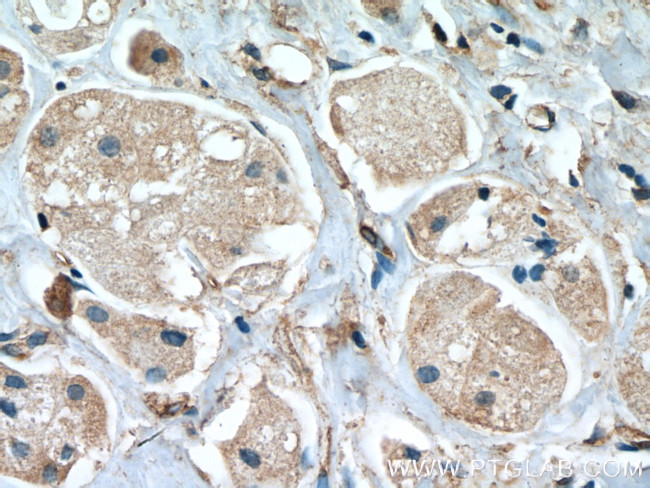

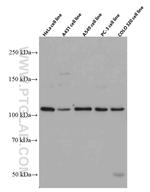


产品信息
66485-1-IG
应用
建议稀释比
已发表文章
产品规格
宿主/亚型
Mouse
/ IgG1
分类
Monoclonal
类型
Antibody
克隆号
1G12C4
抗原
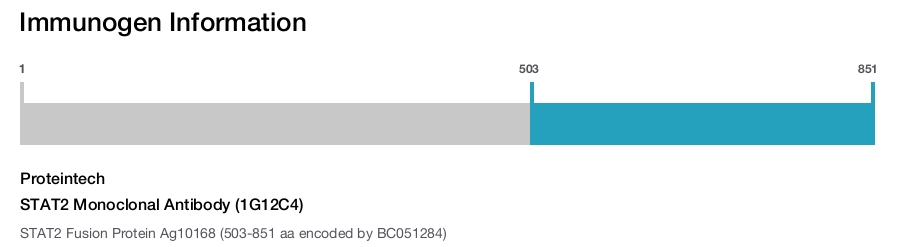
STAT2 Fusion Protein Ag10168 (503-851 aa encoded by BC051284)
偶联物
形式
Liquid
浓度
1 mg/mL
规格
150 µg
保存条件
-20°C
运输条件
Wet ice (domestic); Dry ice (international)
产品详细信息
Immunogen sequence: QFSSYVGRG LNSDQLSMLR NKLFGQNCRT EDPLLSWADF TKRESPPGKL PFWTWLDKIL ELVHDHLKDL WNDGRIMGFV SRSQERRLLK KTMSGTFLLR FSESSEGGIT CSWVEHQDDD KVLIYSVQPY TKEVLQSLPL TEIIRHYQLL TEENIPENPL RFLYPRIPRD EAFGCYYQEK VNLQERRKYL KHRLIVVSNR QVDELQQPLE LKPEPELESL ELELGLVPEP ELSLDLEPLL KAGLDLGPEL ESVLESTLEP VIEPTLCMVS QTVPEPDQGP VSQPVPEPDL PCDLRHLNTE PMEIFRNCVK IEEIMPNGDP LLAGQNTVDE VYVSRPSHFY TDGPLMPSDF (503-851 aa encoded by BC051284)
靶标信息
STAT2 is a member of the STAT protein family. In response to cytokines and growth factors, STAT family members are phosphorylated by the receptor associated kinases, and then form homo- or heterodimers that translocate to the cell nucleus where they act as transcription activators. In response to interferon (IFN), this protein forms a complex with STAT1 and IFN regulatory factor family protein p48 (ISGF3G), in which this protein acts as a transactivator, but lacks the ability to bind DNA directly. Transcription adaptor P300/CBP (EP300/CREBBP) has been shown to interact specifically with this protein, which is thought to be involved in the process of blocking IFN-alpha response by adenovirus.
仅用于科研。不用于诊断过程。未经明确授权不得转售。
Disclaimer

Clicking the images or links will redirect you to a website hosted by BenchSci that provides third-party scientific content. Neither the content nor the BenchSci technology and processes for selection have been evaluated by us; we are providing them as-is and without warranty of any kind, including for use or application of the Thermo Fisher Scientific products presented.

