Search
Disclaimer

Clicking the images or links will redirect you to a website hosted by BenchSci that provides third-party scientific content. Neither the content nor the BenchSci technology and processes for selection have been evaluated by us; we are providing them as-is and without warranty of any kind, including for use or application of the Thermo Fisher Scientific products presented.
Invitrogen
STOML1 (extracellular) Polyclonal Antibody
{{$productOrderCtrl.translations['antibody.pdp.commerceCard.promotion.promotions']}}
{{$productOrderCtrl.translations['antibody.pdp.commerceCard.promotion.viewpromo']}}
{{$productOrderCtrl.translations['antibody.pdp.commerceCard.promotion.promocode']}}: {{promo.promoCode}} {{promo.promoTitle}} {{promo.promoDescription}}. {{$productOrderCtrl.translations['antibody.pdp.commerceCard.promotion.learnmore']}}
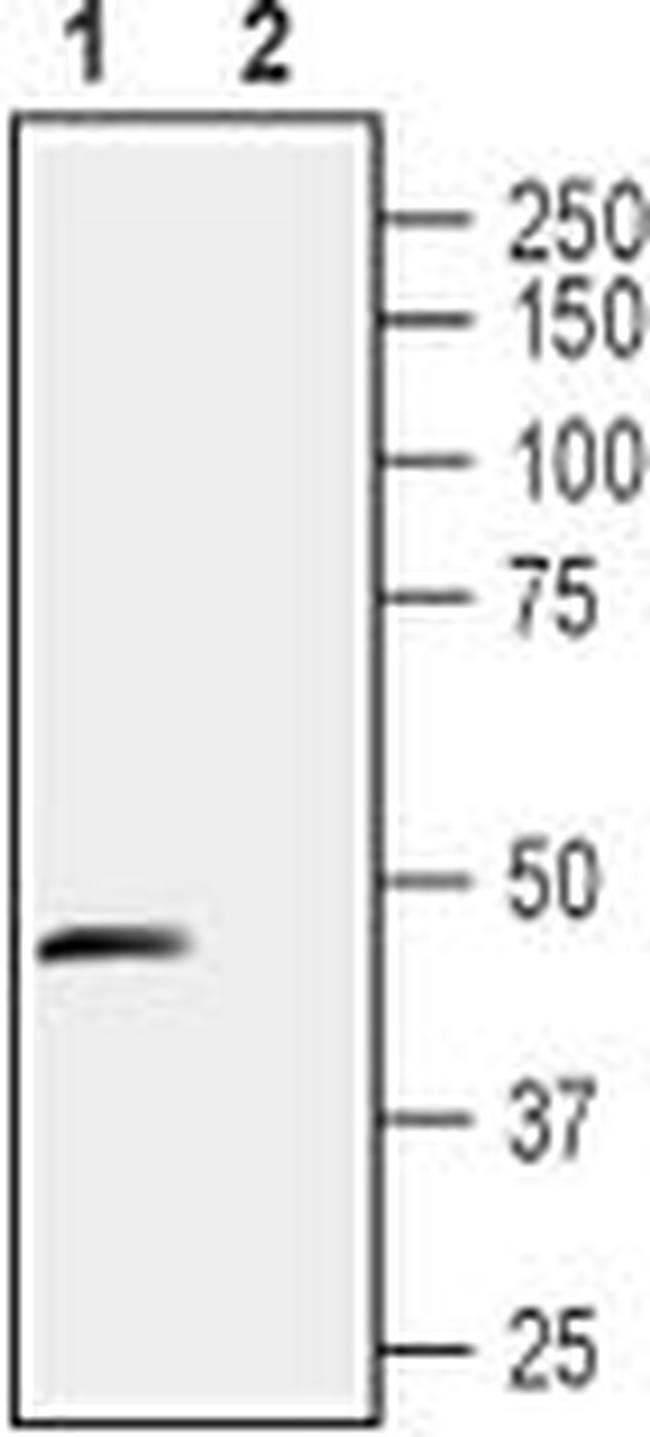
图: 1 / 2
STOML1 (extracellular) Antibody (PA5-111842) in WB
Western Blot analysis of STOML1 was performed in rat dorsal root ganglia lysates. Lane 1: STOML1 (extracellular) Antibody (Product # PA5-111842) at a dilution of 1:500. Lane 2: STOML1 (extracellular) Antibody preincubated with the negative control antigen.


产品信息
PA5-111842
产品规格
宿主/亚型
Rabbit
/ IgG
分类
Polyclonal
类型
Antibody
抗原
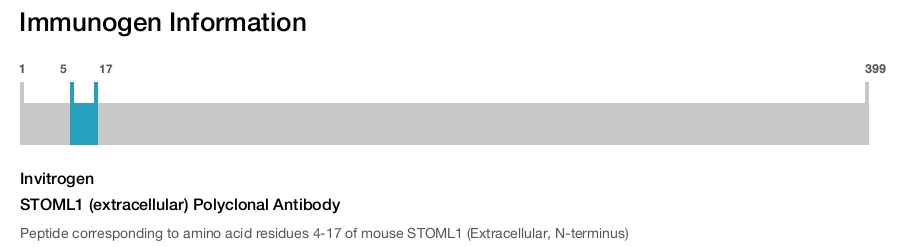
Peptide corresponding to amino acid residues 4-17 of mouse STOML1 (Extracellular, N-terminus)
偶联物
形式
Lyophilized
浓度
0.8 mg/mL
保存条件
-20°C
运输条件
Wet ice
RRID
产品详细信息
Reconstitute antibody with 50 µL of double distilled water (DDW). The reconstituted solution can be stored at 4 degrees C for up to 1 week. For longer periods, small aliquots should be stored at -20 degrees C. Avoid multiple freezing and thawing. Centrifuge all antibody preparations before use (10000 x g 5 min).
Peptide sequence is: (C)RSGYRAL PLGDFDR
Homology: Rat, human amino acid residues are identical.
靶标信息
Stomatin-like protein 1 (STOML1) is encoded by the STOML1 gene located on chromosome 17 in humans. It is part of a family of five mammalian genes that encode peripheral membrane proteins involved in modulating ion channel functions. STOML1 is known to interact specifically with members of the acid-sensing ion channel (ASIC) family, influencing their proton sensitivity. These interactions help regulate ion transport and signaling pathways, which are critical for cellular homeostasis. In addition, STOML1 has been studied in the context of oral squamous cell carcinoma (OSCC), where it is often overexpressed along with STOML2, potentially affecting cancer progression. Structurally, STOML1 contains a stomatin domain which is crucial for its role in membrane association and ion channel modulation. Its expression in olfactory sensory neurons (OSNs) is comparatively lower than other family members, but it still contributes to the localization and functional integrity of related proteins in these cells.
仅用于科研。不用于诊断过程。未经明确授权不得转售。
篇参考文献 (0)
您是否在文献中引用过该产品?请点击下方按钮邮件告知我们。

