Search
Invitrogen
TAS2R3 Polyclonal Antibody
{{$productOrderCtrl.translations['antibody.pdp.commerceCard.promotion.promotions']}}
{{$productOrderCtrl.translations['antibody.pdp.commerceCard.promotion.viewpromo']}}
{{$productOrderCtrl.translations['antibody.pdp.commerceCard.promotion.promocode']}}: {{promo.promoCode}} {{promo.promoTitle}} {{promo.promoDescription}}. {{$productOrderCtrl.translations['antibody.pdp.commerceCard.promotion.learnmore']}}
Additional Information:
{{banner.description}}
产品信息
OSR00152W
应用
建议稀释比
已发表文章
产品规格
宿主/亚型
Rabbit
/ IgG
分类
Polyclonal
类型
Antibody
抗原
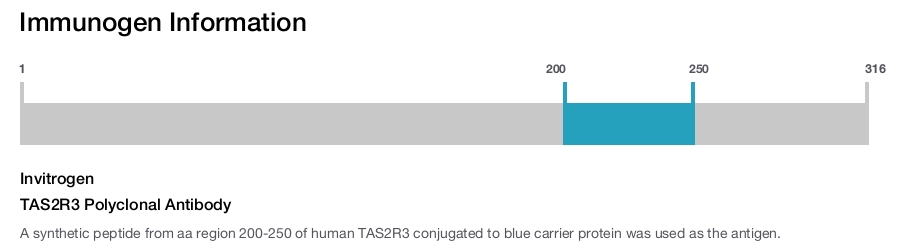
A synthetic peptide from aa region 200-250 of human TAS2R3 conjugated to blue carrier protein was used as the antigen.
偶联物
形式
Lyophilized
浓度
Conc. Not Determined
保存条件
Store at 4°C short term. For long term storage, store at -20°C, avoiding freeze/thaw cycles. Glycerol (1:1) may be added for added stability.
运输条件
Ambient (domestic); Wet ice (international)
RRID
产品详细信息
Glycerol (1:1) may be added for additional stability.
Reconstitute in 100 µL of sterile water
靶标信息
This gene encodes a member of a family of candidate taste receptors that are members of the G protein-coupled receptor superfamily and that are specifically expressed by taste receptor cells of the tongue and palate epithelia. These apparently intronless taste receptor genes encode a 7-transmembrane receptor protein, functioning as a bitter taste receptor. This gene is clustered with another 3 candidate taste receptor genes in chromosome 7 and is genetically linked to loci that influence bitter perception. Gustducin-coupled receptor implicated in the perception of bitter compounds in the oral cavity and the gastrointestinal tract. Signals through PLCB2 and the calcium-regulated cation channel TRPM5. Expressed in subsets of taste receptor cells of the tongue and palate epithelium and exclusively in gustducin-positive cells. Expressed in the antrum and fundus (part of the stomach), duodenum and in gastric endocrine cells. Several bitter taste receptors are expressed in a single taste receptor cell.
仅用于科研。不用于诊断过程。未经明确授权不得转售。
Disclaimer

Clicking the images or links will redirect you to a website hosted by BenchSci that provides third-party scientific content. Neither the content nor the BenchSci technology and processes for selection have been evaluated by us; we are providing them as-is and without warranty of any kind, including for use or application of the Thermo Fisher Scientific products presented.

