Search
Proteintech
TCF12/HEB Polyclonal Antibody
{{$productOrderCtrl.translations['antibody.pdp.commerceCard.promotion.promotions']}}
{{$productOrderCtrl.translations['antibody.pdp.commerceCard.promotion.viewpromo']}}
{{$productOrderCtrl.translations['antibody.pdp.commerceCard.promotion.promocode']}}: {{promo.promoCode}} {{promo.promoTitle}} {{promo.promoDescription}}. {{$productOrderCtrl.translations['antibody.pdp.commerceCard.promotion.learnmore']}}
Additional Information:
{{banner.description}}
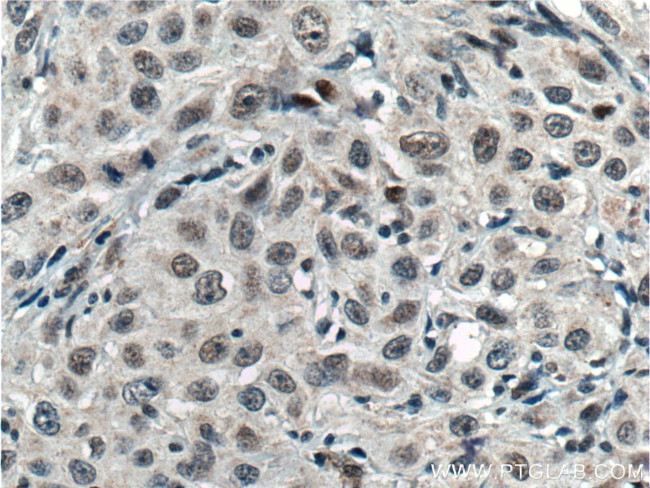

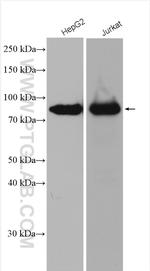
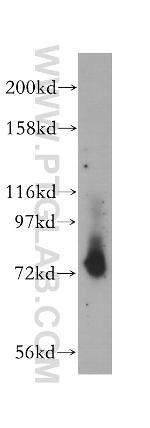


产品信息
14419-1-AP
应用
建议稀释比
已发表文章
产品规格
种属反应
Human,
Mouse,
Rat
已发表种属
Human,
Mouse
宿主/亚型
Rabbit
/ IgG
分类
Polyclonal
类型
Antibody
抗原
TCF12/HEB Fusion Protein Ag5765 (358-706 aa encoded by BC050556)
偶联物
形式
Liquid
浓度
0.18 mg/mL
规格
27 µg
纯化类型
Antigen affinity chromatography
保存液
PBS, pH 7.3, with 50% glycerol
内含物
0.02% sodium azide
保存条件
-20°C
运输条件
Wet ice (domestic); Dry ice (international)
产品详细信息
Immunogen sequence: SNPSTPVGS PSPLTGTSQW PRPGGQAPSS PSYENSLHSL KNRVEQQLHE HLQDAMSFLK DVCEQSRMED RLDRLDDAIH VLRNHAVGPS TSLPAGHSDI HSLLGPSHNA PIGSLNSNYG GSSLVASSRS ASMVGTHRED SVSLNGNHSV LSSTVTTSST DLNHKTQENY RGGLQSQSGT VVTTEIKTEN KEKDENLHEP PSSDDMKSDD ESSQKDIKVS SRGRTSSTNE DEDLNPEQKI EREKERRMAN NARERLRVRD INEAFKELGR MCQLHLKSEK PQTKLLILHQ AVAVILSLEQ QVRERNLNPK AACLKRREEE KVSAVSAEPP TTLPGTHPGL SETTNPMGHM (358-706 aa encoded by BC050556)
靶标信息
TCF12, also known as HTF4, is a member of the basic helix-loop-helix (bHLH) E-protein family that recognizes the consensus binding site (E-box) CANNTG. TCF12 is expressed in many tissues, among them skeletal muscle, thymus, B- and T-cells, and may participate in regulating lineage-specific gene expression through the formation of heterodimers with other bHLH E-proteins. TCF12, in combination with E2A, is required to block thymocyte proliferation prior to pre-TCR expression and is critical for proper T cell differentiation. Recent reports have shown that TCF12 is also a critical factor required for the development of invariant natural killer T cells.
仅用于科研。不用于诊断过程。未经明确授权不得转售。
生物信息学
蛋白别名: bHLHb20; Class A helix-loop-helix transcription factor ME1; Class B basic helix-loop-helix protein 20; DNA-binding protein HTF4; E-box-binding protein; helix-loop-helix transcription factor 4; Salivary-specific cAMP response element-binding protein alpha; SCBP alpha; SCBP-alpha; TCF-12; Transcription factor 12; Transcription factor HTF-4; unnamed protein product
基因别名: A130037E08Rik; ALF1; BHLHB20; CRS3; HEB; HEBAlt; HH26; HsT17266; HTF-4; HTF4; ME1; Meb; p64; REB; SCBPA; TCF-12; TCF12
UniProt ID: (Human) Q99081, (Mouse) Q61286, (Rat) P51514
Entrez Gene ID: (Human) 6938, (Mouse) 21406, (Rat) 25720
transcription regulatory region sequence-specific DNA binding
RNA polymerase II core promoter proximal region sequence-specific DNA binding
RNA polymerase II transcription factor activity, sequence-specific DNA binding
core promoter proximal region sequence-specific DNA binding
transcriptional activator activity, RNA polymerase II transcription regulatory region sequence-specific binding
DNA binding
transcription factor activity, sequence-specific DNA binding
protein binding
cAMP response element binding
bHLH transcription factor binding
SMAD binding
protein heterodimerization activity
protein dimerization activity
E-box binding
HMG box domain binding
DNA-binding transcription factor binding
sequence-specific double-stranded DNA binding
transcriptional activator activity, RNA polymerase II core promoter proximal region sequence-specific binding
transcription factor binding
protein homodimerization activity
transcription regulatory region DNA binding
basic helix-loop-helix transcription factor
regulation of transcription from RNA polymerase II promoter
immune response
nervous system development
muscle organ development
gene expression
positive regulation of gene expression
cell differentiation
positive regulation of neuron differentiation
positive regulation of transcription, DNA-templated
positive regulation of transcription from RNA polymerase II promoter
response to gonadotropin-releasing hormone
transcription, DNA-templated
regulation of transcription, DNA-templated
transcription from RNA polymerase II promoter
multicellular organism development
Disclaimer

Clicking the images or links will redirect you to a website hosted by BenchSci that provides third-party scientific content. Neither the content nor the BenchSci technology and processes for selection have been evaluated by us; we are providing them as-is and without warranty of any kind, including for use or application of the Thermo Fisher Scientific products presented.

