Search
Abnova
TCF19 Polyclonal Antibody, MaxPab™
{{$productOrderCtrl.translations['antibody.pdp.commerceCard.promotion.promotions']}}
{{$productOrderCtrl.translations['antibody.pdp.commerceCard.promotion.viewpromo']}}
{{$productOrderCtrl.translations['antibody.pdp.commerceCard.promotion.promocode']}}: {{promo.promoCode}} {{promo.promoTitle}} {{promo.promoDescription}}. {{$productOrderCtrl.translations['antibody.pdp.commerceCard.promotion.learnmore']}}
Additional Information:
{{banner.description}}
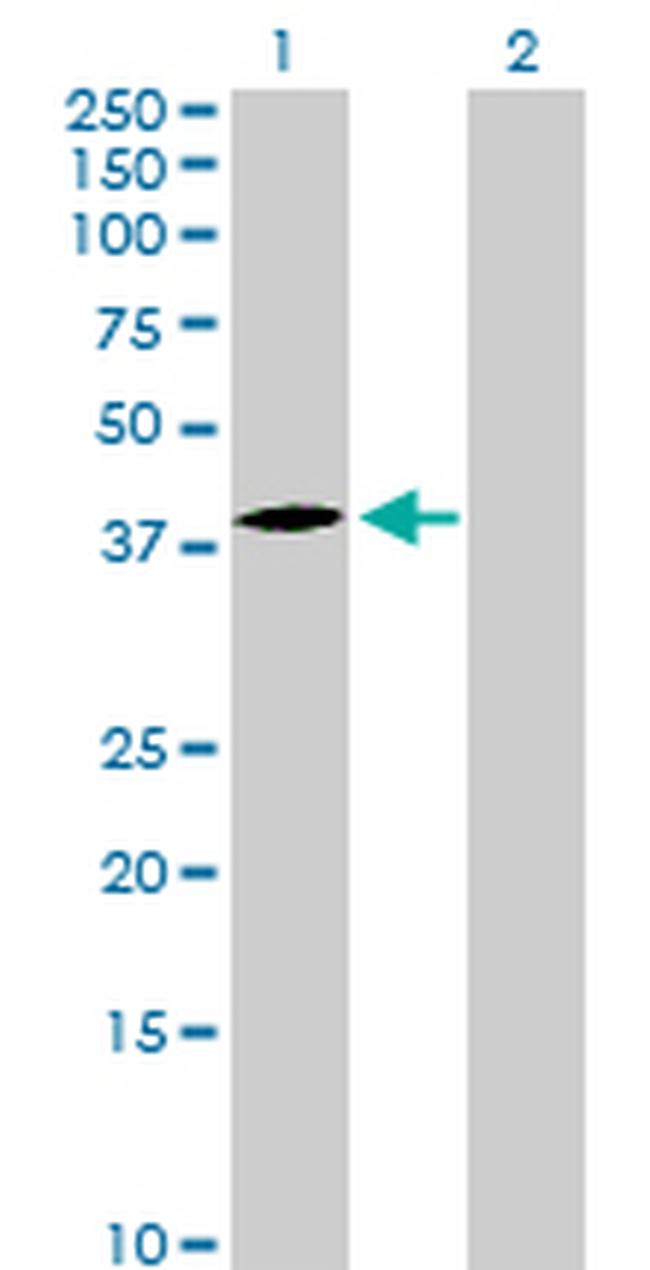
图: 1 / 1
TCF19 Antibody (H00006941-D01P) in WB
Western Blot analysis of TCF19 expression in transfected 293T cell line (H00006941-T01) by TCF19 MaxPab polyclonal antibody.
Lane 1: TCF19 transfected lysate(37.20 KDa).
Lane 2: Non-transfected lysate.
Lane 1: TCF19 transfected lysate(37.20 KDa).
Lane 2: Non-transfected lysate.

产品信息
H00006941-D01P
产品规格
宿主/亚型
Rabbit
/ IgG
分类
Polyclonal
类型
Antibody
抗原
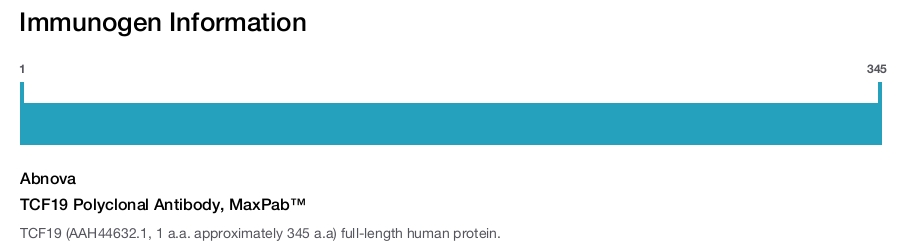
TCF19 (AAH44632.1, 1 a.a. approximately 345 a.a) full-length human protein.
偶联物
形式
Liquid
浓度
See Label
规格
100 µg
保存条件
-20°C, Avoid Freeze/Thaw Cycles
运输条件
Ambient (domestic); Wet ice (international)
产品详细信息
Sequence of this protein is as follows: MLPCFQLLRI GGGRGGDLYT FHPPAGAGCT YRLGHRADLC DVALRPQQEP GLISGIHAEL HAEPRGDDWR VSLEDHSSQG TLVNNVRLPR GHRLELSDGD LLTFGPEGPP GTSPSEFYFM FQQVRVKPQD FAAITIPRSR GEARVGAGFR PMLPSQGAPQ RPLSTFSPAP KATLILNSIG SLSKLRPQPL TFSPSWGGPK SLPVPAPPGE VGTTPSAPPQ RNRRKSVHRV LAELDDESEP PENPPPVLME PRKKLRVDKA PLTPTGNRRG RPRKYPVSAP MAPPAVGGGE PCAAPCCCLP QEETVAWVQC DGCDVWFHVA CVGCSIQAAR EADFRCPGCR AGIQT
靶标信息
TCF-19 (transcription factor 19), also known as SC1 or SC1-1, is a 345 amino acid protein that contains one FHA domain, a proline-rich domain and one PHD-type zinc finger. Localizing to the nucleus, TCF-19 is a growth regulated protein that is believed to function as a trans-activating factor with a role in the transcription of genes involved in the late stages of cell cycle progression (G1 to S transition or entry of cells into G2 and mitosis). TCF-19 is expressed preferentially in the G1-S phase of the cell cycle. The gene encoding TCF-19 localizes to a critical region on chromosome 6 that has been associated with psoriasis vulgaris, a disorder of the skin that is characterized by hyperproliferation of epidermal cells. This suggests that TCF-19, via its regulation of late cell cycle-specific genes, may play a role in the development of this disorder.
仅用于科研。不用于诊断过程。未经明确授权不得转售。
篇参考文献 (0)
您是否在文献中引用过该产品?请点击下方按钮邮件告知我们。
Disclaimer

Clicking the images or links will redirect you to a website hosted by BenchSci that provides third-party scientific content. Neither the content nor the BenchSci technology and processes for selection have been evaluated by us; we are providing them as-is and without warranty of any kind, including for use or application of the Thermo Fisher Scientific products presented.

