Search
Disclaimer

Clicking the images or links will redirect you to a website hosted by BenchSci that provides third-party scientific content. Neither the content nor the BenchSci technology and processes for selection have been evaluated by us; we are providing them as-is and without warranty of any kind, including for use or application of the Thermo Fisher Scientific products presented.
Progen
TKTL1 Monoclonal Antibody (VU-7H2-G5-C1)
{{$productOrderCtrl.translations['antibody.pdp.commerceCard.promotion.promotions']}}
{{$productOrderCtrl.translations['antibody.pdp.commerceCard.promotion.viewpromo']}}
{{$productOrderCtrl.translations['antibody.pdp.commerceCard.promotion.promocode']}}: {{promo.promoCode}} {{promo.promoTitle}} {{promo.promoDescription}}. {{$productOrderCtrl.translations['antibody.pdp.commerceCard.promotion.learnmore']}}
Additional Information:
{{banner.description}}
产品信息
610175PROGEN
产品规格
种属反应
Human
宿主/亚型
Mouse
/ IgG2a, kappa
分类
Monoclonal
类型
Antibody
克隆号
VU-7H2-G5-C1
抗原
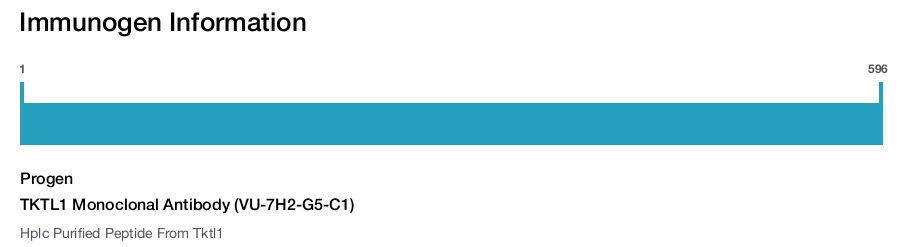
Hplc Purified Peptide From Tktl1
偶联物
形式
Lyophilized
浓度
0.05 mg/mL
纯化类型
Affinity chromatography
保存液
PBS, pH 7.4, with 0.5% BSA
内含物
0.09% sodium azide
保存条件
Store at 4°C short term. For long term storage, store at -20°C, avoiding freeze/thaw cycles.
运输条件
Ambient (domestic); Wet ice (international)
产品详细信息
Reconstitute lyophilized product with 1 mL distilled water.
Expression studies on transketolase-like-1 show that the protein is found in aggressive tumors. The detection of TKTL1 is furthermore correlated with poor patient prognosis and metastasis. Transketolase dependent reactions regulate the non-oxidative part of the pentose-phosphate-pathway (PPP) in glucose metabolism. This pathway generates NADPH and pentose phosphates. The latter are important for nucleic acid metabolism. Beside the ubiquitous transketolase (TKT) other transketolase-like proteins exist. Transketolase-like 1 (TKTL1) is a protein with a 38 amino acid deletion when compared to TKT. TKTL1 expression has been shown in tumors of different entities. Inhibition of TKTL1 expression by RNA interference results in reduced growth of tumor cells, while overexpression of TKTL1 promotes cell proliferation. Recent publications suggest an important role of TKTL1 in the metabolism of tumor cells. In colorectal tumors nuclear as well as cytoplasmic localization has been described.Reactivity on cultured cell lines: THP-1.
靶标信息
Strong TKTL1 protein expression has been correlated with a certain type of glucose metabolism (aerobic glycolysis; Warburg effect) and to cells which are affected by chronic complications of diabetic patients. In colon and urothelial carcinomas, expression at the protein level is correlated with invasiveness of tumors and poor patient survival.
仅用于科研。不用于诊断过程。未经明确授权不得转售。
篇参考文献 (0)
您是否在文献中引用过该产品?请点击下方按钮邮件告知我们。
生物信息学
蛋白别名: TK 2; Transketolase 2; transketolase-2; transketolase-like 1; Transketolase-like protein 1; Transketolase-related protein
基因别名: TKR; TKT2; TKTL1
UniProt ID: (Human) P51854
Entrez Gene ID: (Human) 8277

