Search
Invitrogen
TNFRH3 Polyclonal Antibody
{{$productOrderCtrl.translations['antibody.pdp.commerceCard.promotion.promotions']}}
{{$productOrderCtrl.translations['antibody.pdp.commerceCard.promotion.viewpromo']}}
{{$productOrderCtrl.translations['antibody.pdp.commerceCard.promotion.promocode']}}: {{promo.promoCode}} {{promo.promoTitle}} {{promo.promoDescription}}. {{$productOrderCtrl.translations['antibody.pdp.commerceCard.promotion.learnmore']}}
Additional Information:
{{banner.description}}
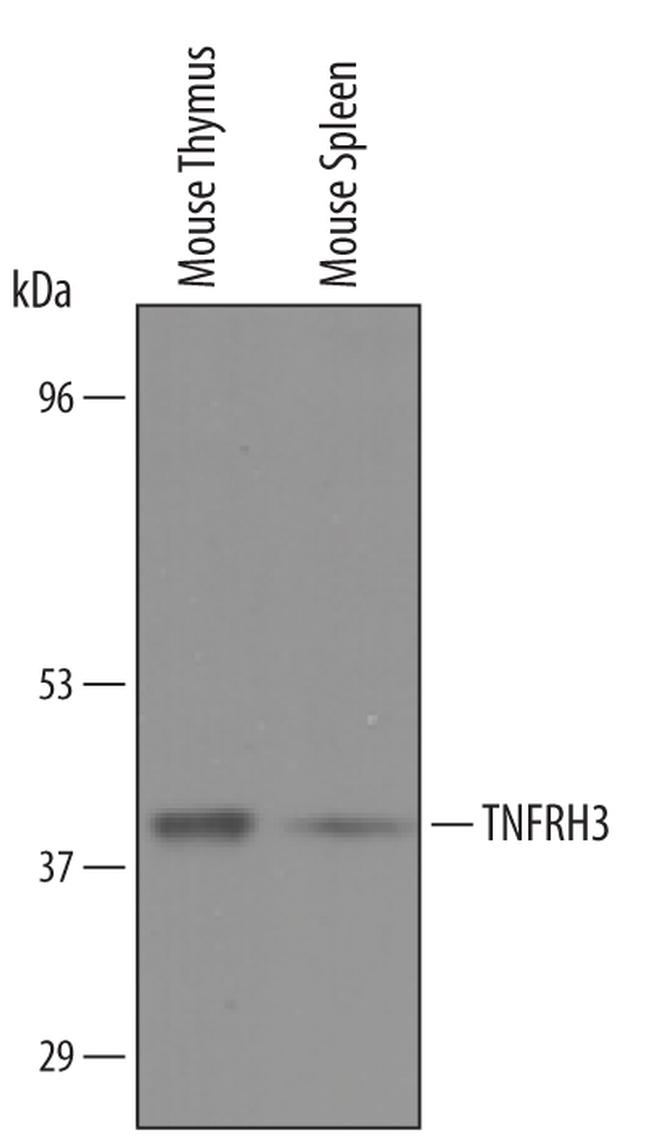
图: 1 / 2
TNFRH3 Antibody (PA5-47723) in WB
Western blot analysis of TNFRH3 in mouse thymus tissue and mouse spleen tissue. Samples were incubated in TNFRH3 polyclonal antibody (Product # PA5-47723) using a dilution of 1 µg/mL followed by a HRP-conjugated Anti-Sheep IgG secondary antibody. A specific band was detected for TNFRH3/TNFRSF26 at approximately 39 kDa (as indicated). This experiment was conducted under reducing conditions.
Please note: We are reviewing Western blot images included in the antibody testing data in our catalog, including those provided by third parties. Unless expressly labeled or annotated as “raw-unedited”, Western blot images included in the antibody testing data in our catalog may have been edited, optimized or otherwise adjusted for presentation.


产品信息
PA5-47723
产品规格
种属反应
Mouse
宿主/亚型
Sheep
/ IgG
分类
Polyclonal
类型
Antibody
抗原
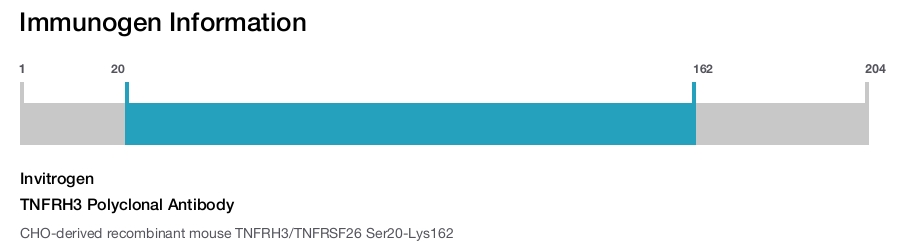
CHO-derived recombinant mouse TNFRH3/TNFRSF26 Ser20-Lys162
偶联物
Unconjugated
Unconjugated
Unconjugated
形式
Lyophilized
浓度
0.2 mg/mL
规格
100 µg
纯化类型
Antigen affinity chromatography
保存液
PBS with 5% trehalose
内含物
No Preservative
保存条件
-20°C, Avoid Freeze/Thaw Cycles
运输条件
Ambient (domestic); Wet ice (international)
RRID
产品详细信息
In direct ELISAs, less than 1% cross-reactivity with recombinant mouse (rm) TNF RI and rmTNF RII is observed.
Reconstitute at 0.2 mg/mL in sterile PBS.
靶标信息
The TNFRH3 gene encodes a protein that is part of the tumor necrosis factor receptor superfamily, which is involved in regulating immune responses, inflammation, and apoptosis. TNFRH3, also identified as tumor necrosis factor receptor homolog 3, is characterized by its similarities to other TNF receptors, yet its specific ligand and signaling pathways remain an area of active research. TNF receptors typically engage in critical interactions with ligands such as TNF-α, facilitating cellular responses that include the modulation of immune cell function, survival, and proliferation. Although TNFRH3's precise function is not fully elucidated, it is hypothesized to play a role in modulating immune signaling and inflammatory responses, potentially impacting autoimmune disease processes and cancer progression by influencing apoptosis and cell survival. Like other members of the TNF receptor family, TNFRH3 might interact with adaptor proteins to form signaling complexes that propagate downstream effects critical for immune homeostasis. Research efforts continue to define its role in physiological and pathological states, aiming to leverage its function for therapeutic applications in treating inflammatory diseases and cancer.
仅用于科研。不用于诊断过程。未经明确授权不得转售。
篇参考文献 (0)
您是否在文献中引用过该产品?请点击下方按钮邮件告知我们。
生物信息学
蛋白别名: mTNFRH3; TNF receptor homolog 3; TNFR; Tumor necrosis factor receptor; tumor necrosis factor receptor superfamily, member 24; unnamed protein product
基因别名: Tnfrh3; Tnfrsf24
UniProt ID: (Mouse) P83626
Entrez Gene ID: (Mouse) 244237
Disclaimer

Clicking the images or links will redirect you to a website hosted by BenchSci that provides third-party scientific content. Neither the content nor the BenchSci technology and processes for selection have been evaluated by us; we are providing them as-is and without warranty of any kind, including for use or application of the Thermo Fisher Scientific products presented.

