Search
Invitrogen
TRAF3 Polyclonal Antibody
{{$productOrderCtrl.translations['antibody.pdp.commerceCard.promotion.promotions']}}
{{$productOrderCtrl.translations['antibody.pdp.commerceCard.promotion.viewpromo']}}
{{$productOrderCtrl.translations['antibody.pdp.commerceCard.promotion.promocode']}}: {{promo.promoCode}} {{promo.promoTitle}} {{promo.promoDescription}}. {{$productOrderCtrl.translations['antibody.pdp.commerceCard.promotion.learnmore']}}
Additional Information:
{{banner.description}}
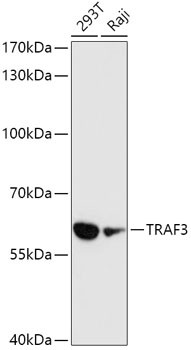
图: 1 / 1
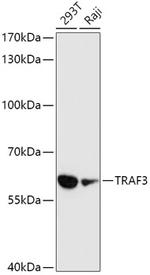
TRAF3 Antibody (PA5-87516) in WB
Western blot analysis of TRAF3 in extracts of various cell lines. Samples were incubated with TRAF3 Polyclonal antibody (Product # PA5-87516) using a dilution of 1:1,000, followed by HRP Goat Anti-Rabbit IgG (H+L) at a dilution of 1:10,000. Lysates/proteins: 25 µg per lane. Blocking buffer: 3% nonfat dry milk in TBST. Detection: ECL Enhanced Kit. Exposure time: 90s.
Please note: We are reviewing Western blot images included in the antibody testing data in our catalog, including those provided by third parties. Unless expressly labeled or annotated as “raw-unedited”, Western blot images included in the antibody testing data in our catalog may have been edited, optimized or otherwise adjusted for presentation.

产品信息
PA5-87516
产品规格
宿主/亚型
Rabbit
/ IgG
分类
Polyclonal
类型
Antibody
抗原
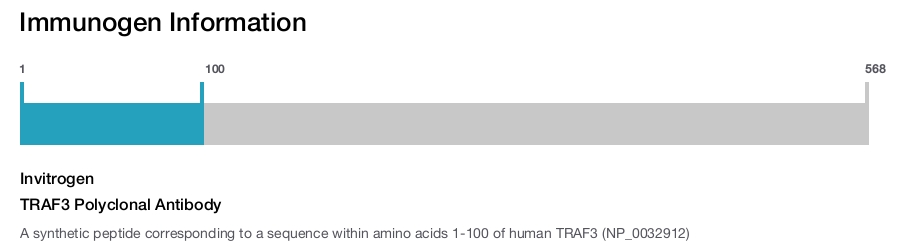
A synthetic peptide corresponding to a sequence within amino acids 1-100 of human TRAF3 (NP_0032912)
偶联物
Unconjugated
Unconjugated
Unconjugated
形式
Liquid
浓度
0.19 mg/mL
规格
19 µg
保存条件
-20°C, Avoid Freeze/Thaw Cycles
运输条件
Ambient (domestic); Wet ice (international)
RRID
产品详细信息
Immunogen sequence: MESSKKMDSP GALQTNPPLK LHTDRSAGTP VFVPEQGGYK EKFVKTVEDK YKCEKCHLVL CSPKQTECGH RFCESCMAAL LSSSSPKCTA CQESIVKDKV; Positive Samples: Mouse brain, Rat brain; Cellular Location: Cytoplasm, Endosome, Mitochondrion
靶标信息
Tumor necrosis factor (TNF) induced signaling is mediated through association of TNF receptor (TNFR) with adaptor proteins, such as TNF receptor associated proteins (TRAFs). TRAFs form a family of cytoplasmic adapter proteins that mediate signal transduction from many members of the TNF-receptor superfamily (e. g. RANK, CD30, CD40, etc. ) and the interleukin-1 receptor. The carboxy-terminal region of TRAFs is required for self-association and interaction with receptor cytoplasmic domains following ligand-induced oligomerization. Recent molecular cloning studies have lead to identification of six TRAFs (TRAF1-TRAF6). TRAF3, originally named CRAF1, interacts directly with the CD40 cytoplasmic tail through a region of similarity to the tumor necrosis factor-alpha (TNF-alpha) receptor-associated factors. TRAF3 binds only a single site, which contains the sequence PEQET, whereas TRAF1 and TRAF2 are capable of binding to either the PEQET site or an additional downstream domain.
仅用于科研。不用于诊断过程。未经明确授权不得转售。
篇参考文献 (0)
您是否在文献中引用过该产品?请点击下方按钮邮件告知我们。
Disclaimer

Clicking the images or links will redirect you to a website hosted by BenchSci that provides third-party scientific content. Neither the content nor the BenchSci technology and processes for selection have been evaluated by us; we are providing them as-is and without warranty of any kind, including for use or application of the Thermo Fisher Scientific products presented.

