Search
Proteintech
TRDN Polyclonal Antibody
{{$productOrderCtrl.translations['antibody.pdp.commerceCard.promotion.promotions']}}
{{$productOrderCtrl.translations['antibody.pdp.commerceCard.promotion.viewpromo']}}
{{$productOrderCtrl.translations['antibody.pdp.commerceCard.promotion.promocode']}}: {{promo.promoCode}} {{promo.promoTitle}} {{promo.promoDescription}}. {{$productOrderCtrl.translations['antibody.pdp.commerceCard.promotion.learnmore']}}
Additional Information:
{{banner.description}}


产品信息
26607-1-AP
产品规格
种属反应
Human,
Mouse,
Rat
宿主/亚型
Rabbit
/ IgG
分类
Polyclonal
类型
Antibody
抗原
Recombinant protein
偶联物
形式
Liquid
纯化类型
Antigen affinity chromatography
保存液
PBS with 50% glycerol
内含物
0.02% sodium azide
保存条件
-20°C
运输条件
Wet ice
产品详细信息
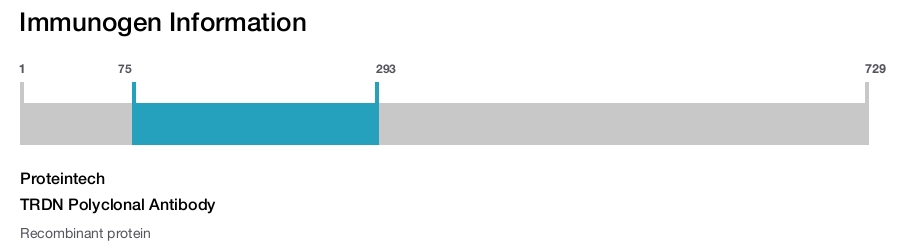
Immunogen sequence: NFSASSIAKI GSDPLKLVRD AMEETTDWIY GFFSLLSDII SSEDEEDDDG DEDSDKGEID EPPLRKKEIH KDKTEKQEKP ERKIQTKVTH KEKEKGKEKV REKEKPEKKA THKEKIEKKE KPETKTVAKE QKKAKTAEKS EEKTKKEVKG GKQEKVKQTA AKVKEVQKTP SKPKEKEDKE KAAVSKHEQK GQSPAIPPPL PTEQASRPTP ASPALEGKY
靶标信息
The junction between the transverse tubules (T-tubules) and the sarcoplasmic reticulum (SR) of skeletal muscle is called the triad. At the triad, dihydropyridine receptors (DHPR's) of the T-tubule serve as voltage sensors in excitation-contraction coupling, while ryanodine receptors (RyR's), the calcium release channels, exist in the membrane of the terminal cisternae of the SR. It is thought that during slow phase depolarization of the T-tubule, a third protein, triadin (MW 95 kDa) transmits electrochemical signals to the SR through direct interaction with both DHPR's and RyR's. Though its exact role in this signaling process is unclear, triadin has been shown to co-localize with both DHPR and RYR at the junctional face of the terminal cisternae.
仅用于科研。不用于诊断过程。未经明确授权不得转售。
篇参考文献 (0)
您是否在文献中引用过该产品?请点击下方按钮邮件告知我们。
生物信息学
蛋白别名: cardiac triadin; CT1; Triadin; triadin 1; triadin 32 kDa (TRISK 32); triadin 49 kDa (TRISK 49); triadin 95; triadin in skeletal muscle; unnamed protein product
基因别名: 2310045H21Rik; CARDAR; CPVT5; EG432451; TDN; TRDN; TRISK
UniProt ID: (Human) Q13061, (Rat) Q9QX75, (Mouse) E9Q9K5
Entrez Gene ID: (Human) 10345, (Rat) 59299, (Mouse) 76757
cellular calcium ion homeostasis
regulation of release of sequestered calcium ion into cytosol by sarcoplasmic reticulum
response to organic cyclic compound
release of sequestered calcium ion into cytosol by sarcoplasmic reticulum
myotube differentiation
cytoplasmic microtubule organization
negative regulation of release of sequestered calcium ion into cytosol
positive regulation of release of sequestered calcium ion into cytosol
heart contraction
endoplasmic reticulum membrane organization
muscle contraction
response to bacterium
regulation of cell communication by electrical coupling
regulation of cardiac muscle contraction by regulation of the release of sequestered calcium ion
regulation of sequestering of calcium ion
establishment of localization in cell
regulation of cardiac muscle cell membrane potential
positive regulation of cell communication by electrical coupling involved in cardiac conduction
Disclaimer

Clicking the images or links will redirect you to a website hosted by BenchSci that provides third-party scientific content. Neither the content nor the BenchSci technology and processes for selection have been evaluated by us; we are providing them as-is and without warranty of any kind, including for use or application of the Thermo Fisher Scientific products presented.

