Search
Invitrogen
TRIM71 Polyclonal Antibody
{{$productOrderCtrl.translations['antibody.pdp.commerceCard.promotion.promotions']}}
{{$productOrderCtrl.translations['antibody.pdp.commerceCard.promotion.promocode']}}: {{promo.promoCode}} {{promo.promoTitle}} {{promo.promoDescription}}. {{$productOrderCtrl.translations['antibody.pdp.commerceCard.promotion.learnmore']}}
{{$ctrl.translations['antibody.pdp.skuNotes.additionalInformation']}}:
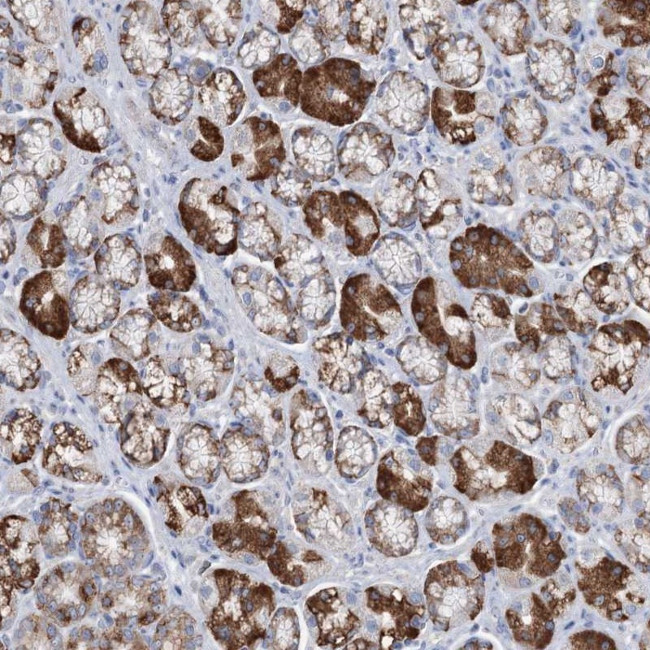
Please note: We are reviewing Western blot images included in the antibody testing data in our catalog, including those provided by third parties. Unless expressly labeled or annotated as “raw-unedited”, Western blot images included in the antibody testing data in our catalog may have been edited, optimized or otherwise adjusted for presentation.

产品信息
PA5-58265
产品规格
种属反应
Human
宿主/亚型
Rabbit
/ IgG
分类
Polyclonal
类型
Antibody
抗原
偶联物
Unconjugated
Unconjugated
Unconjugated
形式
Liquid
浓度
0.1 mg/mL
规格
10 µg
纯化类型
Antigen affinity chromatography
保存液
PBS, pH 7.2, with 40% glycerol
内含物
0.02% sodium azide
保存条件
Store at 4°C short term. For long term storage, store at -20°C, avoiding freeze/thaw cycles.
运输条件
Ambient (domestic); Wet ice (international)
RRID
产品详细信息
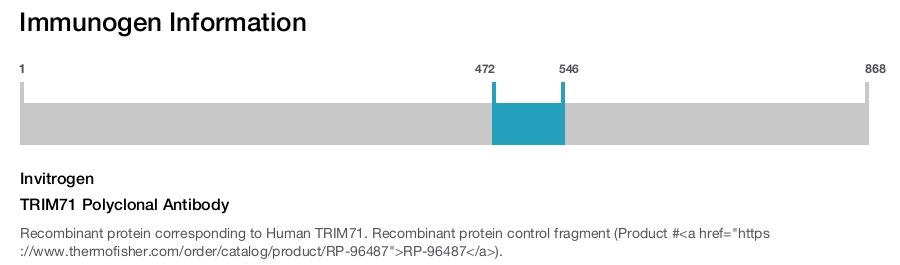
Immunogen sequence: IKSFGFVSSG AFAPLTKATG DGLKRALQGK VASFTVIGYD HDGEPRLSGG DLMSAVVLGP DGNLFGAEVS DQQNG
Highest antigen sequence identity to the following orthologs: Mouse - 92%, Rat - 92%.
靶标信息
TRIM71 is the mammalian ortholog to the C. elegans heterochronic protein Lin41, a protein that is thought to be important in postembryonic development, and is genetically and biochemically downstream of both Shh and Fgf signaling pathways. Similar to its C. elegans homolog, TRIM71 is a target of the microRNA let-7 and is likely to play a role in mammalian development. Recent experiments have indicated that TRIM71 is an E3 ubiquitin ligase and can interact with the Dicer and the Argonaute proteins Ago1, Ago2, and Ago4. Overexpression and depletion of TRIM71 led to inverse changes in Ago2 protein levels, suggesting TRIM71 can regulate Ago2 turnover. Finally, TRIM71 cooperates with the pluripotency factor Lin-28 in regulating let-7.
仅用于科研。不用于诊断过程。未经明确授权不得转售。
篇参考文献 (0)
您是否在文献中引用过该产品?请点击下方按钮邮件告知我们。
生物信息学
蛋白别名: abnormal cell LINeage LIN-41; homolog of C. elegans Lin-41; protein lin-41 homolog; RBCC protein; RING-type E3 ubiquitin transferase TRIM71; tripartite motif containing 71, E3 ubiquitin protein ligase; tripartite motif-containing protein 71
基因别名: HYC4; HYDCC1; LIN-41; LIN41
UniProt ID: (Human) Q2Q1W2
Entrez Gene ID: (Human) 131405
G1/S transition of mitotic cell cycle
protein polyubiquitination
fibroblast growth factor receptor signaling pathway
posttranscriptional regulation of gene expression
protein ubiquitination
negative regulation of translation
neural tube development
gene silencing by RNA
production of miRNAs involved in gene silencing by miRNA
miRNA mediated inhibition of translation
proteasome-mediated ubiquitin-dependent protein catabolic process
protein autoubiquitination
3'-UTR-mediated mRNA destabilization
stem cell proliferation
regulation of neural precursor cell proliferation
Disclaimer

Clicking the images or links will redirect you to a website hosted by BenchSci that provides third-party scientific content. Neither the content nor the BenchSci technology and processes for selection have been evaluated by us; we are providing them as-is and without warranty of any kind, including for use or application of the Thermo Fisher Scientific products presented.

