Search
Proteintech
TRPA1 Polyclonal Antibody
{{$productOrderCtrl.translations['antibody.pdp.commerceCard.promotion.promotions']}}
{{$productOrderCtrl.translations['antibody.pdp.commerceCard.promotion.viewpromo']}}
{{$productOrderCtrl.translations['antibody.pdp.commerceCard.promotion.promocode']}}: {{promo.promoCode}} {{promo.promoTitle}} {{promo.promoDescription}}. {{$productOrderCtrl.translations['antibody.pdp.commerceCard.promotion.learnmore']}}
Additional Information:
{{banner.description}}
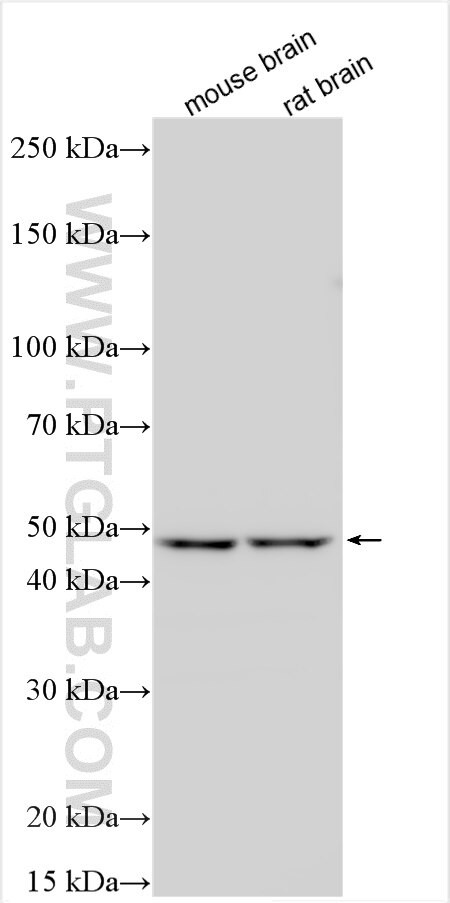

产品信息
25226-1-AP
产品规格
种属反应
Human
宿主/亚型
Rabbit
/ IgG
分类
Polyclonal
类型
Antibody
抗原
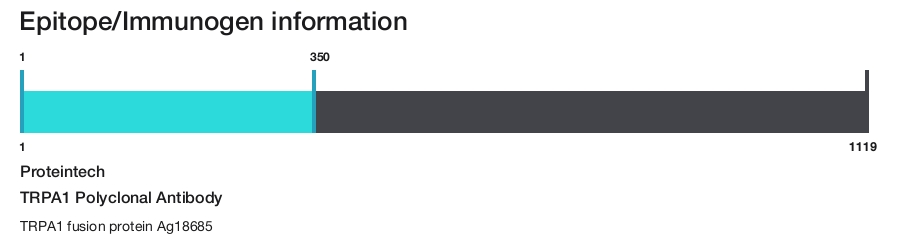
TRPA1 fusion protein Ag18685
偶联物
形式
Liquid
浓度
500 µg/mL
规格
75 µg
纯化类型
Affinity chromatography
保存液
PBS, pH 7.3, with 50% glycerol
内含物
0.02% sodium azide
保存条件
-20°C
运输条件
Wet ice
产品详细信息
Sequence of this protein is as follows: MKRSLRKMWR PGEKKEPQGV VYEDVPDDTE DFKESLKVVF EGSAYGLQNF NKQKKLKRCD DMDTFFLHYA AAEGQIELME KITRDSSLEV LHEMDDYGNT PLHCAVEKNQ IESVKFLLSR GANPNLRNFN MMAPLHIAVQ GMNNEVMKVL LEHRTIDVNL EGENGNTAVI IACTTNNSEA LQILLKKGAK PCKSNKWGCF PIHQAAFSGS KECMEIILRF GEEHGYSRQL HINFMNNGKA TPLHLAVQNG DLEMIKMCLD NGAQIDPVEK GRCTAIHFAA TQGATEIVKL MISSYSGSVD IVNTTDGCHE TMLHRASLFD HHELADYLIS VGADINKIDS EGRSPLILAT
靶标信息
TRPA1 is a TRP-related channel that responds to cold temperatures and pungent compounds and plays a role in both nociceptor and hair cell transduction. TRPA1 is a transformation -associated gene product in lung epithelia, whereas its protein distribution is primarily restricted to sensory neurons. Blocking TRPA1 may be a therapeutic target for treating cold hyperalgesia caused by inflammation and nerve damage. It is now known that TRPA1 protein is also widely expressed outside of the CNS and is dys-regulated during oncogenic transformation. The structure of TRPA1 is highly related to both the protein ankyrin and transmembrane proteins. The specific function of TRPA1 has not yet been determined; however, studies indicate the function may involve a role in signal transduction and growth control.
仅用于科研。不用于诊断过程。未经明确授权不得转售。
篇参考文献 (0)
您是否在文献中引用过该产品?请点击下方按钮邮件告知我们。
生物信息学
蛋白别名: ankyrin-like with transmembrane domains 1; Ankyrin-like with transmembrane domains protein 1; nompC; p120; Transformation-sensitive protein p120; Transient receptor potential cation channel subfamily A member 1; TRPA-1; Wasabi receptor
基因别名: ANKTM1; FEPS; FEPS1; p120; TRPA1
UniProt ID: (Human) O75762
Entrez Gene ID: (Human) 8989
system process
ion transport
calcium ion transport
cellular calcium ion homeostasis
cell surface receptor signaling pathway
response to cold
response to xenobiotic stimulus
urinary bladder smooth muscle contraction
sensory perception of pain
calcium-mediated signaling
cellular response to stress
ion transmembrane transport
cellular response to heat
positive regulation of insulin secretion involved in cellular response to glucose stimulus
response to hydrogen peroxide
response to pain
thermoception
detection of mechanical stimulus involved in sensory perception of pain
detection of chemical stimulus involved in sensory perception of pain
detection of mechanical stimulus involved in sensory perception
protein homotetramerization
transmembrane transport
cellular response to hydrogen peroxide
cellular response to cold
calcium ion transmembrane transport
cellular response to food
cellular response to carbon dioxide
cellular response to caffeine
cellular response to toxic substance
calcium ion transmembrane import into cytosol
regulation of neuronal action potential
cellular response to oxygen-containing compound
regulation of blood circulation
positive regulation of monoatomic anion transport
Disclaimer

Clicking the images or links will redirect you to a website hosted by BenchSci that provides third-party scientific content. Neither the content nor the BenchSci technology and processes for selection have been evaluated by us; we are providing them as-is and without warranty of any kind, including for use or application of the Thermo Fisher Scientific products presented.

