Search
Invitrogen
TSHZ2 Polyclonal Antibody
{{$productOrderCtrl.translations['antibody.pdp.commerceCard.promotion.promotions']}}
{{$productOrderCtrl.translations['antibody.pdp.commerceCard.promotion.viewpromo']}}
{{$productOrderCtrl.translations['antibody.pdp.commerceCard.promotion.promocode']}}: {{promo.promoCode}} {{promo.promoTitle}} {{promo.promoDescription}}. {{$productOrderCtrl.translations['antibody.pdp.commerceCard.promotion.learnmore']}}
Additional Information:
{{banner.description}}
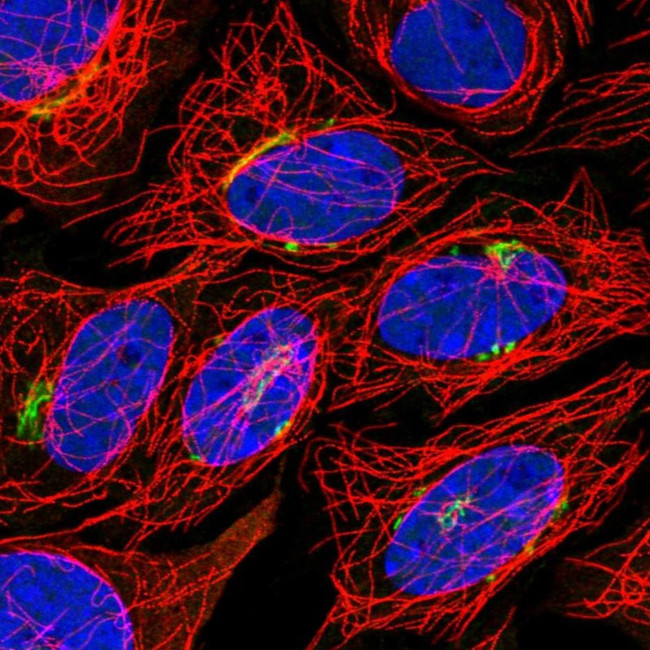
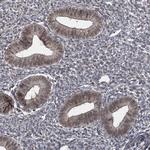
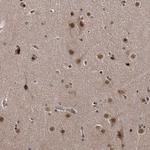
Please note: We are reviewing Western blot images included in the antibody testing data in our catalog, including those provided by third parties. Unless expressly labeled or annotated as “raw-unedited”, Western blot images included in the antibody testing data in our catalog may have been edited, optimized or otherwise adjusted for presentation.


产品信息
PA5-58255
产品规格
宿主/亚型
Rabbit
/ IgG
分类
Polyclonal
类型
Antibody
抗原
偶联物
Unconjugated
Unconjugated
Unconjugated
形式
Liquid
浓度
0.20 mg/mL
规格
20 µg
保存条件
Store at 4°C short term. For long term storage, store at -20°C, avoiding freeze/thaw cycles.
运输条件
Ambient (domestic); Wet ice (international)
RRID
产品详细信息
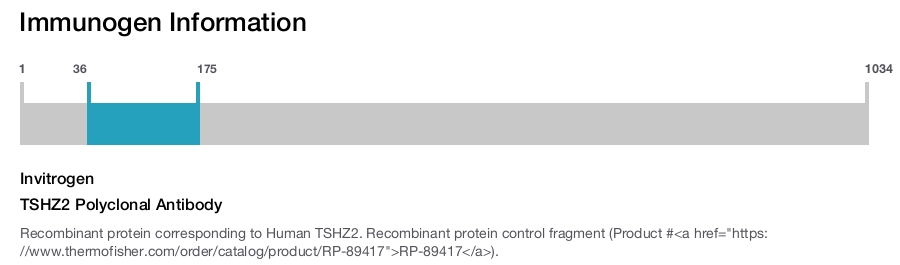
Immunogen sequence: SGSVAQLQGG NDTGTDEELE TGPEQKGCFS YQNSPGSHLS NQDAENESLL SDASDQVSDI KSVCGRDASD KKAHTHVRLP NEAHNCMDKM TAVYANILSD SYWSGLGLGF KLSNSERRNC DTRNGSNKSD FDWHQDALSK
Highest antigen sequence identity to the following orthologs: Mouse - 89%, Rat - 90%.
靶标信息
The Teashirt zinc finger homeobox (TSHZ) family comprise a family of evolutionarily conserved transcription factors that, in Drosophila, are active in specific body parts for patterning, but whose function in vertebrates is less clear. In mice, the known three TSHZ proteins are expressed in distinct patterns in the developing and adult brain, suggesting that they play a role in the establishment of regional identity and specification of cell types within the brain. Recent experiments have shown that the expression of TSHZ2 is frequently downregulated in most breast and prostate cancers and its promoter was unmethylated in virtually all cases, suggesting this family of proteins may also be involved in carcinogenesis.
仅用于科研。不用于诊断过程。未经明确授权不得转售。
篇参考文献 (0)
您是否在文献中引用过该产品?请点击下方按钮邮件告知我们。
Disclaimer

Clicking the images or links will redirect you to a website hosted by BenchSci that provides third-party scientific content. Neither the content nor the BenchSci technology and processes for selection have been evaluated by us; we are providing them as-is and without warranty of any kind, including for use or application of the Thermo Fisher Scientific products presented.

