Search
Disclaimer

Clicking the images or links will redirect you to a website hosted by BenchSci that provides third-party scientific content. Neither the content nor the BenchSci technology and processes for selection have been evaluated by us; we are providing them as-is and without warranty of any kind, including for use or application of the Thermo Fisher Scientific products presented.
Invitrogen
Ub-K63 Monoclonal Antibody (HWA4C4), eBioscience™
{{$productOrderCtrl.translations['antibody.pdp.commerceCard.promotion.promotions']}}
{{$productOrderCtrl.translations['antibody.pdp.commerceCard.promotion.viewpromo']}}
{{$productOrderCtrl.translations['antibody.pdp.commerceCard.promotion.promocode']}}: {{promo.promoCode}} {{promo.promoTitle}} {{promo.promoDescription}}. {{$productOrderCtrl.translations['antibody.pdp.commerceCard.promotion.learnmore']}}


产品信息
14-6077-37
应用
建议稀释比
已发表文章
产品规格
已发表种属
C. elegans,
Human,
Mouse
宿主/亚型
Mouse
/ IgG2a
分类
Monoclonal
类型
Antibody
克隆号
HWA4C4
偶联物
形式
Liquid
浓度
0.5 mg/mL
保存条件
4°C
运输条件
Wet ice
RRID
产品详细信息
Description: Ubiquitin is a highly conserved 76kDa protein which is ligated to many proteins in both monomeric and polymeric forms. Ubiquitin polymers (polyubiquitin) can be found in several varieties depending on which of its 7 lysine residues is the site of ligation. The two most common polymer chains are linked via an isopeptide bond between glycine-76 and either lysine-48 (K-48) or lysine-63 (K-63). K-48-linked polyubiquitination typically results in targeting the protein to the 26S proteosome resulting in proteolysis, although recently exceptions to this have been observed. In contrast, K-63-linked polyubiquitination results in signals related to intracellular trafficking, cell signaling, ribosomal biogenesis, and DNA damage repair. There are also reports that K63-linked polyubiquitin is involved in proteosome-independent proteolysis via autophagy.
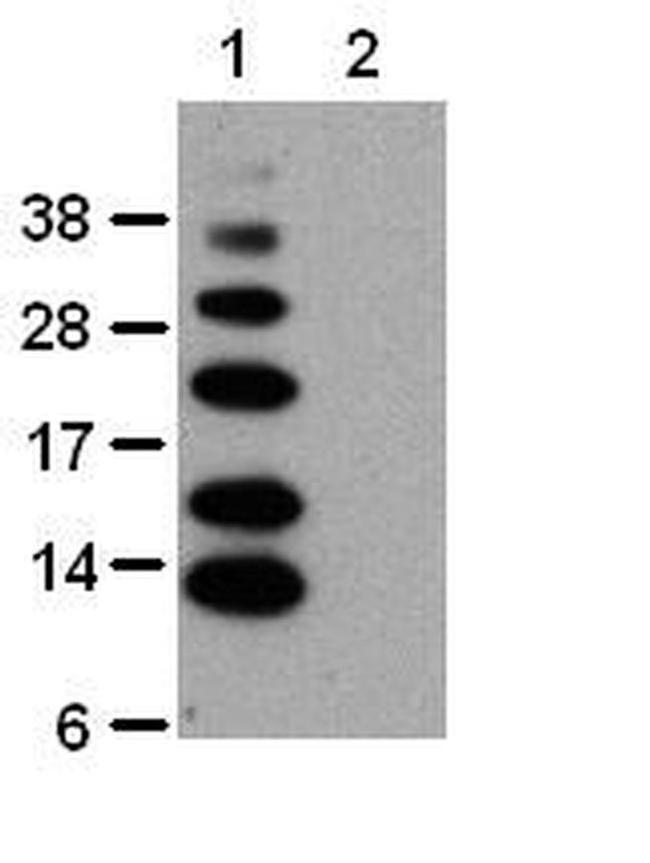
HWA4C4 reacts specifically with the isopeptide linkage region of lysine-63-linked polyubiquitin. It does not react with other forms of ubiquitin including ubiquitin monomer and lysine-48-linked chains.
Applications Reported: This HWA4C4 antibody has been reported for use in immunoblotting (WB).
Applications Tested: This HWA2-8°C4 antibody has been tested by immunoblot of lysine-63-linked polyubiquitin chains. This can be used at less than or equal to 2 µg/mL. It is recommended that the antibody be carefully titrated for optimal performance in the assay of interest.
Purity: Greater than 90%, as determined by SDS-PAGE.
Aggregation: Less than 10%, as determined by HPLC.
Filtration: 0.2 µm post-manufacturing filtered.
靶标信息
Ubiquitin is a conserved 76 amino acid polypeptide and can affect proteasomal degradation of the protein it is bound to, or mediate interactions with other proteins related to post-translational modifications. The degradation of cellular regulatory proteins by the Uubiquitin pathway is important as it controls the cellular growth and proliferation. Ubiquitin-dependent proteolysis occurs after a covalent attachment of the peptide to a lysine residue of a protein, which involves three enzymatic reactions: E1, E2 and E3. The first reaction involves ubiquitin-activating enzyme. The third reaction uses enzyme ubiquitin ligase (E3) to transfer the activated ubiquitin from E2 to a lysine residue on a protein, or directly transfers the ubiquitin from E2 to the substrate.
仅用于科研。不用于诊断过程。未经明确授权不得转售。

