Search
Invitrogen
VEGF-165 Polyclonal Antibody
{{$productOrderCtrl.translations['antibody.pdp.commerceCard.promotion.promotions']}}
{{$productOrderCtrl.translations['antibody.pdp.commerceCard.promotion.promocode']}}: {{promo.promoCode}} {{promo.promoTitle}} {{promo.promoDescription}}. {{$productOrderCtrl.translations['antibody.pdp.commerceCard.promotion.learnmore']}}
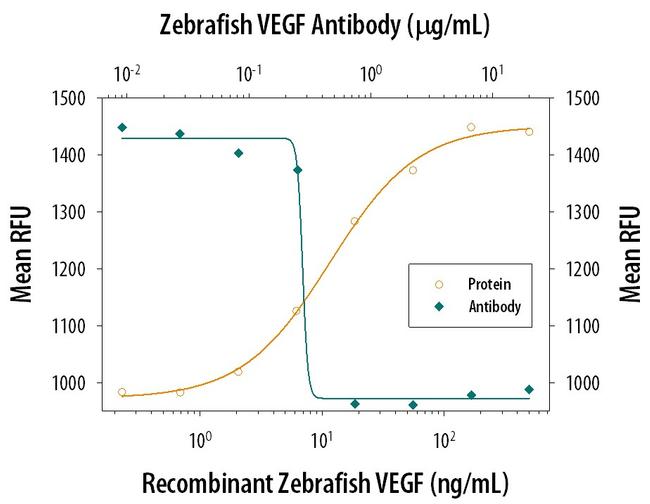
图: 1 / 1
VEGF-165 Antibody (PA5-47103) in Neu
Neutralization of VEGF in HUVEC human umbilical vein endothelial cells. Samples were incubated in VEGF polyclonal antibody (Product # PA5-47103) using a dilution of 80 ng/mL. Recombinant Zebrafish VEGF165 stimulates proliferation in HUVEC human umbilical vein endothelial cells in a dose‚dependent manner (orange line). Proliferation elicited by Recombinant Zebrafish VEGF165 is neutralized (green line) by increasing concentrations of Goat Anti‚Zebrafish VEGF Antigen Affinity‚purified Polyclonal Antibody. The ND50 is typically 0.3-0.6 µg/mL.
Please note: We are reviewing Western blot images included in the antibody testing data in our catalog, including those provided by third parties. Unless expressly labeled or annotated as “raw-unedited”, Western blot images included in the antibody testing data in our catalog may have been edited, optimized or otherwise adjusted for presentation.

产品信息
PA5-47103
产品规格
种属反应
Zebrafish
宿主/亚型
Goat
/ IgG
分类
Polyclonal
类型
Antibody
抗原
Sf 21-derived recombinant zebrafish VEGF165 Ala24-Arg188
偶联物
Unconjugated
Unconjugated
Unconjugated
形式
Lyophilized
浓度
0.2 mg/mL
规格
100 µg
纯化类型
Antigen affinity chromatography
保存液
PBS with 5% trehalose
内含物
No Preservative
保存条件
-20°C, Avoid Freeze/Thaw Cycles
运输条件
Ambient (domestic); Wet ice (international)
RRID
产品详细信息
In Western blots, less than 2% cross-reactivity with recombinant human VEGF165, recombinant mouse VEGF164, and recombinant rat VEGF164 (under non-reducing conditions) is observed.
Reconstitute at 0.2 mg/mL in sterile PBS.
Endoxin level is <0.10 EU per 1 µg of the antibody by the LAL method.
靶标信息
The vascular endothelial growth factor (VEGF) family currently includes VEGF-A, VEGF-B, VEGF-C, VEGF-D, VEGF-E, and PIGF. VEGF and its receptor system have been shown to be the fundamental regulators in the cell signaling of angiogenesis. Most tumors have the absolute requirement of angiogenesis and VEGF has been described as the most potent angiogenic cytokine linked to this process. To date 5 different isoforms of VEGF have been described. These isoforms are generated as the result of alternative splicing from a single VEGF gene. These various isoforms have been shown to bind to two tyrosine-kinase receptors flt-1 (VEGFR-1) and flk-1/KDR (VEGFR-2), which have been found to be expressed almost exclusively on endothelial cells.
仅用于科研。不用于诊断过程。未经明确授权不得转售。
篇参考文献 (0)
您是否在文献中引用过该产品?请点击下方按钮邮件告知我们。
生物信息学
蛋白别名: H-VEGF-165; M-VEGF-165; VEGF165
Disclaimer

Clicking the images or links will redirect you to a website hosted by BenchSci that provides third-party scientific content. Neither the content nor the BenchSci technology and processes for selection have been evaluated by us; we are providing them as-is and without warranty of any kind, including for use or application of the Thermo Fisher Scientific products presented.

