Search
Proteintech
c-MYC Polyclonal Antibody
{{$productOrderCtrl.translations['antibody.pdp.commerceCard.promotion.promotions']}}
{{$productOrderCtrl.translations['antibody.pdp.commerceCard.promotion.viewpromo']}}
{{$productOrderCtrl.translations['antibody.pdp.commerceCard.promotion.promocode']}}: {{promo.promoCode}} {{promo.promoTitle}} {{promo.promoDescription}}. {{$productOrderCtrl.translations['antibody.pdp.commerceCard.promotion.learnmore']}}
Additional Information:
{{banner.description}}

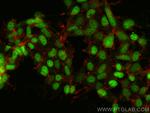
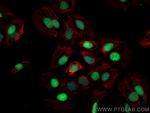
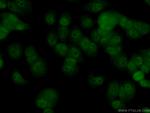
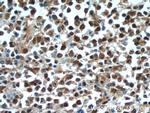


产品信息
10828-1-AP
应用
建议稀释比
已发表文章
产品规格
种属反应
Human,
Mouse
已发表种属
Human,
Mouse,
Rat
宿主/亚型
Rabbit
/ IgG
分类
Polyclonal
类型
Antibody
抗原
c-MYC Fusion Protein Ag1263 (16-454 aa encoded by BC000141)
偶联物
形式
Liquid
浓度
0.29 mg/mL
规格
43.5 µg
纯化类型
Antigen affinity chromatography
保存液
PBS, pH 7.3, with 50% glycerol
内含物
0.02% sodium azide
保存条件
-20°C
运输条件
Wet ice (domestic); Dry ice (international)
产品详细信息
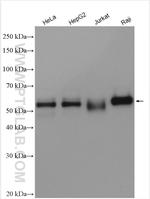
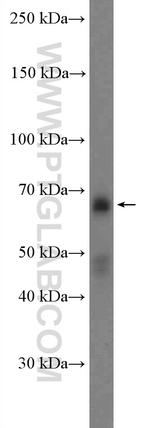
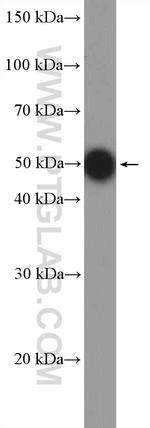
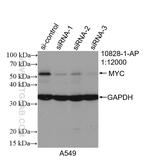
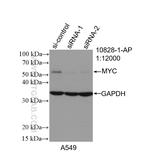
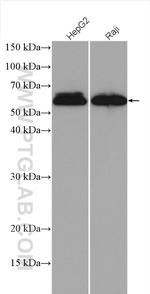
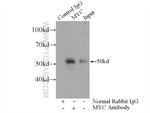
This antibody is a rabbit polyclonal antibody raised against recombinant protein of human MYC. The 50 kDa band recognized by antibody is the native form of MYC, while the other bands, between 60-70 kDa, are the phosphorylated form of MYC .
Immunogen sequence: MPLNVSFTN RNYDLDYDSV QPYFYCDEEE NFYQQQQQSE LQPPAPSEDI WKKFELLPTP PLSPSRRSGL CSPSYVAVTP FSLRGDNDGG GGSFSTADQL EMVTELLGGD MVNQSFICDP DDETFIKNII IQDCMWSGFS AAAKLVSEKL ASYQAARKDS GSPNPARGHS VCSTSSLYLQ DLSAAASECI DPSVVFPYPL NDSSSPKSCA SQDSSAFSPS SDSLLSSTES SPQGSPEPLV LHEETPPTTS SDSEEEQEDE EEIDVVSVEK RQAPGKRSES GSPSAGGHSK PPHSPLVLKR CHVSTHQHNY AAPPSTRKDY PAAKRVKLDS VRVLRQISNN RKCTSPRSSD TEENVKRRTH NVLERQRRNE LKRSFFALRD QIPELENNEK APKVVILKKA TAYILSVQAE EQKLISEEDL LRKRREQLKH KLEQLRNSCA (16-454 aa encoded by BC000141)
靶标信息
The c-Myc protein is a 62 kDa transcription factor that is encoded by the c-Myc gene on human chromosome 8q24. c-Myc is commonly activated in a variety of tumor cells and plays an important role in cellular proliferation, differentiation, apoptosis and cell cycle progression. The phosphorylation of c-Myc has been investigated and previous studies have suggested a functional association between phosphorylation at Thr58/Ser62 by glycogen synthase kinase 3, cyclin dependent kinase, ERK2 and C-Jun N terminal Kinase (JNK) in cell proliferation and cell cycle regulation. Studies have shown that c-Myc is essential for vasculogenesis and angiogenesis in tumor development, which distributes blood throughout the cells. The c-myc oncogene (p62 c-myc) is involved in the control of normal cellular proliferation and differentiation, and the deregulated expression of c-Myc induces apoptosis in different cell types. Antibodies against c-myc epitopes recognize overexpressed proteins containing Myc epitope tag fused to either amino- or carboxy-termini of targeted proteins. c-Myc-, N-Myc- and L-Myc-encoded proteins function in cell proliferation, differentiation and neoplastic disease. Amplification of the c-Myc gene has been found in several types of human tumors including lung, breast and colon carcinomas, while the N-Myc gene has been found amplified in neuroblastomas. Translocation of the c-myc locus on chromosome 8 to the immunoglobulin loci on chromosome 14 (heavy chain); 2 (delta light chain); or 22 (light chain) is described in Burkitts lymphoma and other B-cell lymphoproliferative conditions. An aberrant expression of the c-myc gene occurs in tumors of different origins such as colorectal, gastric, gallbladder, hepatic, mammary, ovarian, endometrial, head and neck, pulmonary, prostatic, thyroidal, oral, ocular, nasopharyngeal, endocrine, as well as hematopoietic neoplasms.
仅用于科研。不用于诊断过程。未经明确授权不得转售。
生物信息学
蛋白别名: avian myelocytomatosis viral oncogene homolog; bHLHe39; c Myc; c-myc; c-myc epitope tag; c-myc protein, first expressed; c-myc proto-oncogene; Class E basic helix-loop-helix protein 39; cmyc; Myc protein; Myc proto-oncogene protein; myc-related translation/localization regulatory factor; ORF 114; ORF 114; putative; ORF 118; Proto-oncogene c-Myc; Transcription factor p64; unnamed protein product; v-myc avian myelocytomatosis viral oncogene homolog; v-myc myelocytomatosis viral oncogene homolog
基因别名: AU016757; BHLHE39; c-Myc; MRTL; MYC; Myc2; MYCC; Niard; Nird
UniProt ID: (Human) P01106, (Mouse) P01108
Entrez Gene ID: (Human) 4609, (Mouse) 17869
RNA polymerase II core promoter proximal region sequence-specific DNA binding
RNA polymerase II transcription factor activity, sequence-specific DNA binding
core promoter proximal region sequence-specific DNA binding
core promoter sequence-specific DNA binding
transcription cofactor binding
transcriptional repressor activity, RNA polymerase II transcription regulatory region sequence-specific binding
transcriptional activator activity, RNA polymerase II transcription regulatory region sequence-specific binding
DNA binding
transcription factor activity, sequence-specific DNA binding
protein binding
ubiquitin protein ligase binding
identical protein binding
macromolecular complex binding
protein dimerization activity
E-box binding
DNA-binding transcription factor binding
SCF ubiquitin ligase complex binding
transcriptional activator activity, RNA polymerase II core promoter proximal region sequence-specific binding
double-stranded DNA binding
transcription factor binding
protein complex binding
sequence-specific DNA binding
protein heterodimerization activity
repressing transcription factor binding
basic helix-loop-helix transcription factor
G1/S transition of mitotic cell cycle
negative regulation of transcription from RNA polymerase II promoter
MAPK cascade
branching involved in ureteric bud morphogenesis
B cell apoptotic process
NK T cell proliferation
positive regulation of mesenchymal cell proliferation
positive regulation of B cell apoptotic process
chromatin remodeling
regulation of transcription, DNA-templated
regulation of transcription from RNA polymerase II promoter
transcription from RNA polymerase II promoter
cellular iron ion homeostasis
cellular response to DNA damage stimulus
cell proliferation
positive regulation of cell proliferation
intrinsic apoptotic signaling pathway in response to DNA damage
response to radiation
response to xenobiotic stimulus
regulation of gene expression
regulation of cell cycle process
positive regulation of gene expression
myotube differentiation
Wnt signaling pathway
rRNA metabolic process
protein processing
regulation of telomere maintenance
positive regulation of telomere maintenance
negative regulation of stress-activated MAPK cascade
protein-DNA complex disassembly
cellular response to UV
cellular response to interferon-alpha
skeletal muscle cell differentiation
middle ear morphogenesis
regulation of apoptotic process
negative regulation of apoptotic process
proteasome-mediated ubiquitin-dependent protein catabolic process
response to alkaloid
pigmentation
hypermethylation of CpG island
fibroblast apoptotic process
negative regulation of monocyte differentiation
positive regulation of transcription, DNA-templated
positive regulation of transcription from RNA polymerase II promoter
positive regulation of fibroblast proliferation
negative regulation of fibroblast proliferation
skeletal system morphogenesis
positive regulation of epithelial cell proliferation
detection of mechanical stimulus involved in sensory perception of sound
chromosome organization
negative regulation of cell division
positive regulation of transcription initiation from RNA polymerase II promoter
negative regulation of transcription initiation from RNA polymerase II promoter
ERK1 and ERK2 cascade
response to growth factor
cellular response to hypoxia
cellular response to xenobiotic stimulus
positive regulation of metanephric cap mesenchymal cell proliferation
positive regulation of intrinsic apoptotic signaling pathway by p53 class mediator
positive regulation of pri-miRNA transcription from RNA polymerase II promoter
regulation of somatic stem cell population maintenance
positive regulation of acinar cell proliferation
acinar cell proliferation
positive regulation of apoptotic signaling pathway
regulation of oxidative phosphorylation
glucose metabolic process
transcription, DNA-templated
DNA-templated transcription, initiation
pyruvate transport
amino acid transport
activation of cysteine-type endopeptidase activity involved in apoptotic process
inner mitochondrial membrane organization
cell cycle arrest
regulation of mitotic cell cycle
response to gamma radiation
negative regulation of gene expression
positive regulation of mitochondrial membrane potential
transformation of host cell by virus
negative regulation of protein binding
cellular response to drug
positive regulation of catalytic activity
positive regulation of cysteine-type endopeptidase activity involved in apoptotic process
canonical Wnt signaling pathway involved in positive regulation of wound healing
canonical Wnt signaling pathway involved in negative regulation of apoptotic process
canonical Wnt signaling pathway involved in positive regulation of apoptotic process
positive regulation of cell cycle
positive regulation of glycolytic process
negative regulation of glucose import
lactic acid secretion
canonical Wnt signaling pathway
negative regulation of cell death
positive regulation of cellular respiration
positive regulation of DNA biosynthetic process
positive regulation of response to DNA damage stimulus
positive regulation of ATP biosynthetic process
Disclaimer

Clicking the images or links will redirect you to a website hosted by BenchSci that provides third-party scientific content. Neither the content nor the BenchSci technology and processes for selection have been evaluated by us; we are providing them as-is and without warranty of any kind, including for use or application of the Thermo Fisher Scientific products presented.

