Search
Invitrogen
c-Met Recombinant Rabbit Monoclonal Antibody (6O7V1)
{{$productOrderCtrl.translations['antibody.pdp.commerceCard.promotion.promotions']}}
{{$productOrderCtrl.translations['antibody.pdp.commerceCard.promotion.promocode']}}: {{promo.promoCode}} {{promo.promoTitle}} {{promo.promoDescription}}. {{$productOrderCtrl.translations['antibody.pdp.commerceCard.promotion.learnmore']}}
{{$ctrl.translations['antibody.pdp.skuNotes.additionalInformation']}}:
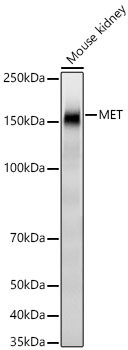
图: 1 / 1
c-Met Antibody (MA5-57868) in WB
Western blot analysis of c-Met in Mouse kidney lysates (25 µg/lane). Samples were incubated with c-Met Recombinant Monoclonal Antibody (Product # MA5-57868) using a dilution of 1:1, 000. Followed by a HRP-conjugated Goat anti-Rabbit IgG (H+L) Secondary Antibody at 1:10,000 dilution. Blocking buffer: 3% nonfat dry milk in TBST; Exposure: 10 seconds.
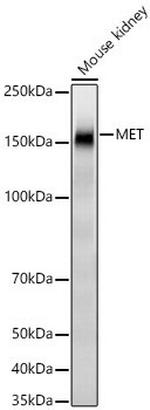
Please note: We are reviewing Western blot images included in the antibody testing data in our catalog, including those provided by third parties. Unless expressly labeled or annotated as “raw-unedited”, Western blot images included in the antibody testing data in our catalog may have been edited, optimized or otherwise adjusted for presentation.

产品信息
MA5-57868
产品规格
种属反应
Human,
Mouse
宿主/亚型
Rabbit
/ IgG
Expression System
HEK293 cells
分类
Recombinant Monoclonal
类型
Antibody
克隆号
6O7V1
抗原
Recombinant protein (or fragment)
偶联物
Unconjugated
Unconjugated
Unconjugated
形式
Liquid
浓度
1 mg/mL
规格
100 µg
纯化类型
Protein A
保存液
PBS, pH 7.3, with 0.05% BSA, 50% glycerol
内含物
0.09% sodium azide
保存条件
-20°C, Avoid Freeze/Thaw Cycles
运输条件
Ambient (domestic); Dry ice (international)
RRID
产品详细信息
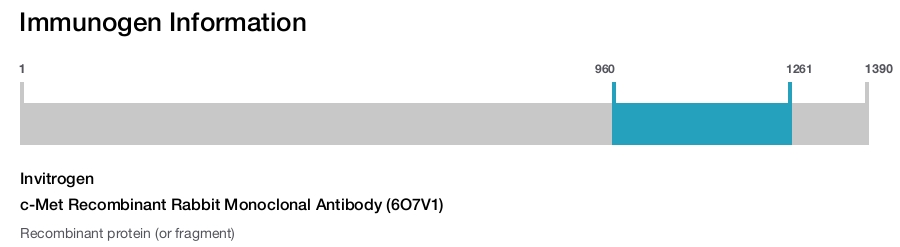
Immunogen sequence: QIKDLGSELV RYDARVHTPH LDRLVSARSV SPTTEMVSNE SVDYRATFPE DQFPNSSQNG SCRQVQYPLT DMSPILTSGD SDISSPLLQN TVHIDLSALN PELVQAVQHV VIGPSSLIVH FNEVIGRGHF GCVYHGTLLD NDGKKIHCAV KSLNRITDIG EVSQFLTEGI IMKDFSHPNV LSLLGICLRS EGSPLVVLPY MKHGDLRNFI RNETHNPTVK DLIGFGLQVA KGMKYLASKK FVHRDLAARN CMLDEKFTVK VADFGLARDM YDKEYYSVHN KTGAKLPVKW MALESLQTQK FT
靶标信息
MET (cMET) is a receptor-like tyrosine kinase whose dysregulation has been linked to many types of human malignancies. After activation of the ligand, MET interacts with the PI3-kinase subunit PIK3R1, PLCG1, SRC, GRB2, and STAT3. There interactions lead to the activation of signaling cascades including RAS-ERK, PI3, kinase-AKT, and PLCgamma-PKC. MET plays a role in embryonic development including gastrulation, development of muscles and neurons, angiogenesis, and kidney formation. It also plays a role in adults including wound healing, organ regeneration, and tissue remodeling. MET has been linked to cancers including gastric, renal, and breast; therefore, making it a target for cancer therapeutics and diagnostic testing.
仅用于科研。不用于诊断过程。未经明确授权不得转售。
篇参考文献 (0)
您是否在文献中引用过该产品?请点击下方按钮邮件告知我们。
生物信息学
蛋白别名: cMet; EC 2.7.10.1; HGF receptor; HGF-SF receptor; HGF/SF receptor; met oncogene; MET proto-oncogene protein; met proto-oncogene tyrosine kinase; oncogene MET; protein-tyrosine kinase (EC 2.7.1.112); proto-oncogene c-Met; sc MET; scatter factor receptor; SF receptor; soluble c met; tyrosine kinase; hepatocyte growth factor receptor; HGFR; tyrosine-protein kinase Met; unnamed protein product
基因别名: AUTS9; c-Met; DA11; DFNB97; HGF; HGFR; Par4; RCCP2
UniProt ID: (Human) P08581
Entrez Gene ID: (Human) 4233, (Mouse) 17295
protein kinase activity
protein tyrosine kinase activity
transmembrane receptor protein tyrosine kinase activity
hepatocyte growth factor-activated receptor activity
protein binding
ATP binding
semaphorin receptor activity
protein phosphatase binding
identical protein binding
molecular function activator activity
beta-catenin binding
phospholipase binding
phosphatidylinositol 3-kinase binding
macromolecular complex binding
negative regulation of transcription from RNA polymerase II promoter
neuron migration
endothelial cell morphogenesis
liver development
placenta development
transmembrane receptor protein tyrosine kinase signaling pathway
chemical synaptic transmission
brain development
muscle organ development
skeletal muscle tissue development
regulation of gene expression
positive regulation of gene expression
negative regulation of gene expression
positive regulation of peptidyl-threonine phosphorylation
negative regulation of peptidyl-threonine phosphorylation
positive regulation of glucose transport
positive regulation of neuron projection development
muscle cell migration
myotube differentiation
regulation of anatomical structure morphogenesis
neuron differentiation
sperm motility
adult behavior
pancreas development
positive regulation of microtubule polymerization
regulation of interleukin-6 production
positive regulation of peptidyl-serine phosphorylation
negative regulation of Rho protein signal transduction
glucose homeostasis
positive regulation of MAPK cascade
positive regulation of DNA replication
positive regulation of mitotic nuclear division
positive regulation of transcription from RNA polymerase II promoter
protein autophosphorylation
hepatocyte growth factor receptor signaling pathway
cell development
branching morphogenesis of an epithelial tube
positive regulation of dendrite morphogenesis
modulation of synaptic transmission
positive chemotaxis
myoblast proliferation
negative regulation of stress fiber assembly
cardiac muscle cell development
cardiac muscle contraction
excitatory postsynaptic potential
regulation of branching involved in salivary gland morphogenesis by mesenchymal-epithelial signaling
establishment of skin barrier
negative regulation of thrombin receptor signaling pathway
semaphorin-plexin signaling pathway
negative regulation of transforming growth factor beta production
reactive oxygen species metabolic process
regulation of cellular response to oxidative stress
positive regulation of p38MAPK cascade
negative regulation of hydrogen peroxide-mediated programmed cell death
positive regulation of endothelial cell chemotaxis
cell surface receptor signaling pathway
negative regulation of autophagy
Disclaimer

Clicking the images or links will redirect you to a website hosted by BenchSci that provides third-party scientific content. Neither the content nor the BenchSci technology and processes for selection have been evaluated by us; we are providing them as-is and without warranty of any kind, including for use or application of the Thermo Fisher Scientific products presented.

