Search
Invitrogen
eIF5B Polyclonal Antibody
{{$productOrderCtrl.translations['antibody.pdp.commerceCard.promotion.promotions']}}
{{$productOrderCtrl.translations['antibody.pdp.commerceCard.promotion.viewpromo']}}
{{$productOrderCtrl.translations['antibody.pdp.commerceCard.promotion.promocode']}}: {{promo.promoCode}} {{promo.promoTitle}} {{promo.promoDescription}}. {{$productOrderCtrl.translations['antibody.pdp.commerceCard.promotion.learnmore']}}
Additional Information:
{{banner.description}}
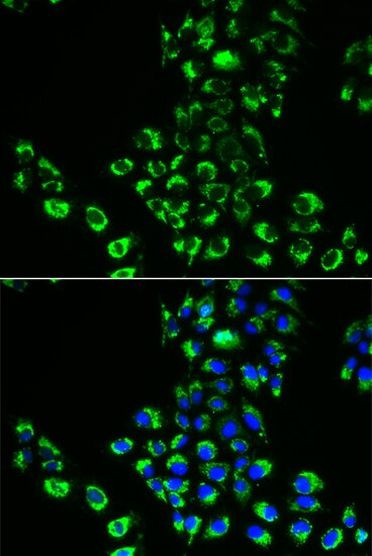

产品信息
PA5-96465
产品规格
宿主/亚型
Rabbit
/ IgG
分类
Polyclonal
类型
Antibody
抗原
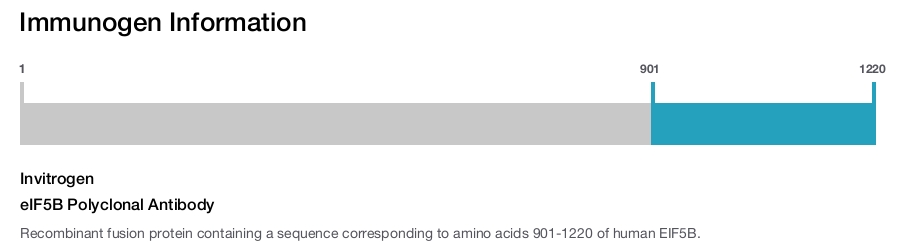
Recombinant fusion protein containing a sequence corresponding to amino acids 901-1220 of human EIF5B.
偶联物
形式
Liquid
浓度
0.81 mg/mL
保存条件
-20°C, Avoid Freeze/Thaw Cycles
运输条件
Wet ice
RRID
产品详细信息
Immunogen sequence: IRGLLLPPPM KELRVKNQYE KHKEVEAAQG VKILGKDLEK TLAGLPLLVA YKEDEIPVLK DELIHELKQT LNAIKLEEKG VYVQASTLGS LEALLEFLKT SEVPYAGINI GPVHKKDVMK ASVMLEHDPQ YAVILAFDVR IERDAQEMAD SLGVRIFSAE IIYHLFDAFT KYRQDYKKQK QEEFKHIAVF PCKIKILPQY IFNSRDPIVM GVTVEAGQVK QGTPMCVPSK NFVDIGIVTS IEINHKQVDV AKKGQEVCVK IEPIPGESPK MFGRHFEATD ILVSKISRQS IDALKDWFRD EMQKSDWQLI VELKKVFEII; Cellular Location: Cytoplasm
靶标信息
Accurate initiation of translation in eukaryotes is complex and requires many factors, some of which are composed of multiple subunits. The process is simpler in prokaryotes which have only three initiation factors (IF1, IF2, IF3). Two of these factors are conserved in eukaryotes: the homolog of IF1 is eIF1A and the homolog of IF2 is eIF5B. This gene encodes eIF5B. Factors eIF1A and eIF5B interact on the ribosome along with other initiation factors and GTP to position the initiation methionine tRNA on the start codon of the mRNA so that translation initiates accurately.
仅用于科研。不用于诊断过程。未经明确授权不得转售。
篇参考文献 (0)
您是否在文献中引用过该产品?请点击下方按钮邮件告知我们。
Disclaimer

Clicking the images or links will redirect you to a website hosted by BenchSci that provides third-party scientific content. Neither the content nor the BenchSci technology and processes for selection have been evaluated by us; we are providing them as-is and without warranty of any kind, including for use or application of the Thermo Fisher Scientific products presented.

