Search
NeoBiotechnologies
p170/MDR1/CD243 Monoclonal Antibody (ABCB1/9307)
{{$productOrderCtrl.translations['antibody.pdp.commerceCard.promotion.promotions']}}
{{$productOrderCtrl.translations['antibody.pdp.commerceCard.promotion.promocode']}}: {{promo.promoCode}} {{promo.promoTitle}} {{promo.promoDescription}}. {{$productOrderCtrl.translations['antibody.pdp.commerceCard.promotion.learnmore']}}
{{$ctrl.translations['antibody.pdp.skuNotes.additionalInformation']}}:
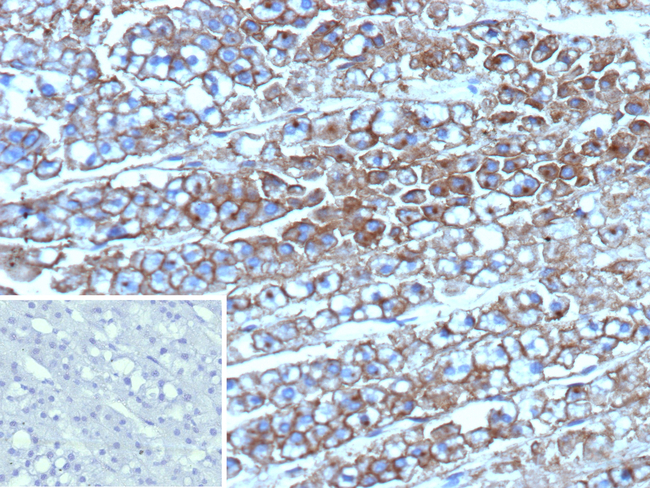
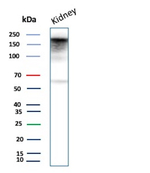
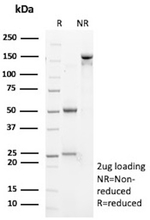
Please note: We are reviewing Western blot images included in the antibody testing data in our catalog, including those provided by third parties. Unless expressly labeled or annotated as “raw-unedited”, Western blot images included in the antibody testing data in our catalog may have been edited, optimized or otherwise adjusted for presentation.


产品信息
5243-MSM7-P1
产品规格
种属反应
Human
宿主/亚型
Mouse
/ IgG2a, kappa
分类
Monoclonal
类型
Antibody
克隆号
ABCB1/9307
抗原
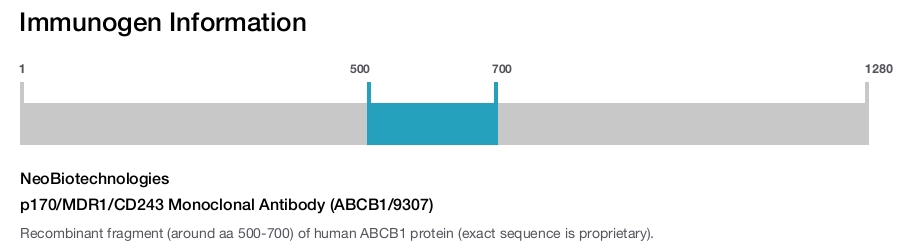
Recombinant fragment (around aa 500-700) of human ABCB1 protein (exact sequence is proprietary).
偶联物
Unconjugated
Unconjugated
Unconjugated
形式
Liquid
浓度
200 µg/mL
规格
100 µg
纯化类型
Protein A
保存液
PBS with 0.05% BSA
内含物
0.05% sodium azide
保存条件
4°C
运输条件
Ambient (domestic); Wet ice (international)
产品详细信息
Product cellular localization: Cytoplasm, Mitochondrion outer membrane, Nucleus.
Positive control: Uterine cervix: almost all columnar epithelial cells, basal squamous epithelial cells and most of the stromal cells must show a strong nuclear staining with only minimal cytoplasmic staining.
Tissue specificity: In reproductive tissues the expression of isoform A and isoform B varies as a consequence of developmental and hormonal status. Isoform A and isoform B are expressed in comparable levels in uterine glandular epithelium during the proliferative phase of the menstrual cycle. Expression of isoform B but not of isoform A persists in the glands during mid-secretory phase. In the stroma, isoform A is the predominant form throughout the cycle. Heterogeneous isoform expression between the glands of the endometrium basalis and functionalis is implying region-specific responses to hormonal stimuli.
靶标信息
The membrane-associated protein encoded by this gene is a member of the superfamily of ATP-binding cassette (ABC) transporters. ABC proteins transport various molecules across extra- and intra-cellular membranes. ABC genes are divided into seven distinct subfamilies (ABC1, MDR/TAP, MRP, ALD, OABP, GCN20, White). This protein is a member of the MDR/TAP subfamily. Members of the MDR/TAP subfamily are involved in multidrug resistance. The protein encoded by this gene is an ATP-dependent drug efflux pump for xenobiotic compounds with broad substrate specificity. It is responsible for decreased drug accumulation in multidrug-resistant cells and often mediates the development of resistance to anticancer drugs. This protein also functions as a transporter in the blood-brain barrier.
仅用于科研。不用于诊断过程。未经明确授权不得转售。
篇参考文献 (0)
您是否在文献中引用过该产品?请点击下方按钮邮件告知我们。
生物信息学
蛋白别名: ATP-binding cassette, sub-family B (MDR/TAP), member 1; colchicin sensitivity; doxorubicin resistance; MDR1; P-glycoprotein; multidrug resistance protein 1; multidrug-resistance; P-glycoprotein; P-glycoprotein 1; phospholipid transporter ABCB1; unnamed protein product; uORF
基因别名: ABC20; CD243; CLCS; ENPAT; GP170; MDR1; p-170; P-GP; PGY1
UniProt ID: (Human) P08183
Entrez Gene ID: (Human) 5243
protein binding
ATP binding
xenobiotic-transporting ATPase activity
efflux transmembrane transporter activity
ATPase activity
transmembrane transporter activity
ubiquitin protein ligase binding
ATPase activity, coupled to transmembrane movement of substances
xenobiotic transporter activity
carboxylic acid transmembrane transporter activity
phosphatidylcholine-translocating ATPase activity
phosphatidylethanolamine flippase activity
ceramide floppase activity
ATPase-coupled intramembrane lipid transporter activity
floppase activity
phosphatidylethanolamine floppase activity
ABC-type transporter activity
G2/M transition of mitotic cell cycle
xenobiotic metabolic process
response to xenobiotic stimulus
phospholipid translocation
terpenoid transport
transmembrane transport
transepithelial transport
stem cell proliferation
ceramide translocation
export across plasma membrane
transport across blood-brain barrier
carboxylic acid transmembrane transport
drug transmembrane export
drug transport across blood-brain barrier
regulation of chloride transport
Disclaimer

Clicking the images or links will redirect you to a website hosted by BenchSci that provides third-party scientific content. Neither the content nor the BenchSci technology and processes for selection have been evaluated by us; we are providing them as-is and without warranty of any kind, including for use or application of the Thermo Fisher Scientific products presented.

