Search
Invitrogen
Human MST1 (STK4) ELISA Kit
{{$productOrderCtrl.translations['antibody.pdp.commerceCard.promotion.promotions']}}
{{$productOrderCtrl.translations['antibody.pdp.commerceCard.promotion.promocode']}}: {{promo.promoCode}} {{promo.promoTitle}} {{promo.promoDescription}}. {{$productOrderCtrl.translations['antibody.pdp.commerceCard.promotion.learnmore']}}
{{$ctrl.translations['antibody.pdp.skuNotes.additionalInformation']}}:
产品规格
检测灵敏度
9.6 pg/mL
测定范围
9.6-3,000 pg/mL
检测样本类型/体积
{Supernatant=100 µL, Plasma=100 µL, Serum=100 µL}
手工操作时间
1 hr 20 min
总时间
4 hr 45 min
均相(无需洗涤)
No
批间差异
12%
批内差异
10%
检测仪器
Absorbance Microplate Reader
产品规格
96 Tests
产品成分
Pre-coated microwell plate
Standard
Biotinylated Detection Antibody
Streptavidin-HRP
Sample Diluent
Wash Buffer Concentrate
Assay Buffer concentrate
Stop Solution
Substrate Solution
Adhesive Plate Covers
Standard
Biotinylated Detection Antibody
Streptavidin-HRP
Sample Diluent
Wash Buffer Concentrate
Assay Buffer concentrate
Stop Solution
Substrate Solution
Adhesive Plate Covers
运输条件
Wet ice
储存
-20°C
蛋白名称
MST1 (STK4)
均相(无需洗涤)
Human
检测试剂盒格式
Sandwich ELISA Kit
检测抗体结合物
Biotin
标签或染料
HRP
关于本试剂盒
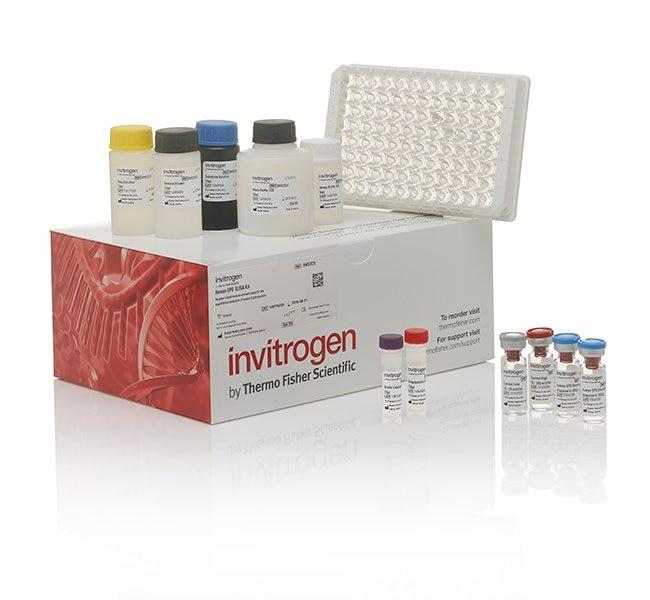
Human MST1 (STK4) ELISA Kit is an enzyme-linked immunosorbent assay for quantitative detection of human STK4.
靶标信息
STK4 (MST1) is a serine/threonine kinase which may be involved in apoptosis. It is possible that this protein induces the chromatin condensation observed in this process. STK4 is a stress-activated, pro-apoptotic kinase which, following caspase-cleavage, enters the nucleus and induces chromatin condensation followed by internucleosomal DNA fragmentation. It is a key component of the Hippo signaling pathway which plays a pivotal role in organ size control and tumor suppression by restricting proliferation and promoting apoptosis. The core of this pathway is composed of a kinase cascade wherein STK3/MST2 and STK4/MST1, in complex with its regulatory protein SAV1, phosphorylates and activates LATS1/2 in complex with its regulatory protein MOB1, which in turn phosphorylates and inactivates YAP1 oncoprotein and WWTR1/TAZ. Phosphorylation of YAP1 by LATS2 inhibits its translocation into the nucleus to regulate cellular genes important for cell proliferation, cell death, and cell migration. STK3/MST2 and STK4/MST1 are required to repress proliferation of mature hepatocytes, to prevent activation of facultative adult liver stem cells (oval cells), and to inhibit tumor formation.
For Research Use Only. Not for use in diagnostic procedures. Not for resale without express authorization.
篇参考文献 (0)
您是否在文献中引用过该产品?请点击下方按钮邮件告知我们。
生物信息学
基因别名 : KRS2, MST1, YSK3
基因ID : (Human) 6789
基因符号 : STK4
蛋白别名 : EC 2.7.11.1, kinase MST1, TIIAC, hippo homolog, kinase responsive to stress 2, mammalian STE20-like protein kinase 1, mammalian sterile 20-like 1, serine/threonine-protein kinase Krs-2, STE20-like kinase MST1, unnamed protein product
UniProt ID (Human) Q13043

