Search
Invitrogen
Human Presenilin 1 ELISA Kit
{{$productOrderCtrl.translations['antibody.pdp.commerceCard.promotion.promotions']}}
{{$productOrderCtrl.translations['antibody.pdp.commerceCard.promotion.promocode']}}: {{promo.promoCode}} {{promo.promoTitle}} {{promo.promoDescription}}. {{$productOrderCtrl.translations['antibody.pdp.commerceCard.promotion.learnmore']}}
{{$ctrl.translations['antibody.pdp.skuNotes.additionalInformation']}}:
产品规格
检测灵敏度
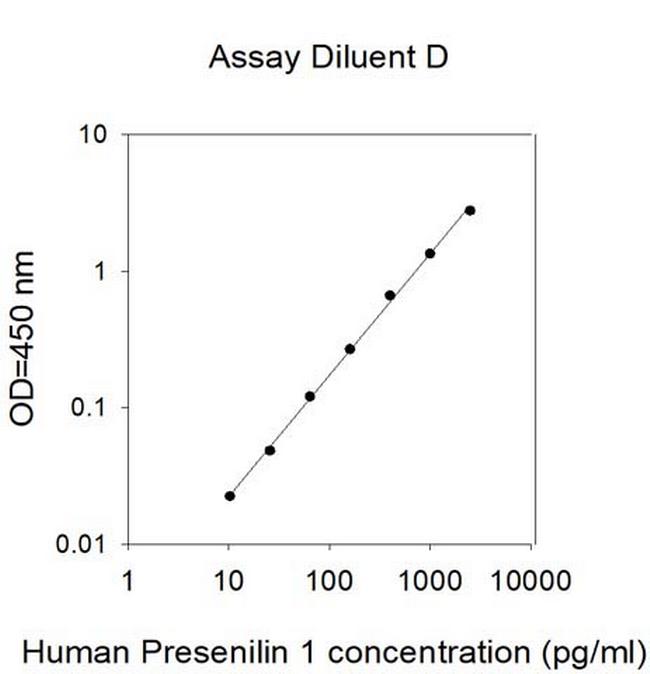
10.5 pg/mL
测定范围
10.5-2,500 pg/mL
检测样本类型/体积
{Supernatant=50 µL, Serum=50 µL, Plasma=50 µL}
手工操作时间
1 hr 20 min
总时间
4 hr 45 min
均相(无需洗涤)
No
批间差异
<12%
批内差异
<10%
检测仪器
Absorbance Microplate Reader
产品规格
96 Tests
产品成分
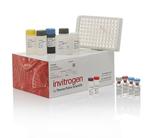
Pre-coated 96 well plate
Standard
Assay Diluent concentrate
Biotinylated Detection Antibody
SAV-HRP
Wash Buffer
Chromogen
Stop Solution
Adhesive Plate Covers
Standard
Assay Diluent concentrate
Biotinylated Detection Antibody
SAV-HRP
Wash Buffer
Chromogen
Stop Solution
Adhesive Plate Covers
运输条件
Wet ice
储存
Maintain refrigerated at 2-8°C for up to 6 months. For long term storage store at -20°C
蛋白名称
Presenilin 1
均相(无需洗涤)
Human
检测试剂盒格式
Sandwich ELISA Kit
检测抗体结合物
Biotin
标签或染料
HRP
关于本试剂盒
Human Presenilin 1 quantitates human Presenilin 1 in serum, plasma, supernatant. The assay will exclusively recognize both natural and recombinant human Presenilin 1.
靶标信息
Presenilin1 was initially identified a marker of susceptibility to early-onset Alzheimer's disease. In addition to PEN2, nicastrin and APH-1, Presenilin1 forms the -gamma-secretase protein complex, a membrane-bound aspartyl protease that can cleave certain proteins at peptide bonds buried within the hydrophobic environment of the lipid bilayer. This cleavage is responsible for a key step in signaling from several cell-surface receptors and is thought to be required for the generation of the neurotoxic amyloid peptides that are central to the pathogenesis of Alzheimer's disease. Like the tumor necrosis factor-alpha-converting enzyme (TACE) and the beta-site cleavage enzyme (BACE) protease families, -gamma-secretase will cleave the amyloid precursor protein (APP), but within the intramembrane region of APP, resulting in either the non-toxic p3 (from the alpha and -gamma cleavage site) or the toxic Abeta amyloid peptide (from the beta and -gamma cleavage site). It is thought that accumulation of the Abeta peptide is the precursor to Alzheimer's disease. Multiple isoforms of presenilin1 are known to exist.
For Research Use Only. Not for use in diagnostic procedures. Not for resale without express authorization.
篇参考文献 (0)
您是否在文献中引用过该产品?请点击下方按钮邮件告知我们。
生物信息学
基因别名 : ACNINV3, AD3, CMD1U, FAD, PS-1, PS1, PSNL1, S182
基因ID : (Human) 5663
基因符号 : PSEN1
蛋白别名 : Alzheimer Disease 3, Minilin, presenilin1, S182 protein, Senilin 1, familial Alzheimer Disease, S182, unnamed protein product
UniProt ID (Human) P49768

