Search

On this page:
Self-contained, single-use solution
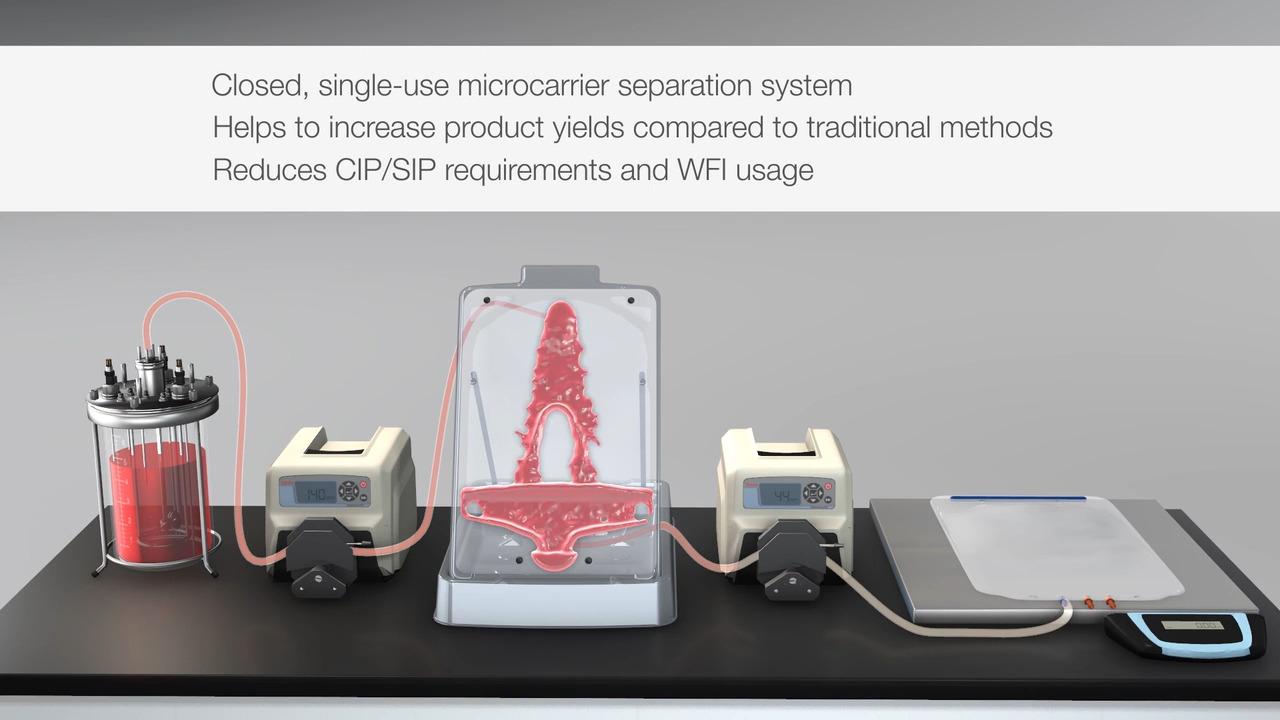
The Thermo Scientific Harvestainer bioprocessing bag (container) is a self-contained, single-use, closed system solution for harvesting and separating cell cultures grown on microcarrier beads. This system helps increase product yields relative to traditional methods and further aids in reducing clean-in-place (CIP), water for injection (WFI), and clean steam requirements. The Harvestainer BPCs, designed for smaller-scale (<12 L) and larger-scale (12–50 L) applications, facilitate equipment maintenance and help to reduce process validations, cycle times, and manual final decanting processes.
Microcarrier harvest solution for consistent workflows
Microcarrier harvests often show variability due to open handling, manual transfers, and inconsistent shear forces, sometimes leading to unpredictable cell recovery, debris carryover, and downstream disruptions. A closed separation system minimizes contamination risk, standardizes flow paths, and enables controlled, reproducible transitions from culture to clarification, supporting predictable, repeatable performance across batches.
The Thermo Scientific Harvestainer is a closed, single-use microcarrier harvest solution engineered to deliver consistent, scalable bioprocessing. By integrating contained separation and disposable flow paths, Harvestainer streamlines operations, reduces cleaning and changeover, and supports reliable scale-up from development to CGMP manufacturing.

How does the Harvestainer work?
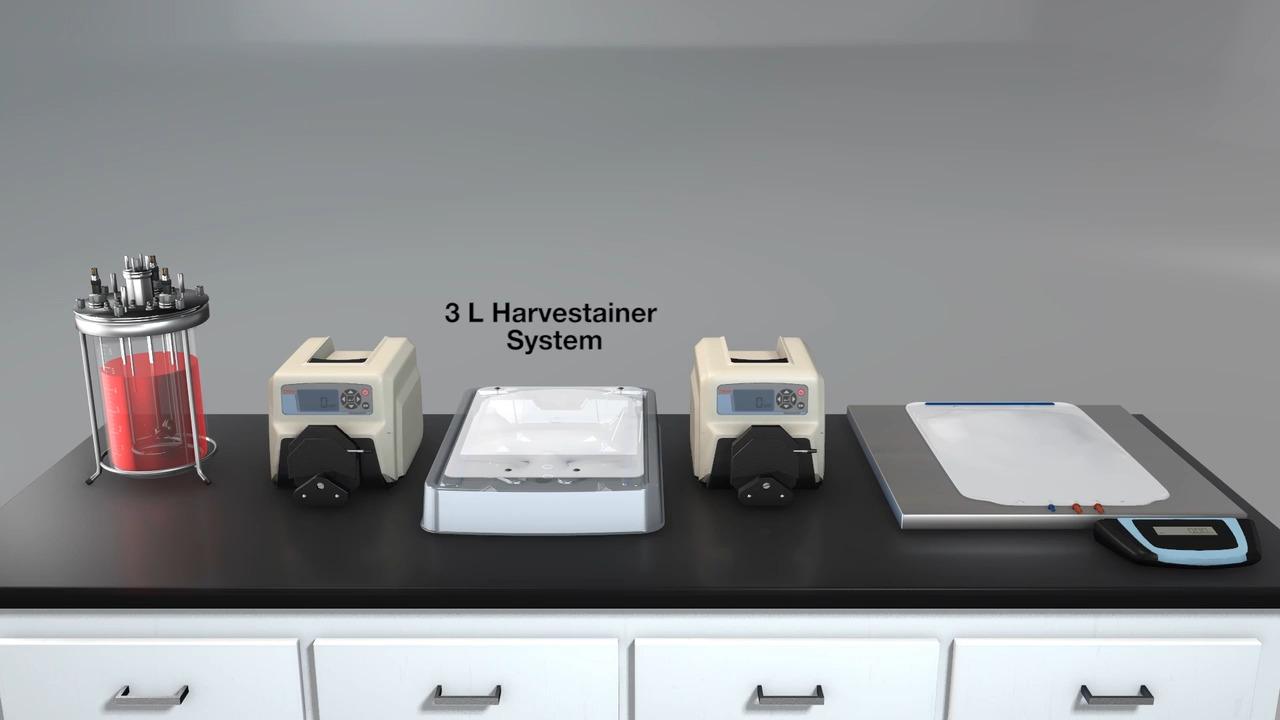
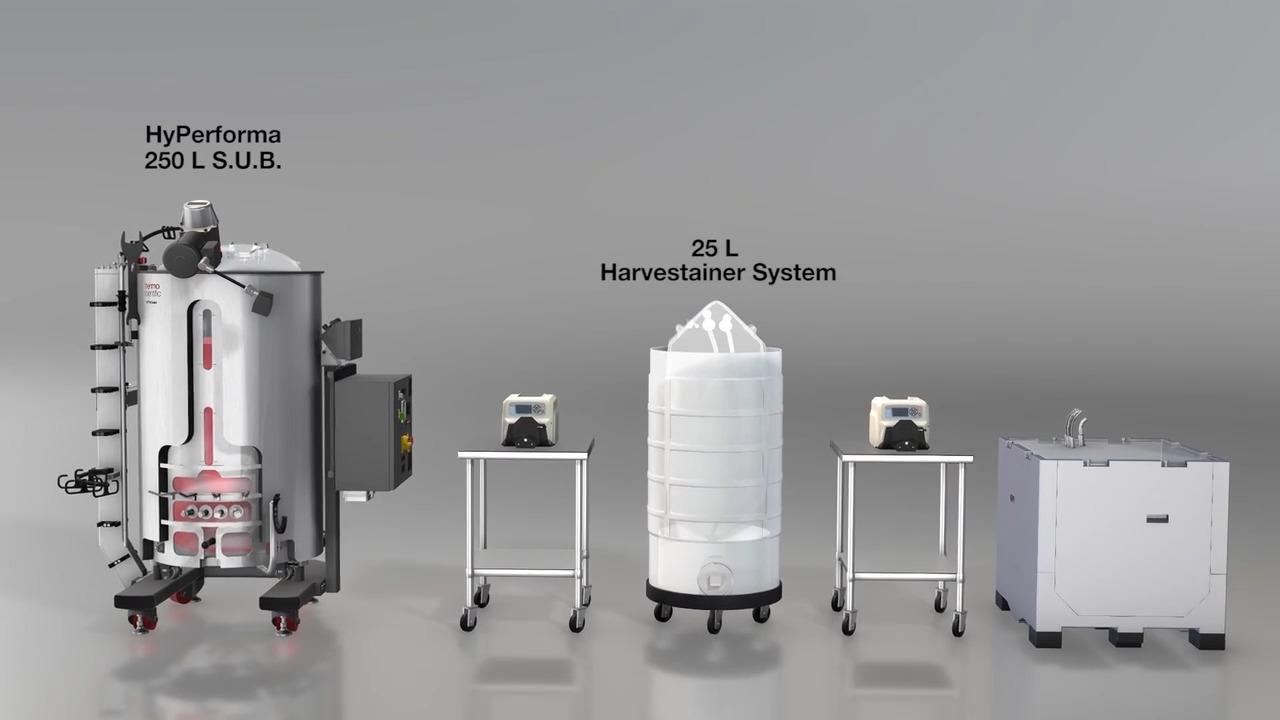
The figure below illustrates how the Harvestainer enables a streamlined, closed approach to separating cells from microcarriers within a single-use system. By integrating key steps into one controlled workflow, it simplifies harvesting while maintaining process consistency from culture to downstream processing.


Watch animations of Harvestainer in action
Architecture optimized for microcarrier workflows
The Harvestainer BPC is composed of Thermo Scientific CX5-14 film, which is a 5-layer, 14 mil cast film produced in a CGMP facility. The outer layer is a polyester elastomer coextruded with an ethylene vinyl alcohol (EVOH) barrier layer and a low-density polyethylene product contact layer.
Inner microbarrier chamber
The microbarrier chamber creates a protected retention zone that traps microcarrier beads while allowing clarified supernatant to flow out. Its internal barrier geometry slows and redirects flow, helping prevent bead escape and minimizing shear, so beads remain contained during separation for consistent harvests.
Flow and drainage pathway
Tubing, dip‑tube placement, and drainage geometry are optimized to guide flow and separate beads from supernatant. Correct dip‑tube depth and angled drainage minimize bead carryover, while preconfigured tubing enables efficient recovery with minimal operator manipulation.
Structural configuration
Chamber format provides structural stability; closed containment preserves sterility and helps prevents spills; integrated supports, ports, and connectors enable secure handling and broad process compatibility, maintaining consistent performance from development to CGMP.
Use the Harvestainer across bioprocessing workflows
The system sits at the microcarrier harvest step between culture and primary clarification, replacing open transfer/settling with closed, contained separation. It interfaces with upstream bags and downstream filters.


Design your single-use fluid transfer assembly—faster and with confidence
Our Single-Use Assembly Configurator Tool makes it easy to create custom assemblies tailored to your process or select in-stock, ready-to-ship options to help reduce lead times.
Explore related bioprocessing bags and containers
Upstream, downstream, and storage are covered with single‑use containers: media/transfer bags, hold/transfer bags, and sterile storage bags with robust films and standard connectors—matched to workflows.
Visit our Bioprocessing Bags page for details.


Related fluid management solutions
Complementary solutions—validated connectors, tubing, aseptic transfer sets, and compatible rigid containers—work with single‑use bags to maintain sterility end‑to‑end.
Explore our fluid management page for details.


Ordering information
Frequently asked questions
Select a Harvestainer by matching culture and bead volumes to chamber capacity, ensuring adequate headspace for flow control, approximately 10%. Consider expected cell density and supernatant volume to avoid bead carryover and maintain separation efficiency. Align dip‑tube length and drainage geometry with vessel dimensions. Verify available pump, clamp, and connector compatibility, and choose single‑ or dual‑chamber formats to meet throughput and turnaround needs.
Separation efficiency scales with bead load, settling behavior, and system configuration. Higher bead volumes increase viscosity and shear sensitivity, affecting retention and carryover. Settling kinetics depend on bead size, density, and cell attachment. Configuration—microbarrier design, dip‑tube depth, flow rate, and drainage geometry—controls residence time and turbulence. Closed, standardized pathways and properly sized chambers maintain predictable supernatant recovery and reproducibility.
The closed-system design helps prevents environmental exposure and cross-contamination, preserving cell and supernatant purity. Contained pathways and sterile connectors protect operator safety by minimizing spills and aerosols. Standardized flow paths, controlled dip‑tube placement, and engineered drainage geometry reduce variability in shear and residence time, enabling consistent bead retention and predictable, repeatable recovery across batches and scales while streamlining transfers to downstream clarification or filtration.
Harvestainer systems connect to bioreactors, pumps, and collection drums via standardized sterile connectors, weldable tubing, and dip‑tube interfaces. Configurable line lengths and port options fit common hardware footprints. Single‑use, closed operation simplifies cleaning validation. Supplier packages typically include material specs, extractables/leachables, gamma and integrity data, and lot traceability—supporting risk assessments, IQ/OQ documentation, and streamlined qualification within existing GMP workflows.
Dip‑tube geometry sets depth and angle to minimize bead entrainment and control residence time. Chamber shape directs laminar flow and creates a retention zone for beads, improving separation and clarified supernatant recovery. Containment hardware—rigid frames, secure ports, and standardized connectors—stabilizes the system, maintains closed pathways, and helps prevent leaks or turbulence, enabling consistent drainage rates, predictable flow profiles, and repeatable performance across scales.
Teams should assess culture volume and target throughput, current and future process scale, bead type/size and settling behavior, required purity and yield, and compatibility with bioreactors, pumps, and collection vessels. Consider facility layout, available floor space, and operator ergonomics. Evaluate closed‑system requirements, single‑use vs. reusable components, documentation needs, and team bandwidth for setup, changeover, and validation to help ensure consistent, scalable performance.
Related resources


Additional bioprocessing resources


Bioprocessing resources


For research use or further manufacturing. Not for diagnostic use or direct administration into humans or animals.