Search
Stem Cell FAQ: What are Pluripotent Stem Cells, How to Maintain Them and Using Essential 8™ Medium
byDavid Welch - 09/24/12
In this weekly series, we’ll explore some frequently asked questions about stem cells and our products for stem cell research. This week, we'll start with the basics.
What are pluripotent stem cells?
Pluripotent Stem Cells (PSCs) can divide indefinitely, self-renew, differentiate and functionally develop into almost any cell in the body, given the right conditions.
There are several kinds of pluripotent stem cells:
- Embryonic Stem Cells: Isolated from the inner cell mass of the blastocyst stage of a developing embryo. These early cells were destined to create a fetus following implantation.
- Embryonic Germ Cells: Derived from aborted fetuses. These early cells were destined to become sperm and eggs.
- Embryonic Carcinoma Cells: Isolated from certain types of fetal tumors.
- Induced Pluripotent Stem Cells: Generated via ectopic expression of one or more genes to reprogram an adult somatic cell.
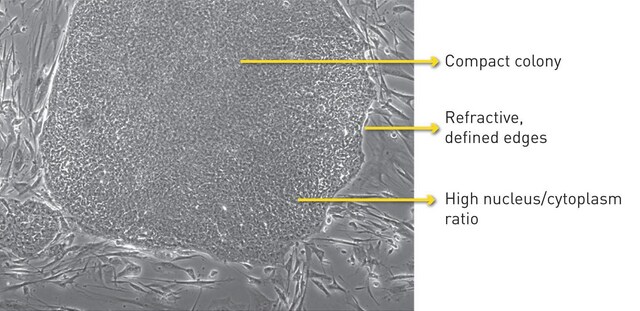
Below is an image of H9 ESC cultured on iMEF. PSCs grow in a compact colony formation with very well defined borders. PSCs have a high nucleus-to-cytoplasm ratio and the colonies grow in a 3-dimensional radial pattern.
How do I maintain Pluripotent Stem Cells (PSCs)?
PSCs are generally maintained on a layer of feeder cells for many passages without any compromise to proliferation, pluripotency or differentiation potential. Feeder cells are usually murine embryonic fibroblasts (MEF), which must be irradiated or chemically treated to inactive them (noted as iMEF) prior to culturing with PSCs. Alternatively, PSCs can be maintained in feeder-free conditions using specialized media systems on a matrix-coated tissue culture surface.
Check out our Introduction to Stem Cell Maintenance for tips and tricks on Pluripotent Stem Cell culture
What is Essential 8™ Medium?
Essential 8™ Medium is a xeno-free and feeder-free medium specially formulated for the growth and expansion of human PSCs. Originally developed by Chen et al. in the laboratory of James Thomson, and validated by Cellular Dynamics International, Essential 8™ Medium has been extensively tested and is proven to maintain pluripotency in multiple PSC lines.
There are three major differences that you will observe with cells cultured in Essential 8™ Medium on Vitronectin (VTN-N) compared to other feeder-free systems:
- Cells are typically passaged ~24 hours sooner than they would be with other feeder-free medium.
- Passaging should take place when cells are at ~85% confluency. If cells are passaged when they are more than 85% confluent, the health of the cells and final cell yield may be compromised.
- Cells must be passaged in EDTA. Collagenase and dispase are not recommended.
How to prepare Essential 8™ Medium
This video will show you how to prepare complete Essential 8™ Medium for the consistent, robust, cost-effective feeder-free culture of PSCs.
Below, Dr. Rupa Shevde discusses the evolution of pluripotent stem cell culture media, from KnockOut™ Serum Replacement on feeders to current feeder-free solutions.