Search
Extractables and Leachables Information

Identify and quantify leachable impurities
A drug product container-closure system should not release chemicals that can accumulate in the drug product in quantities sufficient to present a risk of toxicity, or affect its stability or efficacy.
We are unique in offering comprehensive analytical workflows including ICP-MS, GC-MS, LC-MS and advanced information to enable identification and quantification of unknown organic and elemental impurities.
Extractable and leachable impurities from pharmaceutical container-closure and production systems
In May 1999, the U.S. FDA published a guidance document on Container Closure Systems for Packaging Human Drugs and Biologics. The FDA mandated that pharmaceutical manufacturers demonstrate the safety of materials used in production systems, container closure systems or drug delivery devices. Failure to demonstrate material safety could result in failure to receive FDA approval for a product. Everything from glass and plastic bottles to foil pouches and the ink used in labels and packaging materials has the potential to leach unwanted contaminants into a drug product.
What are "extractables"?
In order to study the risk of materials extraction studies are performed; generally using aggressive solvent conditions including acidic, basic, organic and aqueous solvents and sohxlet or accelerated solvent extraction. It is important that the extraction process does not deform the material of interest. Compounds present in the resulting extracts are called "extractables". Extractables studies are typically performed to create a "worst case scenario" and assist in materials selection and early risk assessment.
What are "leachables"?
Leachables are chemical species that make their way into the product under normal product, application or storage conditions. There is generally an overlap such that the leachables involved may be classified as a subset of the extractables. Forced or accelerated leachable studies can be performed to assess leachables that migrate under simulated environmental conditions by analyzing the drug formulation after exposure to elevated temperature. However, if the leachable interacts with the drug product or packaging materials, new components can be present. These are termed secondary leachables. Drug formulations often contain buffers, surfactants, fillers and other excipients. This complexity means that there are sometimes secondary leachables that can only be identified after long stability studies over the typical drug shelf life.

Click image to enlarge

Click image to enlarge
Detecting extractables and leachables: using the right tests
Extractable and leachable studies identify key components using a range of analytical technologies:
- Volatile organic compounds —typically performed using headspace GC-MS
- Semi-volatile organic compounds —typically performed using GC-MS or high resolution accurate mass (HRAM) GC-MS
- Non-volatile organic compounds —typically performed HRAM LC-MS/MS
- Elemental impurities (metals) —typically performed ICP-MS
Quantification of these compounds is performed using relative reference standards, in which a qualified toxicologist calculates the analytical evaluation threshold (AET), above which an extractable or leachable needs to be reported for toxicological assessment. Analytical data for these impurity classes is meant to provide information to help customers determine what further studies are needed to mitigate risks associated with the final product.
There are currently no single regulated method prescribed for analyzing extractables and leachables. Generally, the Product Quality Research Institute (PQRI) recommendation document in the table below is accepted by the industry as a primary recommendation to follow as it was drafted with U.S. FDA involvement. However, to date it has not been formally accepted. There are several methods in draft currently being considered by global regulators and guidance documents from industry bodies, such as BioPhorum Operations Group (BPOG) and BioProcess Systems Alliance (BPSA):
| Author | Focus | Title | Year |
|---|---|---|---|
| PQRI | OINDP Drugs | Best Practices for Extractables and Leachables in Orally Inhaled and Nasal Drug Products: An Overview of the PQRI Recommendations | 2008 |
Featured extractables & leachables learning content
Video
Join industry expert Dr. Jason Creasy from GlaxoSmithKline as he talks with The Medicine Maker magazine about the history, developments and future of extractable impurities testing for pharmaceuticals.
Video
Smithers Rapra are leaders in extractables and leachables testing and consultancy services. Listen to Dr. Andrew Feilden from Smithers Rapra as he discusses the changing landscape of this discipline and new technology that is making the task easier.
Webinar series

Join this 3-part webinar series to learn extractables and leachables testing for pharmaceutical container-closure systems and food contact materials. Hear from experts about regulations and the latest technologies and workflows to deliver E&L testing.
Publication

The National Institute for Bioprocessing Research and Training (NIBRT) is publishing new research investigating extractable & leachable impurities in the manufacture of biopharmaceuticals. Get their groundbreaking research report first.
Editorial

Get this interesting and informative editorial from The Medicine Maker magazine, which talks with experts in extractables and leachables testing.
Application

Learn how the most advanced GC-MS technology available can be used to give absolute confidence in unknown identification and quantification of extractable and leachable impurities.
Poster video
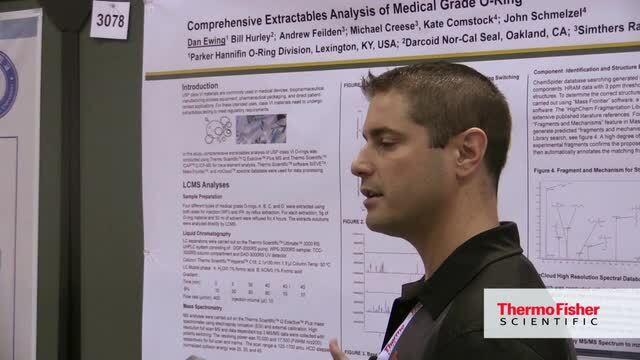
Join applications scientist Keeley Murphy as he presents this extractables and leachables poster at the American Association of Pharmaceutical Scientists (AAPS) conference.
Poster note

In this study, comprehensive extractables analysis of USP class VI O-rings was conducted using LC-MS and ICP-MS. Organic compounds were identified using mzCloud high-resolution MS/MS libraries.
Search extractables & leachables library
No records were found matching your criteria
Extractables & leachables videos
Related Resources
Support
Our general purpose product lines, including LC-MS products, are not intended for in vitro diagnostic purposes in accordance with our product documentation, manuals, and labels. They are designated for General Laboratory Use Only.
Our general purpose product lines have not been tested or validated for such applications and their use for in vitro diagnostic purposes may result in health and safety risks. They are designated for Research Use Only Applications.
For Research Use Only - Not For Use In Diagnostic Procedures.
Thermo Scientific Orbitrap Exploris 与 Excedion 系列质谱仪为配备大气压电离(API)源的 Orbitrap 仪器,适用于液相色谱(LC)-质谱(MS)的高通量应用。该类仪器设计为置于实验室台面,并能在色谱峰处保持质量准确度(mass accuracy),通过高分辨率、准确质量(high‑resolution accurate‑mass)检测支持可靠的鉴定与定量。
CMD SchemaApp code