Search

Cell line data table of contents
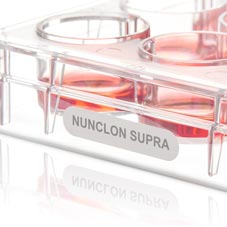
NEW Nunclon Supra Surfaces for advanced cell culturing
We are proud to provide a new product line surface treatment that will support improved cell yield and morphology as well enabling you to do xeno-free or low-serum applications.
Order yours today: Dishes | Flasks | Plates | 96-well plates
See how our surfaces perform with 39 cell types and cell lines at thermofisher.com/supradata
For Nunclon Delta surfaces:
For Nunclon Sphera surfaces:
Nunclon surface performance data
We’ve tested the most-used cell lines on Thermo Scientific Nunclon Delta, Supra and Sphera cell culture plastics side-by-side with the leading competitor to validate Nunc cell culture plastics’ place in your cell culture hood.
Please note: We are adding data for more cells all the time.
A431 doubling times and gene expression
A431 cells grown on Nunc Nunclon Delta surfaces, in combination with Gibco cell culture media and fetal bovine serum have been tested to support consistent cell growth.
A431 morphology with Nunclon Delta surfaces
Below are representative brightfield images of A431 cells grown on Nunclon Delta surfaces (left) and Corning® tissue culture (TC)-treated surfaces (middle), and those switched to Nunclon Delta surfaces (ND) surface for 10 passage doublings (right). Images were captured using EVOS Cell Imaging Systems under 10X magnification.

A431 cell viability and growth with Nunclon Delta surfaces
- Graph (A) shows observations on mean cell viability of A431 cells grown on either Nunclon Delta surfaces or Corning TC surfaces (for 30 population doublings). Those switched to Nunclon Delta surfaces TC treated surfaces (for 10 passage doublings) are plotted on the y-axis.
- Graph (B) shows mean population doubling time of A431 cells propagated on Nunclon Delta surfaces and Corning TC treated surfaces (for 30 population doublings). Those switched to Nunclon Delta surfaces TC treated surface (for 10 passage doublings) are plotted on the y-axis.

Note: Error bars represent SEM. n.s. = not significant (by Student’s unpaired t-test).
A431 gene expression with Nunclon Delta surfaces
The below image describes A431 cells grown on Nunclon Delta plates or Corning® TC surfaces for at least 10 passage doublings were assayed for cell health with respect to expression of two common endogenous genes, EGFR (epidermal growth factor receptor) and VEFGA (vascular endothelial growth factor alpha). The normalized relative gene expression of cells grown on Corning TC surface with respect to Nunclon Delta surfaces surface is shown on the y-axis.

Note: Error bars represent SEM. n.s. = not significant (by Student’s unpaired t-test).
Please note: For the above A431 Nunclon Delta vs Corning TC surface experiments, the following formulations of cell culture media and reagents were used: Gibco IMDM, 10% Gibco FBS, and 1% Penicillin Streptomycin.
A549 doubling times and EGFR activation
A549 cells grown on Nunclon Delta surfaces, in combination with Gibco cell culture media and fetal bovine serum have been tested to support consistent cell growth.
A549 morphology with Nunclon Delta surfaces
Below are representative brightfield images of A549 cells grown on Nunclon Delta surfaces (left) and Corning tissue culture (TC)-treated surfaces (middle), and those switched to Nunclon Delta surfaces (ND) surface for 10 passage doublings (right). Images were captured using EVOS Cell Imaging Systems under 10X magnification.

A549 cell viability and growth with Nunclon Delta surfaces
- Graph (A) shows observations on mean cell viability of A549 cells grown on either Nunclon Delta surfaces or Corning TC surfaces (for 30 population doublings). Those switched to Nunclon Delta surfaces TC treated surfaces (for 10 passage doublings) are plotted on the y-axis.
- Graph (B) shows mean population doubling time of A549 cells propagated on Nunclon Delta surfaces and Corning TC treated surfaces (for 30 population doublings). Those switched to Nunclon Delta surfaces TC treated surface (for 10 passage doublings) are plotted on the y-axis.

Note: Error bars represent SEM. n.s. = not significant (by Student’s unpaired t-test).
A549 EGFR activation with Nunclon Delta surfaces
A549 cells grown on Nunclon Delta surfaces (Nunc) or Corning TC (Corning) surfaces as well as those switched to Nunclon Delta surfaces (S to ND) surface, were treated with epidermal growth factor (EGF, 200 ng/mL) for 10 minutes. Total cell lysates (30 mg) were subjected to western blot analysis for EGFR phosphorylation using anti-phospho-EGFR (Tyr1086) rabbit polyclonal antibody 0.5 µg/mL. Total EGFR and GAPDH were used as experimental and normalization controls respectively.

Please note: For the above A549 Nunclon Delta vs Corning TC surface experiments, the following formulations of cell culture media and reagents were used: Gibco IMDM, 10% Gibco FBS, and 1% Penicillin Streptomycin.
Caco-2 doubling times, morphology, and cell attachment
Caco-2 cells grown on Nunclon Delta surfaces, in combination with Gibco cell culture media and fetal bovine serum have been tested to support consistent cell growth.
Caco-2 morphology with Nunclon Delta surfaces
Below are representative brightfield images of Caco-2 cells grown on Nunclon Delta surfaces (left) and Corning tissue culture (TC)-treated surfaces (middle), and those switched to Nunclon Delta surfaces (ND) surface for 10 passage doublings (right). Images were captured using EVOS Cell Imaging Systems under 10X magnification.

Caco-2 cell viability and growth with Nunclon Delta surfaces
- Graph (A) shows observations on mean cell viability of Caco-2 cells grown on either Nunclon Delta surfaces or Corning TC surfaces (for 30 population doublings). Those switched to Nunclon Delta surfaces TC treated surfaces (for 10 passage doublings) are plotted on the y-axis.
- Graph (B) shows mean population doubling time of Caco-2 cells propagated on Nunclon Delta surfaces and Corning TC treated surfaces (for 30 population doublings). Those switched to Nunclon Delta surfaces TC treated surface (for 10 passage doublings) are plotted on the y-axis.

Note: Error bars represent SEM. n.s. = not significant (by Student’s unpaired t-test).
Caco-2 cell attachment with Nunclon Delta surfaces
As an extension of cell attachment and growth, Caco-2 cells grown on Nunclon Delta surfaces (left) and Corning® TC surfaces (middle), and those switched to Nunclon Delta surfaces (ND) surface (right) were stained for the tight junction protein ZO-3, shown in green. The nucleus was stained with DAPI (shown in blue). No morphological difference was observed between the surfaces. Cells were grown on 6-well plates and stained on the same surface. Images were captured using EVOS M5000 imaging system under 20X magnification and cropped using the same aspect ratio for better visualization.

Please note: For the above Caco-2 Nunclon Delta vs Corning TC surface experiments, the following formulations of cell culture media and reagents were used: Gibco DMEM, 20% Gibco FBS, and 0.5% Penicillin Streptomycin.
CHO-K1 doubling times, morphology, and transfection efficiency
CHO-K1 cells grown on Nunclon Delta surfaces, in combination with Gibco cell culture media and fetal bovine serum have been tested to support consistent cell growth.
CHO-K1 morphology with Nunclon Delta surfaces
Below are representative brightfield images of CHO-K1 cells grown on Nunclon Delta surfaces (left) and Corning tissue culture (TC)-treated surfaces (middle), and those switched to Nunclon Delta surfaces (ND) surface for 10 passage doublings (right). Images were captured using EVOS Cell Imaging Systems under 10X magnification.