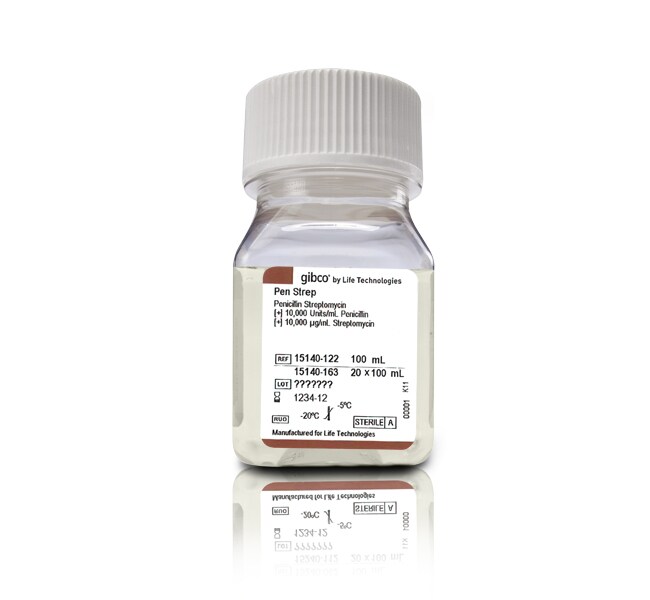
Penicillin-Streptomycin (10.000 U/ml)
Try new Pen-Strep antibiotic with GlutaMAX supplement, a stable alternative to L-glutamine that enhances cell health. Learn more >
Penicillin-Streptomycin (10.000 U/ml)
Gibco™

Penicillin-Streptomycin (10.000 U/ml)

Diese Lösung enthält 10.000 Einheiten/ml Penicillin und 10.000 μg/ml Streptomycin. Die Antibiotika Penicillin und Streptomycin verhindern mit ihrer kombinierten WirkungWeitere Informationen
Have Questions?
Ansicht ändernbuttonViewtableView
KatalognummerMenge
15140122
auch als 15140-122 bezeichnet
100 mL
15140148
auch als 15140-148 bezeichnet
20 mL
15140163
auch als 15140-163 bezeichnet
20 x 100 mL
Katalognummer 15140122
auch als 15140-122 bezeichnet
Preis (EUR)
27,65
Exklusiv online
28,86
Ersparnis 1,21 (4%)
Each
Zum Warenkorb hinzufügen
Menge:
100 mL
Preis (EUR)
27,65
Exklusiv online
28,86
Ersparnis 1,21 (4%)
Each
Zum Warenkorb hinzufügen
Diese Lösung enthält 10.000 Einheiten/ml Penicillin und 10.000 μg/ml Streptomycin. Die Antibiotika Penicillin und Streptomycin verhindern mit ihrer kombinierten Wirkung gegen grampositive und gramnegative Bakterien eine bakterielle Kontamination von Zellkulturen. Penicillin, das ursprünglich aus dem Pilz Penicillium gewonnen wurde, wirkt direkt, indem es den Neuaufbau der bakteriellen Zellwand stört, sowie indirekt, indem es die Freisetzung von Enzymen auslöst, die die Zellwand weiter verändern. Streptomycin wurde ursprünglich aus Streptomyces griseus isoliert. Es wirkt, indem es sich an die 30S-Untereinheit des bakteriellen Ribosoms anlagert, was zu einer Hemmung der Proteinsynthese und anschließendem Absterben sensitiver Bakterien führt.

Wir bieten eine breite Palette an Antibiotika und Antimykotika in Pulver- und flüssiger Form an. Erfahren Sie mehr über die folgenden Produkttypen:

Zellkultur Antibiotika-Auswahl
Selektive Antibiotika (einschließlich empfohlener Arbeitskonzentrationen)

Erfahren Sie mehr über die Verwendung von Antibiotika und Antimykotika in der Zellkultur und lesen Sie Richtlinien für die Dekontamination von Kulturen.

Nur für Forschungszwecke. Nicht zur Verwendung bei diagnostischen Verfahren.
Specifications
Konzentration100X
Zur Verwendung mit (Anwendung)Zur Prävention von Zellkulturkontaminationen
Menge100 mL
Haltbarkeit12 Monate
VersandbedingungTrockeneis
FormFlüssig
ProdukttypAntibiotikum
SterilitätSteril gefiltert
Sterilization MethodSterile-filtered
Unit SizeEach
Inhalt und Lagerung
Lagerbedingungen: -5 bis -20 °C
Versandbedingungen: Trockeneis
Haltbarkeit: 12 Monate ab Herstellungsdatum

Häufig gestellte Fragen (FAQ)

My Penicillin-Streptomycin solution is not colorless. Is this normal?

Yes, this is normal and will not affect the potency or application of the product. This solution is typically colorless. However, it can have a pink to yellow color tint. The coloring is a carry-over from the manufacturing process of Streptomycin - the genus that Steptomycin is isolated from (Actinomycetes Streptomyces griseus) is responsible for a wide variety of pigments.

Find additional tips, troubleshooting help, and resources within our Cell Culture Support Center.

How can I decontaminate my cultures?

When an irreplaceable culture becomes contaminated, researchers may attempt to eliminate or control the contamination.

1. Determine if the contamination is bacteria, fungus, mycoplasma, or yeast. Read more here to view characteristics of each contaminant.
2. Isolate the contaminated culture from other cell lines.
3. Clean incubators and laminar flow hoods with a laboratory disinfectant, and check HEPA filters.
4. Antibiotics and antimycotics at high concentrations can be toxic to some cell lines. Therefore, perform a dose-response test to determine the level at which an antibiotic or antimycotic becomes toxic. This is particularly important when using an antimycotic such as Gibco Fungizone reagent or an antibiotic such as tylosin.

The following is a suggested procedure for determining toxicity levels and decontaminating cultures:

1. Dissociate, count, and dilute the cells in antibiotic-free media. Dilute the cells to the concentration used for regular cell passage.
2. Dispense the cell suspension into a multiwell culture plate or several small flasks. Add the antibiotic of choice to each well in a range of concentrations. For example, we suggest the following concentrations for Gibco Fungizone reagent: 0.25, 0.50, 1.0, 2.0, 4.0, and 8.0 µg/mL.
3. Observe the cells daily for signs of toxicity such as sloughing, appearance of vacuoles, decrease in confluency, and rounding.
4. When the toxic antibiotic level has been determined, culture the cells for two to three passages using the antibiotic at a concentration one- to two-fold lower than the toxic concentration.
5. Culture the cells for one passage in antibiotic-free media.
6. Repeat step 4.
7. Culture the cells in antibiotic-free medium for four to six passages to determine if the contamination has been eliminated.

Find additional tips, troubleshooting help, and resources within our Cell Culture Support Center.

What antibiotics do you offer to help control or eliminate cell culture contamination?

Please view the following page to browse the cell culture antibiotics we offer (https://www.thermofisher.com/us/en/home/life-science/cell-culture/mammalian-cell-culture/antibiotics.html).

Find additional tips, troubleshooting help, and resources within our Cell Culture Support Center.

Zitierungen und Referenzen (34)

Zitierungen und Referenzen
Abstract
Identification of a novel redox-sensitive gene, Id3, which mediates angiotensin II-induced cell growth.
Authors:Mueller Cornelius; Baudler Stephanie; Welzel Hilke; Böhm Michael; Nickenig Georg;
Journal:Circulation
PubMed ID:12021231
BACKGROUND: Reactive oxygen species, such as superoxide (O(2)(-)), are involved in the abnormal growth of various cell types. Angiotensin II (Ang II) is one of the most potent inducers of oxidative stress in the vasculature. The molecular events involved in Ang II-induced proliferation of vascular smooth muscle cells (VSMCs) are ... More
Involvement of c-Src Tyrosine Kinase Upstream of Class I Phosphatidylinositol (PI) 3-Kinases in Salmonella Enteritidis Rck Protein-mediated Invasion.
Authors:Wiedemann A, Rosselin M, Mijouin L, Bottreau E, Velge P,
Journal:J Biol Chem
PubMed ID:22810232
'The Salmonella outer membrane protein Rck mediates a Zipper entry mechanism controlled by tyrosine phosphorylation and class I phosphatidylinositol 3-kinase (PI 3-kinase). However, the underlying mechanism leading to this signaling cascade remains unclear. The present study showed that using Rck-coated beads or Rck-overexpressing Escherichia coli, Rck-mediated actin polymerization and invasion ... More
Structural and energetic characteristics of the heparin-binding site in antithrombotic protein C.
Authors:Friedrich U, Blom AM, Dahlbäck B, Villoutreix BO,
Journal:J Biol Chem
PubMed ID:11316800
'Human activated protein C (APC) is a key component of a natural anticoagulant system that regulates blood coagulation. In vivo, the catalytic activity of APC is regulated by two serpins, alpha1-antitrypsin and the protein C inhibitor (PCI), the inhibition by the latter being stimulated by heparin. We have identified a ... More
Hypoxia induces the activation of the phosphatidylinositol 3-kinase/Akt cell survival pathway in PC12 cells: protective role in apoptosis.
Authors:Alvarez-Tejado M, Naranjo-Suarez S, Jiménez C, Carrera AC, Landázuri MO, del Peso L,
Journal:J Biol Chem
PubMed ID:11294857
'Hypoxia is a common environmental stress that influences signaling pathways and cell function. Several cell types, including neuroendocrine chromaffin cells, have evolved to sense oxygen levels and initiate specific adaptive responses to hypoxia. Here we report that under hypoxic conditions, rat pheochromocytoma PC12 cells are resistant to apoptosis induced by ... More
Electrophoretic profiling of both RNA and protein from a single 250-pL sample.
Authors: Zabzdyr Jennifer L; Lillard Sheri J;
Journal:Anal Chem
PubMed ID:11985318
'A novel approach is described that uses capillary electrophoresis (CE) to electrophoretically sample and separate both protein and RNA from a single injected plug of cell lysate. A 250-pL sample of lysate from Chinese hamster ovary cells (9.6 x 10(7) cells/mL) was hydrodynamically injected into a capillary containing a Tris-based ... More