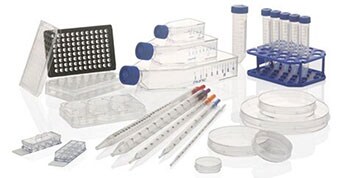
a variety of cell culture vessels, including tubes, dishes, flasks and chamber slides

Cell culture plastics are available in a wide range of formats, sizes, and surfaces to suit a variety of cell culture applications. Use the below cell culture vessel guide to help choose the right plastics for your cell culture application.

See all Thermo Scientific Nunc Cell Culture Plastics
View useful numbers for cell culture


Tissue culture treated plates

Many different plastic types have been used over the years for cell culture and cell-based assays. These are polyethylene terephthalate (PET), high- and low-density polyethylene (PE), polyvinyl chloride (PVC), and polypropylene (PP), but the most frequently used plastic in labs today is polystyrene (PS). The low cost of PS, coupled with its inert chemistry, makes it an optimal choice to use for a disposable culture surface.

In its pure form, PS is hydrophobic, which is excellent for suspension cell culture. However, the majority of the cells derived from vertebrates, with the exception of hematopoietic cell lines and a few others, are anchorage-dependent and must be cultured on a surface that is specifically treated to allow cell adhesion and spreading, known as a tissue culture- (TC) or cell culture-treated surface. This treatment process includes exposing a PS surface to a plasma gas, which partially modifies and cleaves the polymer chain, leaving behind oxygen-containing functional groups such as hydroxyl and carboxyl. The resulting negative charge on the PS surface makes it more hydrophilic and improves the attachment of anchorage-dependent cells.

The properties of PS surfaces can be further optimized by coating the surface, for example using peptides (e.g., poly-D-lysine or PDL), proteins (e.g., collagen), or polysaccharides. PDL is a chemically synthesized, polycationic, extracellular matrix (ECM) that can help mediate the negative charges of both the cell membrane and surface, thereby facilitating cell adhesion to TC-treated plastic.

ECM proteins such as collagen provide an attachment framework for the adhesion and growth of certain cell types that have difficulties growing on the regular TC-treated surface. Collagen I is suitable for endothelial and epithelial cells, muscle cells, and hepatocytes. Collagen type IV is the major constituent of basement membranes and offers conditions more physiologically relevant to cells.


Types of cell culture vessels

When it comes to cell culture, selecting the appropriate vessel affects successful cell growth and downstream experiments. Different types of cell culture vessels are designed to meet various research needs and applications, each offering exceptional features and benefits. From dishes and flasks to spinner flasks, roller bottles, plates, chamber slides, and tubes, these vessels facilitate the necessary environment for cell propagation, maintenance, and analysis. Understanding the characteristics and advantages of each vessel type can help researchers choose the right options for their specific cell culture requirements. Below, we explore the different types of cell culture vessels and their respective uses in more detail.

培养皿

Cell culture dishes are disposable shallow containers specifically designed to support the growth and propagation of cells in culture. They come in a variety of sizes—in single- or multi-well formats—and are usually made of PS or polycarbonate, which allows distortion-free microscopic observation. They are often supplied with lids that allow for consistent gas exchange while offering protection from the environment. With dishes, it is significantly easier to select individual colonies from a transfected cell population compared to a flask.

See cell culture dishes

培养瓶

Depending on the application, cell culture flasks are available untreated, TC-treated, or treated with other materials. The size can vary from 12.5 cm2 to 300 cm2 with either straight or angled necks. Angled necks offer several advantages—they allow easier access to the entire growth surface and help prevent media from reaching the cap and allow media to be poured from the flask with less dripping.

Explore cell culture flasks

Shake flasks

These single-use, crystal-clear PETG flasks are robust and break-resistant, excellent for mixing and storage. Standard non-vented closures prevent spilling and contamination, while optional vented closures (0.22 µm) enhance gas exchange, benefiting suspension cell culture.

View shake flasks

TripleFlask products

TripleFlask products feature three parallel growth surfaces, offering a total culture area of 500 cm² within the footprint of a traditional T175 flask. These flasks are designed for efficient gas exchange and ease of use, making them useful for high-density cell culture applications.

View TripleFlask products

滚瓶

Roller bottles are developed for applications such as the industrial scale production of vaccines, monoclonal antibodies, and biotherapeutics, and are made of PS or polyethylene terephthalate glycol (PETG). Compared to flasks, roller bottles have larger growth surfaces, enable slow and steady mixing of the medium over the cells, and help increase medium-to-surface contact.

Find roller bottles

Cell culture plates

Cell culture plates can range from 4 wells to 384 wells, which can be used for multiple cultures at once. Depending on the application, cell culture plates are available untreated, TC-treated, or treated with other materials. TC plates have uniform and compatible surfaces for cell attachment and growth.

See cell culture plates

Cell Factory Systems offer a high-yield, scalable solution for cell culture, featuring multiple layers to maximize surface area within a compact footprint. Designed for efficient gas exchange and ease of handling, these systems are exceptional for large-scale production of cells, viruses, and proteins.

腔室载玻片

腔室载玻片由一个可拆卸的培养基腔室与一个经贴壁细胞培养处理的载玻片连接而成。借此,您可在单个显微镜载玻片上进行细胞接种、孵育、固定和染色。部分腔室载玻片具有经化学修饰的生长表面,该表面具有类似于 PDL 涂层的特征。

探索腔室载玻片

有多种不同的管可用于细胞培养、离心或储存。经 TC 处理的管可用于培养,锥形管可协助多种应用—从样本储存到细胞分离。

查找细胞培养管


仅供科研使用,不可用于诊断目的。