Search
Invitrogen
ADORA1 Polyclonal Antibody
{{$productOrderCtrl.translations['antibody.pdp.commerceCard.promotion.promotions']}}
{{$productOrderCtrl.translations['antibody.pdp.commerceCard.promotion.promocode']}}: {{promo.promoCode}} {{promo.promoTitle}} {{promo.promoDescription}}. {{$productOrderCtrl.translations['antibody.pdp.commerceCard.promotion.learnmore']}}
{{$ctrl.translations['antibody.pdp.skuNotes.additionalInformation']}}:
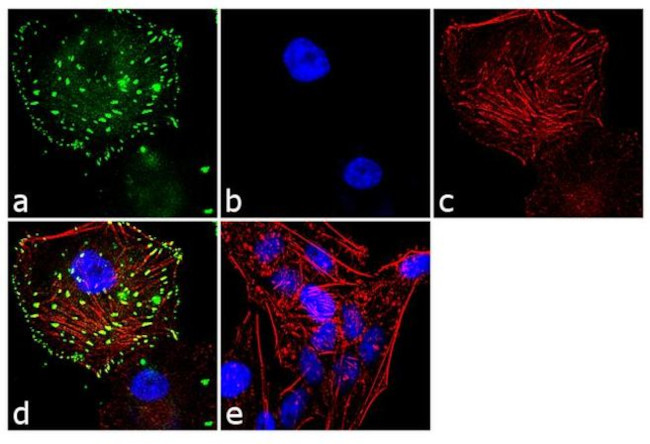
图: 1 / 3
ADORA1 Antibody (PA3-041) in ICC/IF
Immunofluorescence analysis of Adenosine Receptor A1 was performed using 90% confluent log phase HeLa cells. The cells were fixed with 4% paraformaldehyde for 10 minutes, permeabilized with 0.1% Triton™ X-100 for 10 minutes, and blocked with 1% BSA for 1 hour at room temperature. The cells were labeled with Adenosine Receptor A1 Rabbit Polyclonal Antibody (Product # PA3-041) at 1:250 dilution in 0.1% BSA and incubated for 3 hours at room temperature and then labeled with Goat anti-Rabbit IgG (Heavy Chain) Superclonal™ Secondary Antibody, A... View More
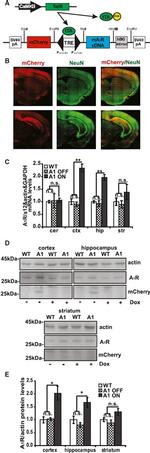
Please note: We are reviewing Western blot images included in the antibody testing data in our catalog, including those provided by third parties. Unless expressly labeled or annotated as “raw-unedited”, Western blot images included in the antibody testing data in our catalog may have been edited, optimized or otherwise adjusted for presentation.


产品信息
PA3-041
产品规格
种属反应
Human,
Mouse
已发表种属
Mouse
宿主/亚型
Rabbit
/ IgG
分类
Polyclonal
类型
Antibody
抗原
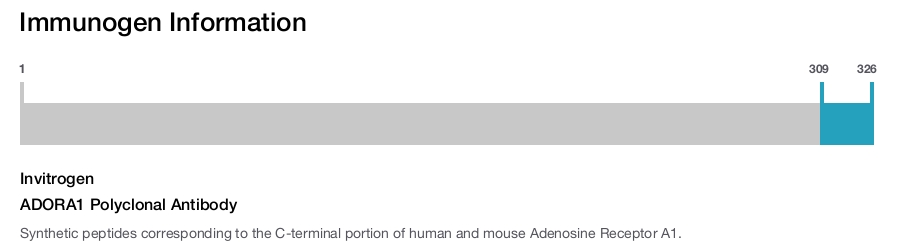
Synthetic peptides corresponding to the C-terminal portion of human and mouse Adenosine Receptor A1.
偶联物
Unconjugated
Unconjugated
Unconjugated
形式
Liquid
浓度
Conc. Not Determined
保存液
whole serum
内含物
0.05% sodium azide
保存条件
-20°C, Avoid Freeze/Thaw Cycles
运输条件
Ambient (domestic); Wet ice (international)
RRID
产品详细信息
PA3-041 detects Adenosine Receptor A1 from human and mouse samples. Reactivity is stronger in mouse, and is only recommended for use in overexpressed or recombinant human samples.
PA3-041 has been successfully used in Western blot applications. By Western blot PA3-041 detects a ~34-37 kDa band representing Adenosine Receptor A1 from mouse brain.
The PA3-041 immunogen is a mix of synthetic peptides corresponding to the C-terminal portion of human and mouse Adenosine Receptor A1 residues. The immunizing sequences are: C(309) Q P A P P I D E D L P E E R P D D(326) for human, and C(309) Q P K P P I E E D I P E E K A D D(326) for mouse.
靶标信息
Adenosine receptors (ARs) are members of the 7-transmembrane domain G-protein-coupled receptor superfamily. Structural, biochemical and pharmacological analyses of the AR genes and protein has led to the discovery of four distinct AR subtypes (A1, A2a, A2b, A3). Activation of ARs mediates several receptor subtype-specific physiological processes that include cardiac rate, smooth muscle tone, platelet aggregation, inflammation, cell growth and death, and neurotransmission. The A1AR is a glycoprotein that can activate Gi and Go proteins in vitro. In intact cells, agonist occupation of the A1AR has been shown to cause pertussis toxin-sensitive inhibition of adenylyl cyclase activity and, in some systems, a stimulation of phospholipase C resulting in mobilization of intracellular calcium stores. Activation of potassium channels by A1AR has been intensively studied in relation to its dramatic effects on the cardiovascular system. A1AR protein is highly expressed in brain (especially cerebellum, hippocampus, thalamus, and cortex) and spinal cord and in part, modulates neurotransmitter release. In white adipocytes A1AR inhibits lipolysis and stimulates glucose uptake. Other tissues also express A1AR including kidney and testis.
仅用于科研。不用于诊断过程。未经明确授权不得转售。
生物信息学
蛋白别名: adenylate cyclase inhibitor; ADO-A1 receptor; ADORA1; AR; lacks the first 3 and part of the fourth transmembrane domains; lacks the N-terminus and first three transmembrane domains; lacks the N-terminus and the first three transmembrane domains; unnamed protein product
基因别名: A1-AR; A1AR; A1R; AA1R; ARA1; RDC7; Ri
UniProt ID: (Human) P30542, (Mouse) Q60612
Entrez Gene ID: (Human) 134, (Mouse) 11539
G-protein coupled adenosine receptor activity
G-protein coupled receptor binding
purine nucleoside binding
G-protein coupled receptor activity
protein binding
heat shock protein binding
G-protein beta/gamma-subunit complex binding
heterotrimeric G-protein binding
macromolecular complex binding
protein heterodimerization activity
temperature homeostasis
response to hypoxia
adenosine receptor signaling pathway
regulation of respiratory gaseous exchange by neurological system process
negative regulation of acute inflammatory response
positive regulation of peptide secretion
positive regulation of systemic arterial blood pressure
negative regulation of systemic arterial blood pressure
protein targeting to membrane
phagocytosis
inflammatory response
signal transduction
epidermal growth factor receptor signaling pathway
G-protein coupled receptor signaling pathway
adenylate cyclase-inhibiting G-protein coupled receptor signaling pathway
cell-cell signaling
nervous system development
negative regulation of cell proliferation
negative regulation of glutamate secretion
response to purine-containing compound
lipid catabolic process
negative regulation of synaptic transmission, GABAergic
positive regulation of nucleoside transport
negative regulation of neurotrophin production
positive regulation of dephosphorylation
G-protein coupled purinergic nucleotide receptor signaling pathway
vasodilation
negative regulation of circadian sleep/wake cycle, sleep
negative regulation of circadian sleep/wake cycle, non-REM sleep
negative regulation of apoptotic process
positive regulation of potassium ion transport
positive regulation of MAPK cascade
positive regulation of G-protein coupled receptor protein signaling pathway
negative regulation of blood pressure
positive regulation of blood pressure
negative regulation of hormone secretion
cognition
detection of temperature stimulus involved in sensory perception of pain
negative regulation of lipid catabolic process
positive regulation of lipid catabolic process
positive regulation of protein kinase B signaling
regulation of sensory perception of pain
negative regulation of synaptic transmission, glutamatergic
fatty acid homeostasis
regulation of cardiac muscle contraction
excitatory postsynaptic potential
triglyceride homeostasis
regulation of cardiac muscle cell contraction
apoptotic signaling pathway
regulation of presynaptic cytosolic calcium ion concentration
negative regulation of long-term synaptic potentiation
negative regulation of leukocyte migration
regulation of glomerular filtration
regulation of cell communication
regulation of signaling
negative regulation of inflammatory response
negative regulation of mucus secretion
inhibition of non-skeletal tissue mineralization
negative regulation of long term synaptic depression
Disclaimer

Clicking the images or links will redirect you to a website hosted by BenchSci that provides third-party scientific content. Neither the content nor the BenchSci technology and processes for selection have been evaluated by us; we are providing them as-is and without warranty of any kind, including for use or application of the Thermo Fisher Scientific products presented.

