Search
Invitrogen
AKAP12 Polyclonal Antibody
{{$productOrderCtrl.translations['antibody.pdp.commerceCard.promotion.promotions']}}
{{$productOrderCtrl.translations['antibody.pdp.commerceCard.promotion.viewpromo']}}
{{$productOrderCtrl.translations['antibody.pdp.commerceCard.promotion.promocode']}}: {{promo.promoCode}} {{promo.promoTitle}} {{promo.promoDescription}}. {{$productOrderCtrl.translations['antibody.pdp.commerceCard.promotion.learnmore']}}
Additional Information:
{{banner.description}}
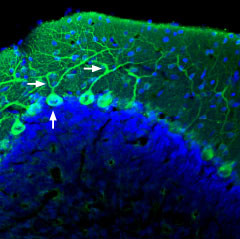
图: 1 / 2
AKAP12 Antibody (PA5-111897) in IHC (F)
Immunohistochemistry analysis of AKAP12 in perfusion-fixed, frozen rat cerebellum tissue sections using AKAP12 Antibody (Product # PA5-111897) at a dilution of 1:400, followed by goat anti-rabbit-AlexaFluor-488. AKAP12 immunoreactivity (green) is detected in Purkinje cells and their dendritic trees (arrows). Cell nuclei are stained with DAPI (blue).



产品信息
PA5-111897
产品规格
宿主/亚型
Rabbit
/ IgG
分类
Polyclonal
类型
Antibody
抗原
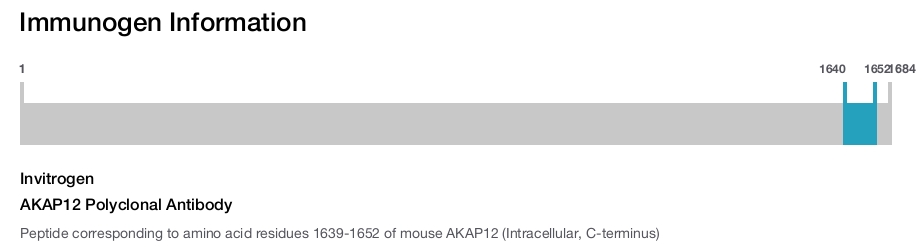
Peptide corresponding to amino acid residues 1639-1652 of mouse AKAP12 (Intracellular, C-terminus)
偶联物
Unconjugated
Unconjugated
Unconjugated
形式
Lyophilized
浓度
0.8 mg/mL
规格
40 µg
保存条件
-20°C
运输条件
Wet ice
RRID
产品详细信息
Reconstitute antibody with 50 µL of double distilled water (DDW). The reconstituted solution can be stored at 4 degrees C for up to 1 week. For longer periods, small aliquots should be stored at -20 degrees C. Avoid multiple freezing and thawing. Centrifuge all antibody preparations before use (10000 x g 5 min).
Peptide sequence is: (C)GNLTKES PDTNGPK
Homology: Rat amino acid residues identical; human - 13/14 amino acid residues identical.
靶标信息
The A-kinase anchor proteins (AKAPs) are a group of structurally diverse proteins, which have the common function of binding to the regulatory subunit of protein kinase A (PKA) and confining the holoenzyme to discrete locations within the cell. This gene encodes a member of the AKAP family. The encoded protein is expressed in endothelial cells, cultured fibroblasts, and osteosarcoma cells. It associates with protein kinases A and C and phosphatase, and serves as a scaffold protein in signal transduction. This protein and RII PKA colocalize at the cell periphery. This protein is a cell growth-related protein. Antibodies to this protein can be produced by patients with myasthenia gravis. Alternative splicing of this gene results in two transcript variants encoding different isoforms.
仅用于科研。不用于诊断过程。未经明确授权不得转售。
篇参考文献 (0)
您是否在文献中引用过该产品?请点击下方按钮邮件告知我们。
Disclaimer

Clicking the images or links will redirect you to a website hosted by BenchSci that provides third-party scientific content. Neither the content nor the BenchSci technology and processes for selection have been evaluated by us; we are providing them as-is and without warranty of any kind, including for use or application of the Thermo Fisher Scientific products presented.

