Search
Abnova
AKR1C4 Polyclonal Antibody, MaxPab™
{{$productOrderCtrl.translations['antibody.pdp.commerceCard.promotion.promotions']}}
{{$productOrderCtrl.translations['antibody.pdp.commerceCard.promotion.viewpromo']}}
{{$productOrderCtrl.translations['antibody.pdp.commerceCard.promotion.promocode']}}: {{promo.promoCode}} {{promo.promoTitle}} {{promo.promoDescription}}. {{$productOrderCtrl.translations['antibody.pdp.commerceCard.promotion.learnmore']}}
Additional Information:
{{banner.description}}
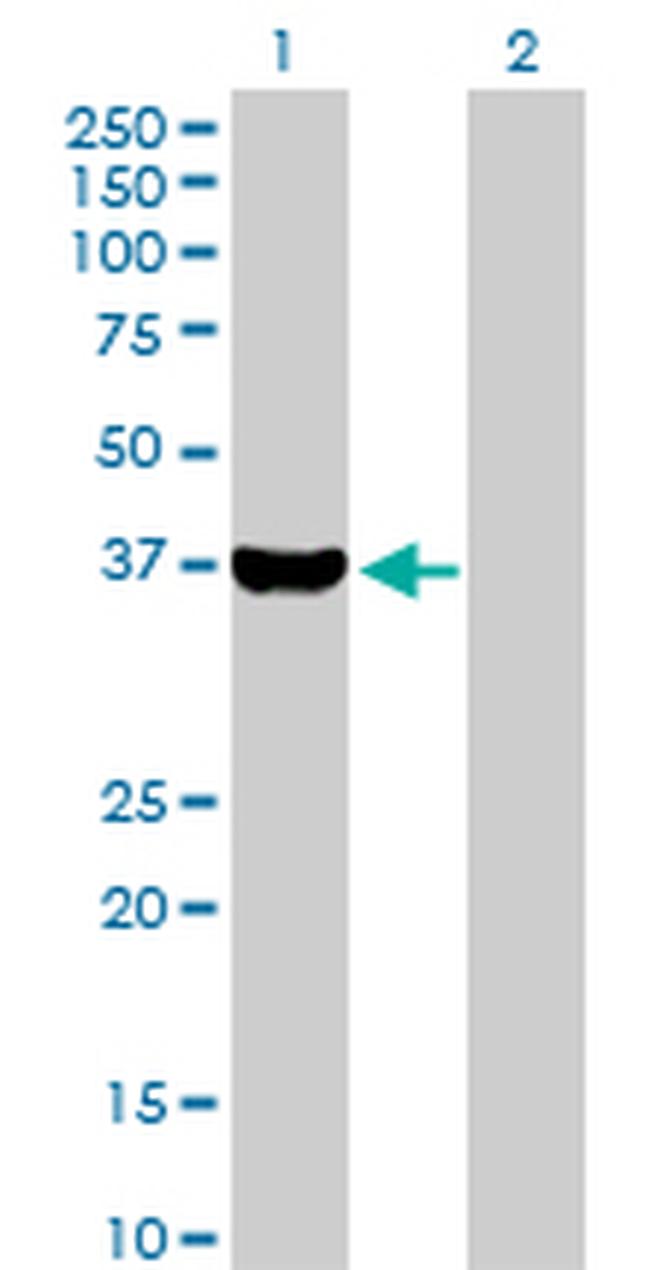
图: 1 / 2
AKR1C4 Antibody (H00001109-D01P) in WB
Western Blot analysis of AKR1C4 expression in transfected 293T cell line (H00001109-T01) by AKR1C4 MaxPab polyclonal antibody.
Lane 1: AKR1C4 transfected lysate(37.20 KDa).
Lane 2: Non-transfected lysate.
Lane 1: AKR1C4 transfected lysate(37.20 KDa).
Lane 2: Non-transfected lysate.


产品信息
H00001109-D01P
产品规格
宿主/亚型
Rabbit
/ IgG
分类
Polyclonal
类型
Antibody
抗原
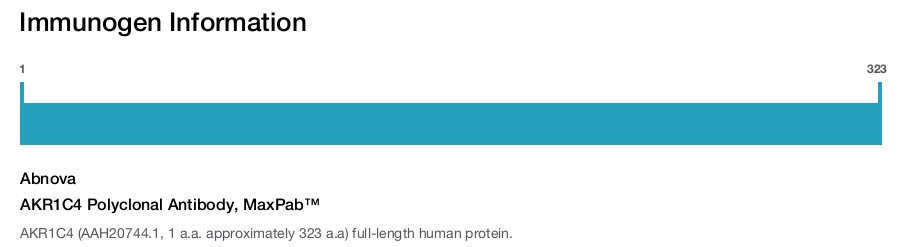
AKR1C4 (AAH20744.1, 1 a.a. approximately 323 a.a) full-length human protein.
偶联物
Unconjugated
Unconjugated
Unconjugated
形式
Liquid
浓度
See Label
规格
100 µg
保存条件
-20°C, Avoid Freeze/Thaw Cycles
运输条件
Ambient (domestic); Wet ice (international)
产品详细信息
Sequence of this protein is as follows: MDPKYQRVEL NDGHFMPVLG FGTYAPPEVP RNRAVEVTKL AIEAGFRHID SAYLYNNEEQ VGLAIRSKIA DGSVKREDIF YTSKLWCTFF QPQMVQPALE SSLKKLQLDY VDLYLLHFPM ALKPGETPLP KDENGKVIFD TVDLSATWEV MEKCKDAGLA KSIGVSNFNY RQLEMILNKP GLKYKPVCNQ VECHPYLNQS KLLDFCKSKD IVLVAHSALG TQRHKLWVDP NSPVLLEDPV LCALAKKHKR TPALIALRYQ LQRGVVVLAK SYNEQRIREN IQVFEFQLTS EDMKVLDGLN RNYRYVVMDF LMDHPDYPFS DEY
靶标信息
This gene encodes a member of the aldo/keto reductase superfamily, which consists of more than 40 known enzymes and proteins. These enzymes catalyze the conversion of aldehydes and ketones to their corresponding alcohols by utilizing NADH and/or NADPH as cofactors. The enzymes display overlapping but distinct substrate specificity. This enzyme catalyzes the bioreduction of chlordecone, a toxic organochlorine pesticide, to chlordecone alcohol in liver. This gene shares high sequence identity with three other gene members and is clustered with those three genes at chromosome 10p15-p14.
仅用于科研。不用于诊断过程。未经明确授权不得转售。
篇参考文献 (0)
您是否在文献中引用过该产品?请点击下方按钮邮件告知我们。
Disclaimer

Clicking the images or links will redirect you to a website hosted by BenchSci that provides third-party scientific content. Neither the content nor the BenchSci technology and processes for selection have been evaluated by us; we are providing them as-is and without warranty of any kind, including for use or application of the Thermo Fisher Scientific products presented.

