Search
Invitrogen
ARTS1 Polyclonal Antibody
{{$productOrderCtrl.translations['antibody.pdp.commerceCard.promotion.promotions']}}
{{$productOrderCtrl.translations['antibody.pdp.commerceCard.promotion.promocode']}}: {{promo.promoCode}} {{promo.promoTitle}} {{promo.promoDescription}}. {{$productOrderCtrl.translations['antibody.pdp.commerceCard.promotion.learnmore']}}
产品信息
PA5-148599
产品规格
种属反应
Mouse
宿主/亚型
Goat
/ IgG
分类
Polyclonal
类型
Antibody
抗原
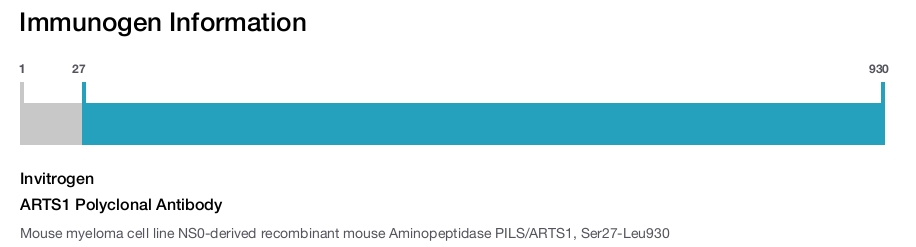
Mouse myeloma cell line NS0-derived recombinant mouse Aminopeptidase PILS/ARTS1, Ser27-Leu930
偶联物
Unconjugated
Unconjugated
Unconjugated
形式
Lyophilized
浓度
0.2 mg/mL
规格
100 µg
纯化类型
Antigen affinity chromatography
保存液
PBS with trehalose
内含物
no preservative
保存条件
Store at 4°C short term. For long term storage, store at -20°C, avoiding freeze/thaw cycles.
运输条件
Ambient (domestic); Wet ice (international)
RRID
产品详细信息
Reconstitute at 0.2 mg/mL in sterile PBS.
靶标信息
The endoplasmic reticulum (ER) aminopeptidase 1 (ERAP1) is a 120 kDa protein localized to the lumen of the ER, which removes NH2-terminal residues from many antigenic precursors for MHC class I peptide presentation. Peptides that are presented by MHC class I on the surface of a cell must be 8-11 residues long, and ERAP1 specifically trims peptides of 9 amino acids or more. ERAP1 is also induced by interferon- gamma. The gene encoding human ERAP1 maps to chromosome 5q15. ERAP1 has previously been characterized as adipocyte-derived leucine aminopeptidase (A-LAP), puromycin-insensitive leucine-specific aminopeptidase (PILS-AP) and aminopeptidase regulator of TNFR1 shedding (ARTS-1). A-LAP is thought to inactivate several bioactive peptides, including angiotensin II and, subsequently, may be involved in the regulation of blood pressure. PILS-AP is described as playing a role in angiogenesis by regulating the proliferation and migration of endothelial cells, and ARTS-1 is characterized as a TNFR1 binding protein that promotes TNFR1 shedding. Further research will be necessary to fully elucidate the functions of this protein.
仅用于科研。不用于诊断过程。未经明确授权不得转售。
篇参考文献 (0)
您是否在文献中引用过该产品?请点击下方按钮邮件告知我们。
生物信息学
蛋白别名: adipocyte-derived leucine aminopeptidase; aminopeptidase PILS; puromycin-insensitive leucyl-specific aminopeptidase; type 1 tumor necrosis factor receptor shedding aminopeptidase regulator; unnamed protein product; VEGF-induced aminopeptidase
基因别名: A-LAP; ARTS-1; Arts1; ERAAP; PILSA; PILSAP
UniProt ID: (Mouse) Q9EQH2
Entrez Gene ID: (Mouse) 80898
Disclaimer

Clicking the images or links will redirect you to a website hosted by BenchSci that provides third-party scientific content. Neither the content nor the BenchSci technology and processes for selection have been evaluated by us; we are providing them as-is and without warranty of any kind, including for use or application of the Thermo Fisher Scientific products presented.

