Search
Proteintech
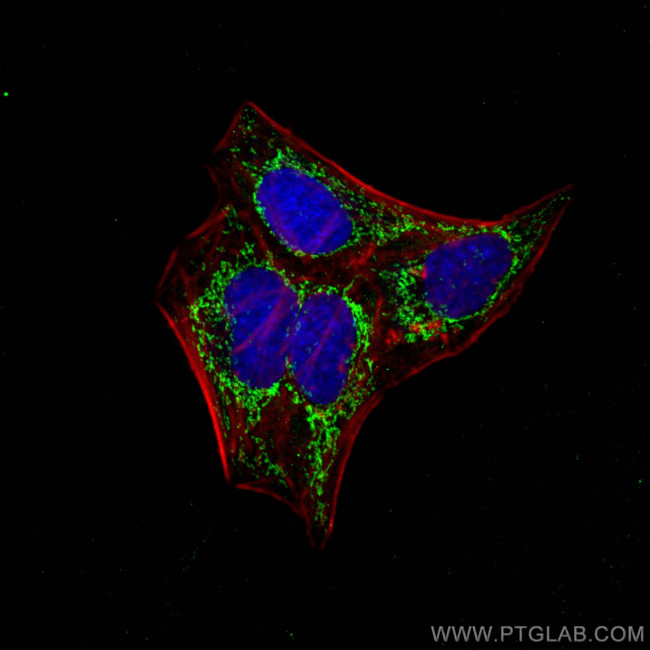
ATPB Monoclonal Antibody (1A11B9), CoraLite® Plus 488
{{$productOrderCtrl.translations['antibody.pdp.commerceCard.promotion.promotions']}}
{{$productOrderCtrl.translations['antibody.pdp.commerceCard.promotion.viewpromo']}}
{{$productOrderCtrl.translations['antibody.pdp.commerceCard.promotion.promocode']}}: {{promo.promoCode}} {{promo.promoTitle}} {{promo.promoDescription}}. {{$productOrderCtrl.translations['antibody.pdp.commerceCard.promotion.learnmore']}}
Additional Information:
{{banner.description}}

产品信息
CL488-66600
产品规格
种属反应
Human,
Mouse,
Rat
宿主/亚型
Mouse
/ IgG2b
分类
Monoclonal
类型
Antibody
克隆号
1A11B9
抗原
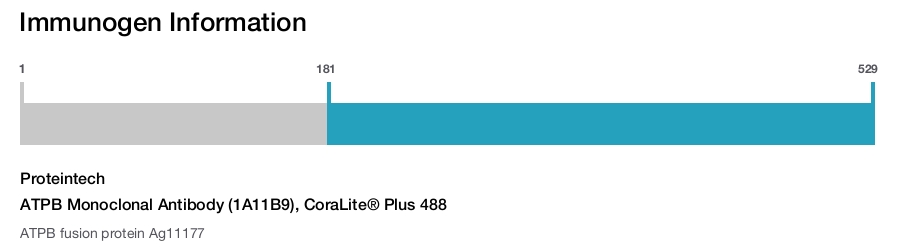
ATPB fusion protein Ag11177
偶联物
CoraLite® Plus 488
CoraLite® Plus 488
CoraLite® Plus 488
激发/发射光谱
493/522 nm
形式
Liquid
浓度
1 mg/mL
规格
100 µg
纯化类型
Protein A
保存液
PBS, pH 7.3, with 50% glycerol, 0.5% BSA
内含物
0.05% ProClin 300
保存条件
-20°C, store in dark
运输条件
Wet ice
产品详细信息
Immunogen sequence: EILVTGIKVV DLLAPYAKGG KIGLFGGAGV GKTVLIMELI NNVAKAHGGY SVFAGVGERT REGNDLYHEM IESGVINLKD ATSKVALVYG QMNEPPGARA RVALTGLTVA EYFRDQEGQD VLLFIDNIFR FTQAGSEVSA LLGRIPSAVG YQPTLATDMG TMQERITTTK KGSITSVQAI YVPADDLTDP APATTFAHLD ATTVLSRAIA ELGIYPAVDP LDSTSRIMDP NIVGSEHYDV ARGVQKILQD YKSLQDIIAI LGMDELSEED KLTVSRARKI QRFLSQPFQV AEVFTGHMGK LVPLKETIKG FQQILAGEYD HLPEQAFYMV GPIEEAVAKA DKLAEEHSS
靶标信息
ATP synthase is extremely conserved through evolution and can be found in plants, fungi, bacteria, and animals. The ATP synthase enzyme is a transmembrane protein responsible for driving the reversible reaction from ADP+ phosphate to ATP. This reaction is accomplished by a flux of protons across the membrane as a result of electron transfer. The ATP synthase protein has two main sections; the F1 ATP-ase (soluble) and the F0 ATP-ase (membrane embedded). The F1 section consists of the alpha, beta, gamma, delta, and epsilon subunits. While the F0 consists of a, b, and c subunits.
仅用于科研。不用于诊断过程。未经明确授权不得转售。
篇参考文献 (0)
您是否在文献中引用过该产品?请点击下方按钮邮件告知我们。
生物信息学
蛋白别名: ATP synthase F(1) complex catalytic subunit beta, mitochondrial; ATP synthase F(1) complex subunit beta, mitochondrial; ATP synthase F1 subunit beta; ATP synthase subunit beta, mitochondrial; ATP synthase, H+ transporting mitochondrial F1 complex, alpha subunit; ATP synthase, H+ transporting mitochondrial F1 complex, beta subunit; ATP synthase, H+ transporting, mitochondrial F1 complex, beta polypeptide; Atp5b; epididymis secretory protein Li 271; MGC5231; mitochondrial ATP synthase beta subunit; mitochondrial ATP synthase, H+ transporting F1 complex beta subunit; mitochondrial ATP synthetase, beta subunit; unnamed protein product
基因别名: ATP5B; ATP5F1B; ATPMB; ATPSB; HEL-S-271; HUMOP2
UniProt ID: (Human) P06576, (Rat) P10719, (Mouse) P56480
Entrez Gene ID: (Human) 506, (Rat) 171374, (Mouse) 11947
nucleotide binding
protein binding
ATP binding
MHC class I protein binding
angiostatin binding
metal ion binding
proton-transporting ATP synthase activity, rotational mechanism
proton-transporting ATPase activity, rotational mechanism
calcium ion binding
ATPase activity
lipoprotein particle receptor activity
hydrolase activity
hydrolase activity, acting on acid anhydrides, catalyzing transmembrane movement of substances
ATP synthase
angiogenesis
osteoblast differentiation
generation of precursor metabolites and energy
lipid metabolic process
ATP biosynthetic process
ion transport
negative regulation of cell adhesion involved in substrate-bound cell migration
ATP synthesis coupled proton transport
mitochondrial ATP synthesis coupled proton transport
positive regulation of blood vessel endothelial cell migration
ATP metabolic process
regulation of intracellular pH
cellular response to interleukin-7
hydrogen ion transmembrane transport
receptor-mediated endocytosis
ATP hydrolysis coupled proton transport
proton transport
transport
Disclaimer

Clicking the images or links will redirect you to a website hosted by BenchSci that provides third-party scientific content. Neither the content nor the BenchSci technology and processes for selection have been evaluated by us; we are providing them as-is and without warranty of any kind, including for use or application of the Thermo Fisher Scientific products presented.

